Underground Survival: How Aquatic Weeds Persist Through Adverse Conditions
Turions and tubers represent the most biologically sophisticated reproductive adaptations of invasive aquatic plants — specialized dormancy structures that allow populations to persist through conditions that would eliminate adult plants, accumulate in the sediment as a long-term propagule bank, and regenerate infestations for years or decades after management. Understanding the biology, formation, survival characteristics, and management implications of these structures is essential for designing programs with any realistic chance of long-term population reduction.
What Are Turions?
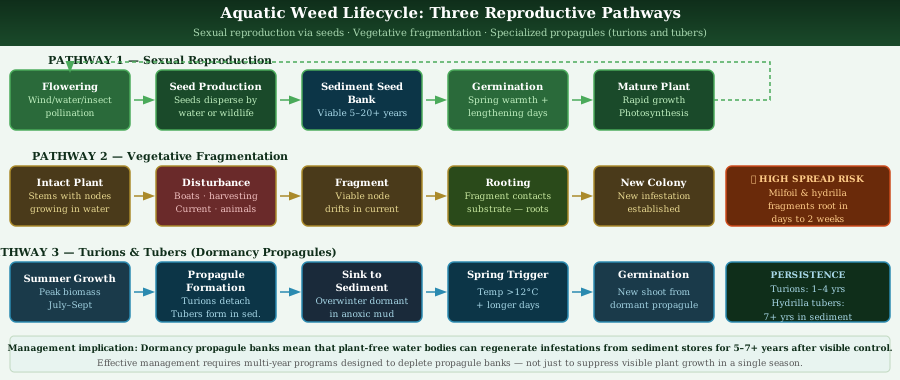
Turions are compact, specialized dormancy buds produced by aquatic plants in response to decreasing daylength and cooling temperatures in late summer and fall. Unlike seeds (which are products of sexual reproduction and contain embryonic tissue), turions are vegetative structures — genetically identical clones of the parent plant, composed of tightly packed leaf buds and dense carbohydrate reserves. Key turion characteristics:
- Formation: Produced in leaf axils (the angle between leaf and stem) in response to photoperiod cues, typically beginning in August–September in temperate climates. Hydrilla produces 2–6 turions per node at peak production; a single hydrilla plant can produce thousands of turions per season. Hydrilla biology →
- Detachment and dispersal: Turions detach from the parent plant as it dies back in autumn and sink to the sediment due to their higher density relative to water. The sinking behavior is adaptive — it deposits turions in the sediment where temperatures are more stable and where they are protected from ice disturbance and desiccation.
- Dormancy maintenance: Turions overwinter in the sediment in a state of reduced metabolic activity. The dense carbohydrate reserves (primarily starch) provide the energy for survival through winter and for initial growth the following spring. Dormancy is broken by a combination of warming temperatures (typically above 12°C for hydrilla), increasing daylength, and changes in dissolved oxygen and CO₂ concentration.
- Viability and persistence: Turion viability in sediment varies by species and conditions but typically ranges from 1–4 years. Hydrilla turions remain viable for up to 3 years; coontail turions for 1–2 years. This multi-year viability means that even after successful adult plant elimination, turion regeneration continues for 2–4 growing seasons — requiring multi-year management programs to deplete the turion bank.
What Are Tubers?
Tubers are a separate and distinct structure from turions, produced exclusively by hydrilla in U.S. waters (both biotypes, but more prominently by the dioecious biotype in the Southeast). Tubers are starchy underground storage organs produced on stolons (horizontal underground stems) in the top 5–20 cm of lake sediment. They are the biological equivalent of potato tubers in function, though far more resilient in aquatic sediment environments.
Key hydrilla tuber characteristics that make them the most significant long-term management challenge in U.S. aquatic weed management:
- Production volume: Dense hydrilla infestations can produce 100–1,000 tubers per square meter of lake bottom in sediment depths accessible to stolons. A heavily infested lake can accumulate hundreds of millions of viable tubers per hectare. This extraordinary tuber density creates a practically inexhaustible regeneration reserve.
- Sediment depth: Tubers are produced at depths of 2–20 cm in the sediment, placing them well below the depth reached by most herbicide penetration and below any mechanical disruption that does not involve sediment excavation.
- Survival in anoxia: Hydrilla tubers are adapted to survive in the anoxic (oxygen-free) conditions that typically prevail in deeper sediment layers. This anaerobic tolerance, combined with their starch reserves, allows survival for documented periods of 7 years or more in anoxic sediment.
- Germination triggers: Tubers germinate when temperature and light conditions at the sediment surface are appropriate — typically in spring, when temperatures at the sediment surface exceed about 15°C. A single tuber produces one shoot, which rapidly grows toward the surface and begins photosynthesizing, then produces new turions and tubers in the same growing season, replenishing the propagule bank. Systemic herbicide programs for tuber depletion →
Turions in Other Aquatic Weed Species
Beyond hydrilla, turion production is a significant management consideration in several other species:
- Coontail (Ceratophyllum demersum): Produces dense winter buds (a form of turion) that detach and overwinter in sediment. Coontail lacks roots and relies entirely on vegetative reproduction — turions are the primary mechanism for winter survival and spring regeneration. Coontail biology →
- Curly-leaf pondweed (Potamogeton crispus): Produces specialized overwintering structures called burr-like propagules or bulbils that function similarly to turions. Crucially, these structures allow curly-leaf pondweed to persist through its unusual summer die-back and regenerate populations the following fall — making it the premier cool-season invasive aquatic weed in northern states. Curly-leaf pondweed biology →
- Various Potamogeton species: Many pondweed species produce turion-like propagules that provide both dormancy through adverse conditions and a mechanism for vegetative spread distinct from stem fragmentation.
Management Implications: Why Tubers and Turions Define Treatment Timelines
The propagule bank dynamics of turions and tubers are the primary reason why aquatic weed management programs require multi-year commitments to achieve lasting results:
- Year 1–2 of herbicide programs: Treatment suppresses adult plant growth and reduces new propagule production. However, the large existing bank of viable propagules continues germinating, providing most of the plants that require retreatment in subsequent seasons.
- Years 3–5: Continued treatment maintains suppression while the propagule bank is gradually depleted through germination (followed by control), natural mortality, and reduced new production. Population density trends downward.
- Years 5–7+ (for severe hydrilla infestations): Propagule bank is substantially depleted; required treatment intensity decreases; native plant recolonization may begin. Full sustainable suppression achieved.
Treatments targeting the propagule bank directly — systemic herbicides applied at doses that penetrate into the water column in contact with sediment, and at timings that maximize uptake by newly germinating propagules — are the most efficient approach to accelerating this depletion timeline. Herbicide strategies for propagule bank depletion →
Frequently Asked Questions
How do turions differ from seeds?
Turions are vegetative dormancy structures — genetically identical clones of the parent plant, produced without sexual reproduction. Seeds are products of sexual reproduction, containing embryonic tissue combining genetic material from two parents. Turions are typically shorter-lived than seeds (1–4 years vs. potentially 20+ years for some aquatic seeds), but they are produced in much larger quantities (thousands per plant vs. hundreds for most aquatic species) and are more reliably viable than seeds, which have variable germination rates depending on dormancy requirements. From a management perspective, turions respond to the same systemic herbicide treatments as adult plants — unlike seeds, which may require different management approaches.
Why can't mechanical harvesting remove tubers?
Hydrilla tubers are produced at depths of 2–20 cm in the sediment, well below the cutting depth of standard mechanical harvesting equipment. Harvesting equipment cuts plants at or just above the sediment surface — it does not excavate sediment. The only mechanical approaches that could physically remove tubers are sediment dredging (removal of the entire tuber-containing sediment layer) or water drawdown combined with freezing conditions (winter drawdown), which can kill tubers in the top few centimeters. Dredging is extremely expensive and ecologically disruptive; drawdown requires water level infrastructure and planning. For most lakes, systemic herbicide programs designed to deplete the tuber bank over multiple seasons are the only practical long-term management approach.
Does removing all plants in a single season eliminate turion and tuber banks?
No — and this is one of the most important management misconceptions to correct. A single season of apparent complete plant control does not eliminate the propagule bank. Viable turions and tubers from previous seasons remain in the sediment and continue germinating in subsequent years. Reducing the propagule bank requires either (a) preventing new propagule production while allowing existing propagules to germinate and be controlled — repeated over multiple seasons — or (b) directly depleting propagules through winter drawdown, sustained systemic herbicide concentrations, or sediment treatment. Programs that achieve apparent complete control in year one but don't plan for years 2–5 of retreatment invariably see full population recovery.
References
- Langeland, K.A. (1996). Hydrilla verticillata: the perfect aquatic weed. Castanea, 61, 293–304.
- Haramoto, T., and Ikusima, I. (1988). Life cycle of Egeria densa Planch., an aquatic plant naturalized in Japan. Aquatic Botany, 30(4), 389–403.
- Van, T.K., et al. (1978). Effect of daylength on turion formation and growth of hydrilla. Weed Science, 26(1), 2–4.
- Gettys, L.A., et al. (2014). Biology and Control of Aquatic Plants: A Best Management Practices Handbook, 3rd ed. Aquatic Ecosystem Restoration Foundation.