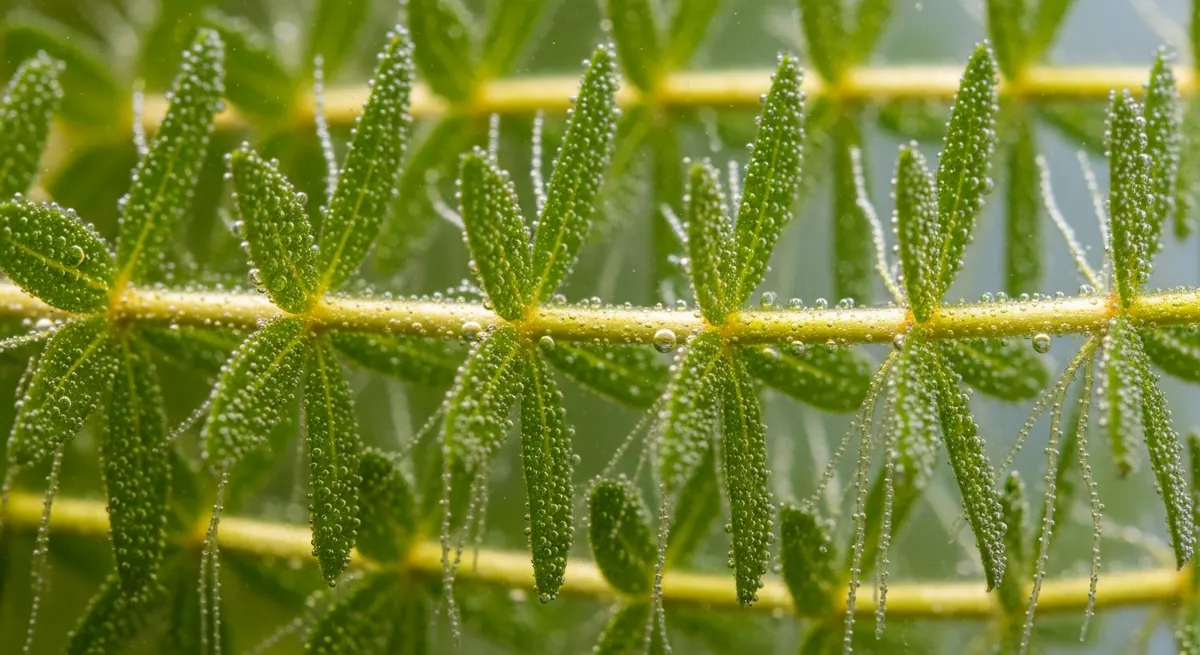
Two Growth Strategies, Two Management Challenges
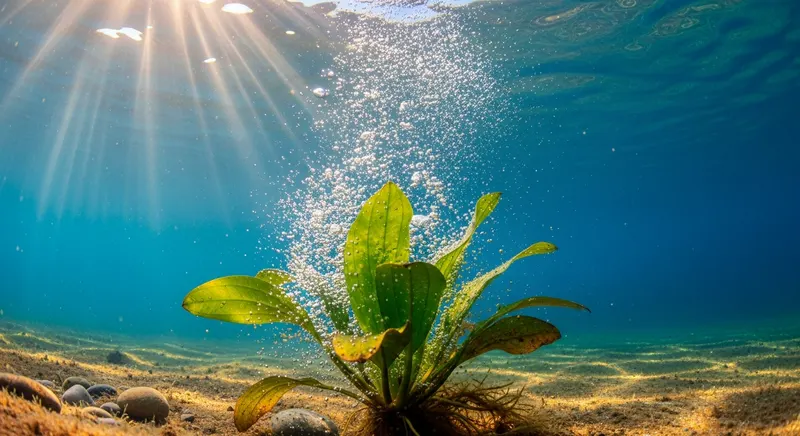
Aquatic weeds grow by two fundamentally different strategies: rooted growth (plants anchored to the sediment via root and rhizome systems, whether they grow as submerged, emergent, or floating-leaved species) versus free-floating growth (plants entirely unattached to the substrate, drifting with wind and water currents while drawing nutrients directly from the water column). These two growth strategies create entirely different ecological impacts, competitive dynamics, and management requirements.
Rooted Aquatic Plants: Biology and Competitive Advantage
Rooted aquatic plants — including all submerged species (hydrilla, milfoil, pondweeds, coontail) and emergent species (cattails, Phragmites, alligator weed) — anchor to the lake bottom via roots, stolons, or rhizomes. This anchoring provides several competitive advantages:
- Sediment nutrient access: Rooted plants can draw phosphorus, nitrogen, and other nutrients directly from the sediment, where concentrations are typically 10–100 times higher than in the overlying water column. This gives rooted species a significant growth advantage over floating plants in systems where water column nutrients are depleted but sediment nutrients are high — which describes most productive temperate lakes. Nutrient loading guide →
- Structural stability: Root and rhizome systems anchor plants against water flow and wave action, allowing them to persist in conditions that would disperse free-floating species.
- Underground propagule storage: The root and rhizome systems serve as overwintering storage for tubers, turions, and root crown reserves — the primary mechanism for perennial persistence and post-management regrowth. Turion and tuber biology →
The management implication of rooted growth is critical: because root systems survive below the sediment surface, mechanical cutting of above-ground biomass does not kill the plant. Rooted perennial species regrow vigorously from root crowns and rhizomes following cutting or harvesting. Chemical control with systemic herbicides — which are translocated from leaves to roots — is the only non-physical approach that can reach and kill underground root systems. Systemic herbicide strategies →
Submerged Rooted Plants: The Dominant Management Problem
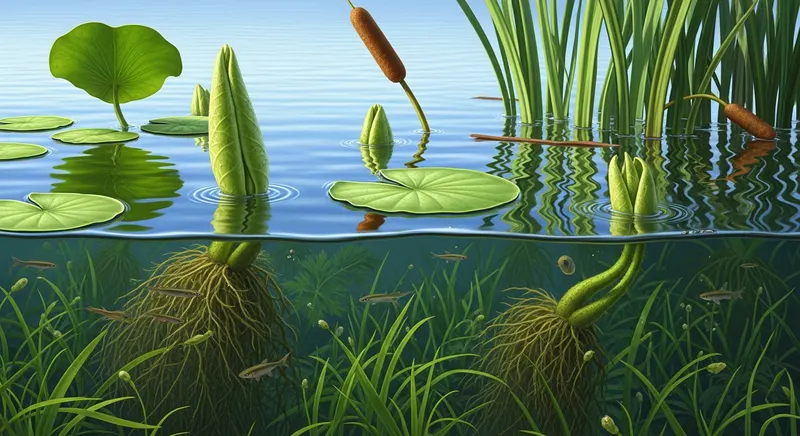
Submerged rooted plants (hydrilla, Eurasian milfoil, coontail, pondweeds, elodea) grow entirely below the water surface, with roots or rhizomes in the sediment and vegetative tissue throughout the water column. Their key biological characteristics:
- Rapid vertical growth toward the surface (hydrilla: 2–3 cm per day under optimal conditions) creates dense canopy layers that exclude light from native plants below.
- Dense beds occupy the entire water column from sediment to surface in shallow areas, eliminating open-water zones fish and wildlife depend on for navigation and feeding.
- Photosynthesis occurs throughout the water column, leading to extreme diurnal oxygen swings — supersaturation during peak afternoon photosynthesis, potential hypoxia in pre-dawn hours. Oxygen depletion mechanisms →
- Rooted submerged plants are primary targets for systemic herbicide treatments and the species most amenable to grass carp biocontrol. Biocontrol for submerged weeds →
Free-Floating Plants: Different Biology, Different Management
Free-floating plants — water hyacinth, water lettuce, giant salvinia, duckweed, Azolla — are unattached to the substrate and float on the water surface, absorbing all their nutrients directly from the water column through specialized root structures dangling below the plant surface. Their distinct characteristics:
- Rapid surface colonization: Free-floating plants grow and spread on the water surface, driven by wind and current. Surface coverage expansion can be extreme — water hyacinth mats have grown from a few plants to full lake coverage in a single growing season in warm climates. Water hyacinth growth rates →
- Complete light exclusion: Dense floating mats prevent light from penetrating to submerged species below, simultaneously eliminating all submerged plant photosynthesis and blocking atmospheric oxygen exchange at the surface. The water below a thick floating mat can approach complete anoxia even in full sunlight.
- Water column nutrient removal: Because floating plants absorb nutrients from the water column rather than the sediment, they effectively remove water column nutrients from circulation when plants are harvested and removed. This is one of the few situations where mechanical removal contributes directly to nutrient management. Water quality impacts →
- No root kill challenge: Because floating plants have no underground root systems, they do not leave a propagule bank in the sediment. Removing or killing floating plants does not leave behind a hidden reserve of tubers or root crowns that regenerate — a significant management advantage. However, seed banks may persist for many years for species like water hyacinth.
Emergent Rooted Plants: The Perennial Rhizome Problem
Emergent aquatic plants (cattails, Phragmites australis, alligator weed in warm regions) grow from rooted systems in shallow water or saturated soil, with stems emerging above the water surface. Their underground rhizome systems are massive — Phragmites rhizomes can penetrate to depths of 2 meters and extend horizontally for tens of meters — and are the primary mechanism for both persistence and lateral spread. Cutting or burning above-ground stems without killing the rhizome produces vigorous regrowth; effective emergent weed management requires herbicide treatment targeting the rhizome system. Phragmites management →
Management Summary by Growth Form
| Growth Form | Primary Species | Root Kill Needed | Best Control Methods |
|---|---|---|---|
| Submerged rooted | Hydrilla, milfoil, pondweeds, elodea | Yes — essential for lasting control | Systemic herbicides; grass carp; integrated programs |
| Free-floating | Water hyacinth, salvinia, duckweed | No — no root system in sediment | Mechanical removal; contact herbicides; biocontrol insects |
| Emergent | Cattails, Phragmites, alligator weed | Yes — rhizome kill essential | Systemic herbicides applied to foliage; cutting + herbicide combination |
| Floating-leaved rooted | Lotus, native water lilies, pondweeds | Yes for invasive species | Selective herbicides; careful mechanical removal to preserve native species |
Frequently Asked Questions
Why do rooted aquatic weeds grow back so fast after cutting?
Rooted perennial aquatic weeds survive cutting because the carbohydrate reserves stored in their underground root and rhizome systems are not affected by above-ground cutting. After cutting, the plant responds exactly as a lawn grass does to mowing — it uses stored root reserves to produce new above-ground growth rapidly. In warm summer conditions, hydrilla and milfoil can regrow from cut root systems to full canopy height in 30–60 days. This is why mechanical cutting alone cannot achieve long-term control of established rooted perennials — only approaches that reach the root system (systemic herbicides, winter freezing drawdown) can interrupt the regrowth cycle.
Are free-floating plants easier to control than rooted species?
In some respects, yes. Free-floating plants do not leave propagule banks in the sediment, so killing the above-water plant does not leave a hidden underground reserve ready to regenerate. Mechanical removal of floating mats (harvesting, boom containment and removal) can physically remove the infestation if all plant material is collected. However, floating plants often regenerate rapidly from fragments, seeds, or re-introduction from connected waters, and their rapid growth rates mean that incomplete removal results in full mat re-coverage in weeks. Water hyacinth, in particular, can re-establish from a handful of missed plants to full mat coverage within one growing season.
References
- Cronk, J.K., and Fennessy, M.S. (2001). Wetland Plants: Biology and Ecology. CRC Press, Boca Raton, FL.
- Sculthorpe, C.D. (1967). The Biology of Aquatic Vascular Plants. Edward Arnold, London.
- Gettys, L.A., et al. (2014). Biology and Control of Aquatic Plants: A Best Management Practices Handbook, 3rd ed. Aquatic Ecosystem Restoration Foundation.
- Barko, J.W., et al. (1986). Sediment interactions with submerged macrophyte growth and community dynamics. Aquatic Botany, 26, 59–64.
Ten-Year Lake Management Plan: Lake Wingra, WI
Lake Wingra, a 342-acre urban lake in Madison, WI, developed a comprehensive 10-year management plan coordinating the City of Madison, University of Wisconsin, and adjacent neighborhood associations. The plan addressed Eurasian watermilfoil, curly-leaf pondweed, and purple loosestrife through an integrated approach including targeted herbicide treatment, mechanical harvesting, native plant restoration, and public education.
Key outcome: The structured multi-agency planning process secured consistent funding across multiple budget cycles, a key advantage over ad hoc management. Native plant restoration efforts showed measurable progress in designated restoration zones within three years of initiation.
As a lakefront property owner I was completely lost until I found AquaticWeed.org. The permit guidance alone saved me from making costly, potentially illegal treatment mistakes.
Gerald Renfrew Lakefront Landowner, WI · Vilas CountyI've managed aquatic vegetation on Texas reservoirs for 15 years. The water hyacinth control content here is the most up-to-date, practical guidance I've found anywhere online.
Travis McKinley Commercial Fishing Guide, TX · Lake Travis / Lake Austin