Last updated: May 27, 2026 · Reviewed by the AquaticWeed.org Editorial Team
Overview
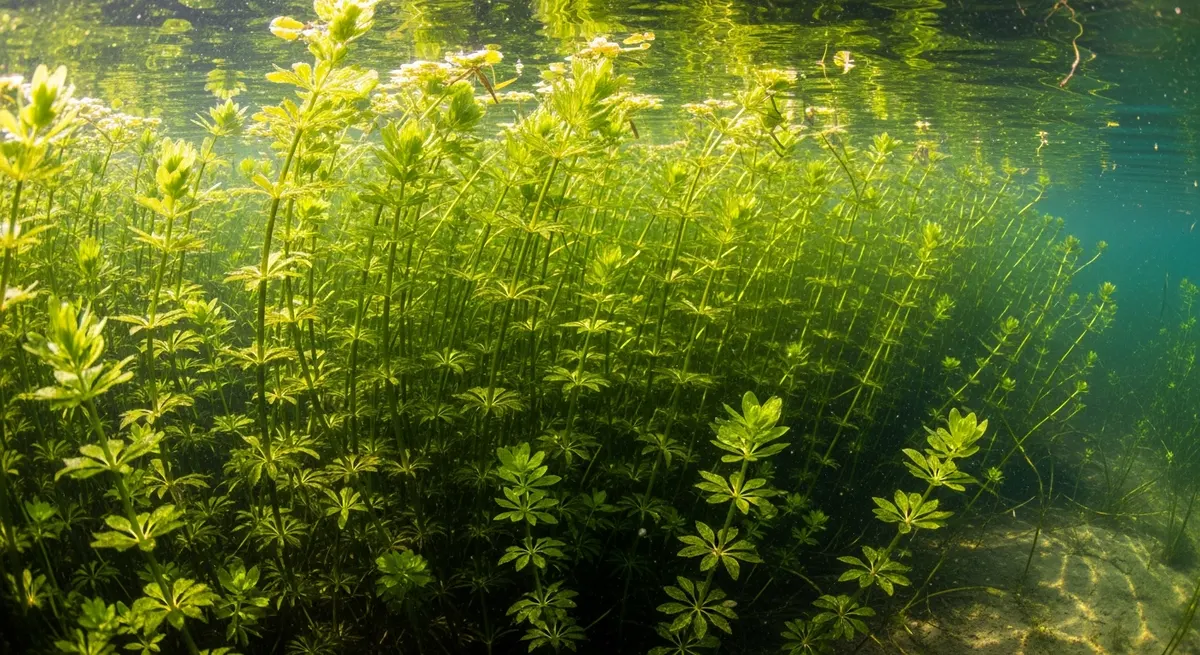
Hydrilla is one of the most problematic submerged aquatic weeds in the United States. Native to Asia, it was introduced through the aquarium trade and has since spread throughout the Southeast, Mid-Atlantic, and other regions. It can grow in extremely low light and a wide range of nutrient conditions, giving it a competitive advantage over native aquatic plants. Hydrilla is listed as a Federal Noxious Weed, meaning interstate transport and sale is prohibited. Its combination of explosive growth, multiple reproductive strategies, and environmental tolerance make it one of the most costly aquatic invasives to manage.
Identification Characteristics
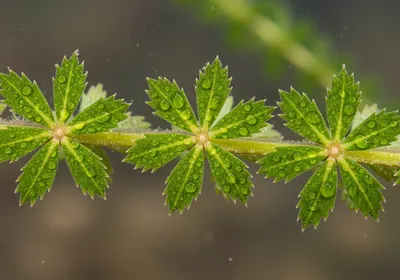
Hydrilla is identified by its small, pointed leaves arranged in whorls of 4–8 around the stem — a key feature that distinguishes it from native elodea, which has exactly three leaves per whorl. Each leaf has serrated edges visible to the naked eye, and a single diagnostic tooth on the midrib on the underside of each leaf. This midrib tooth is the most reliable single identification character. Stems are slender and can grow very long, branching frequently near the surface.
Two biotypes exist in North America: a dioecious (separate male and female plants) biotype common in the Southeast, and a monoecious biotype that has spread into the Mid-Atlantic and Northeast. Both biotypes produce turions — small, dark axillary buds that detach and overwinter in sediment — and underground tubers that can persist in sediment for over 10 years, making eradication effectively impossible once established.
When removed from water, hydrilla leaves collapse limply against the stem, unlike coontail whose stiff leaves hold their shape. The plant is dark green to olive green, though it can appear brownish-red under high light conditions.
| Feature | Hydrilla (invasive) | Native Elodea |
|---|---|---|
| Leaves per whorl | 4–8 (usually 5) | Always 3 |
| Leaf margin | Visibly serrated to the naked eye | Smooth or very fine teeth |
| Tooth on underside of midrib | Yes — diagnostic | Absent |
| Tubers in sediment | Yes (long-lived) | No |
| Axillary turions on stem | Yes | No |
| Regulatory status | Federally listed invasive | Native, ecologically beneficial |
Growth Habit & Ecology
Hydrilla is an extraordinarily fast-growing plant that can grow up to one inch per day under optimal conditions, forming dense monospecific mats at the water surface that can extend across entire water bodies. It thrives across an exceptional range of environmental conditions — from near-anoxic, turbid water to clear oligotrophic systems, from fresh water to brackish conditions up to 7 ppt salinity, and in temperatures from 50°F to 85°F.
The plant reproduces through four distinct mechanisms: (1) Vegetative fragmentation — even tiny stem fragments with a single node can root and establish new plants, making mechanical control potentially counterproductive; (2) Turions — small axillary buds that detach from the plant, sink to the bottom, and remain dormant through unfavorable conditions before germinating; (3) Tubers — starchy underground storage organs produced in the sediment that can survive for over a decade; (4) Seeds — produced by monoecious biotypes, these provide genetic diversity and further spread potential.
Hydrilla can grow at depths up to 20 feet in clear water, and its exceptional low-light tolerance — it can photosynthesize at just 1% of surface light intensity — allows it to establish in turbid conditions where native submerged plants cannot survive.
Habitat Preferences
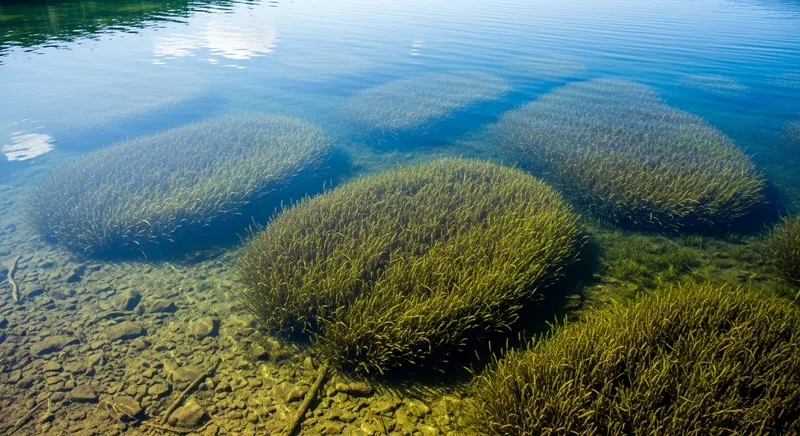
Hydrilla occupies virtually every freshwater habitat type in the United States: lakes, ponds, reservoirs, rivers, drainage canals, tidal estuaries, and irrigation ditches. It tolerates extraordinary ranges of environmental conditions that would limit other aquatic plants. Water depth is not a barrier — hydrilla can establish at depths ranging from less than one foot to over twenty feet in clear water. Its exceptional low-light tolerance (photosynthesis at just 1% of surface light intensity) allows it to thrive even in turbid, heavily shaded water where native submerged plants fail.
Hydrilla grows in both hard and soft water, from pH 5.5 to 10, and can survive in slightly brackish water up to 7 parts per thousand salinity — allowing it to colonize tidal areas where most invasive submerged plants cannot persist. It establishes in both standing and slowly flowing water, and in both cold temperate climates (when dormant in winter) and year-round tropical conditions. This combination of tolerances makes hydrilla uniquely capable of colonizing any water body, anywhere, regardless of water quality. Once established, it is extremely difficult to displace even by improving water clarity and reducing nutrients — strategies that help suppress other invasive species.
Spread Mechanisms
Hydrilla spreads through four distinct pathways, each contributing to its range expansion and making prevention extremely challenging. Recreational watercraft represent the primary vector: stem fragments as small as a single node — invisible to a casual inspection — can lodge in propellers, live wells, bilge water, anchor chains, trailer wheel wells, and fishing equipment. When that boat enters a new water body, the fragment detaches and establishes a new colony. A single fragment the size of a thumbnail can seed an infestation.
Turions — small, dark axillary buds — are produced in abundance throughout the growing season, detach from plants, and are distributed by water currents, flooding events, and birds. Waterfowl that feed in infested water bodies carry turions on their feathers and feet to distant water bodies. Underground tubers can survive for over a decade in sediment, meaning that even after successful surface suppression, disturbance or dredging can expose viable tubers that regenerate the infestation. The monoecious biotype also produces seeds, adding a fifth pathway unique to that strain. Hydrilla's illegal sale through the aquarium trade — under mislabeled names — has also contributed to its spread into new states.
Prevention is the only fully effective strategy. The Clean, Drain, Dry protocol eliminates the watercraft pathway if followed rigorously. Reporting new sightings to state wildlife agencies enables early response before colonies expand.
Similar Species & How to Tell Them Apart
Hydrilla is most often confused with native elodea (Elodea canadensis), invasive Brazilian waterweed (Egeria densa), and several native pondweeds with whorled or strap-like leaves. Misidentification has real management consequences: native elodea is ecologically valuable and should not be treated, while Brazilian waterweed requires different herbicide selection.
Hydrilla vs. native elodea: Elodea has 3 leaves per whorl (rarely 4); hydrilla typically has 5 (range 3–8). Elodea leaves are smooth-margined; hydrilla leaves are noticeably serrated — the serrations can be felt by running a leaf between thumb and forefinger — and many hydrilla leaves bear one or more spines on the underside of the midrib. Elodea produces no tubers or turions; hydrilla produces both. See the full identification hub for diagnostic images.
Hydrilla vs. Brazilian waterweed: Brazilian waterweed has 4–6 leaves per whorl, leaves 1.5–4 cm long (longer than hydrilla's 0.5–2 cm), and produces conspicuous white flowers at the water surface (hydrilla flowers are tiny and inconspicuous). Brazilian waterweed produces no tubers and no turions, and has smooth leaf margins. Both are non-native invasives and both require management, but herbicide selection and dosing differ.
Hydrilla vs. native pondweeds: Most native Potamogeton species have alternate (not whorled) leaf arrangement, often with floating leaves of a distinctly different shape from submerged leaves, and they lack the diagnostic midrib spines and tubers. Curly-leaf pondweed is the only common pondweed with a superficially whorled look, but its leaves are wavy-edged and bluish-green, never the bright spring-green of hydrilla. When in doubt, photograph a leaf-whorl close-up and submit through your state invasive-species reporting portal — most states verify within days. Do not initiate treatment based on uncertain identification.
Seasonal Growth Pattern
In frost-free climates — primarily Florida and the Gulf Coast — hydrilla grows continuously year-round, reaching peak above-ground biomass in summer and fall. In temperate regions with winter freezes, the annual cycle begins with new growth from tubers and turions in March–April as water warms above 50°F. Growth accelerates through May and June, with plants elongating rapidly and branching toward the surface.
By July–September, dense monospecific surface mats develop in shallow to mid-depth water, reaching the surface in areas under 10 feet deep. This peak mat period is when hydrilla causes the most severe recreational, navigational, and ecological impacts — surface mats can extend across entire bays and lake sections. Turion production increases in late summer and fall in response to cooling temperatures and shortening days; turions detach and sink to sediment to overwinter.
In October–November, above-ground growth begins to die back in colder regions as water temperature drops below 50°F. By December and January, plants in freeze zones appear largely absent from the water column — giving a misleading impression of control. Meanwhile, tubers and turions in sediment remain fully viable, ready to resprout the following spring. This seasonal dormancy is why annual inspection and monitoring are essential; hydrilla's "disappearance" in winter does not mean it is gone.
Ecological Impact
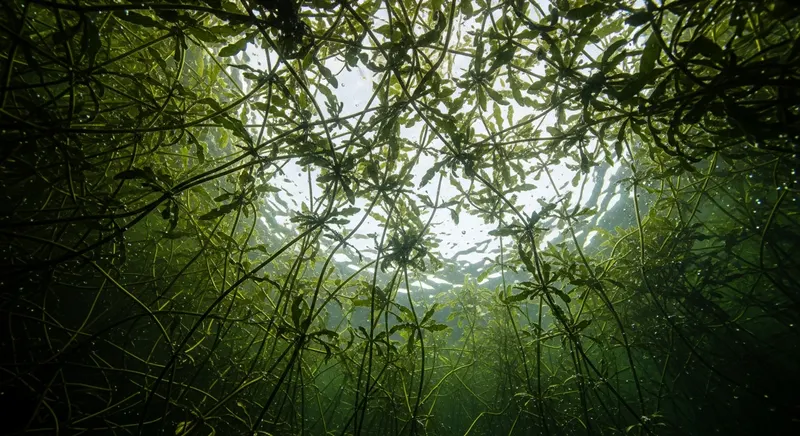
The ecological and economic consequences of hydrilla infestations are severe and well-documented. Dense monocultures displace native aquatic vegetation, dramatically reducing plant community diversity. A diverse native submerged plant community of 20+ species can be reduced to near-monospecific hydrilla stands within a few growing seasons.
Dense surface mats block sunlight from reaching the water column, eliminating photosynthesis by native submerged plants. Decomposing biomass depletes dissolved oxygen, creating hypoxic zones that stress or kill fish, invertebrates, and other aquatic organisms. The dense mats alter water circulation patterns, creating stagnant zones that favor mosquito breeding. Navigation becomes impaired; boat propellers are fouled; swimming is made dangerous; water intake structures for irrigation and municipal supplies are blocked.
Economically, hydrilla management costs tens of millions of dollars annually in Florida alone. Property values around infested water bodies decline. Sport fishing, which contributes billions to state economies, is impaired. The U.S. Army Corps of Engineers has spent hundreds of millions of dollars managing hydrilla in navigable waterways since the 1970s.
Water Quality Effects
Hydrilla infestations produce some of the most pronounced water quality changes documented for any aquatic invasive plant. Dense surface canopies suppress wind-driven mixing and disrupt the normal day–night oxygen cycle. During the day, photosynthesis elevates surface dissolved oxygen above the canopy, but the shaded water column underneath frequently goes hypoxic (less than 2 mg/L) because mixing is suppressed and respiration continues. At night, combined plant respiration and bacterial decomposition can drive dissolved oxygen below 1 mg/L throughout much of the column — lethal to most warmwater sport fish.
Heavy daytime photosynthesis in dense canopies can also push pH above 9.0 in poorly buffered systems, shifting ammonia toward its more toxic un-ionized form and stressing fish and invertebrates. When the canopy dies back — naturally or after treatment — decomposing biomass consumes dissolved oxygen rapidly and the sudden release of stored phosphorus often fuels cyanobacterial blooms within weeks. Reservoir managers across the Southeast routinely time treatments to avoid the warmest months precisely because of this oxygen-crash and bloom-trigger sequence.
A subtler effect is on water clarity. Hydrilla can briefly improve clarity by outcompeting phytoplankton and trapping sediment, but this clear-water state is conditional on a living canopy and collapses dramatically when the canopy dies — sometimes flipping a reservoir to a persistent turbid, algae-dominated regime that is far harder to reverse. See the water quality degradation guide for the underlying mechanisms.
Risks to People, Property & Infrastructure
Hydrilla creates direct risks to lake users, infrastructure, property values, and even wildlife health. Recreational risks are the most immediate: dense canopies entangle swimmers — particularly children and weak swimmers who can panic when caught in submerged stems — foul boat propellers and water intake screens, snag fishing lines, and make near-shore wading dangerous because the mat hides bottom contours and drop-offs. Drowning incidents in hydrilla-infested water bodies have led to public-safety closures of swimming areas in several southern reservoirs.
Infrastructure risks are substantial. Hydrilla mats clog irrigation intakes, power-plant cooling water systems, and municipal water supply screens, requiring continuous mechanical cleaning. In hydroelectric and flood-control reservoirs, dense growth in the forebay reduces turbine efficiency and constricts spillway capacity during high-flow events. Southeastern utilities, particularly in Florida collectively spend tens of millions of dollars annually on hydrilla management at water intakes. Drainage canals in agricultural regions experience reduced flow capacity, increased flood risk, and accelerated sedimentation.
Property value impacts are well documented: hedonic pricing studies on lakes in Florida, North Carolina, and Texas show 15–35% reductions in waterfront property values on heavily infested lakes compared with managed comparables. The loss propagates to local tax bases and to tourism-dependent businesses.
Wildlife disease risk is unique to hydrilla and severe. Hydrilla in some southeastern reservoirs hosts a cyanobacterium (Aetokthonos hydrillicola) that produces a neurotoxin causing avian vacuolar myelinopathy (AVM), a fatal neurological disease that has killed at least 150 bald eagles since the 1990s along with thousands of American coots and other waterbirds. AVM is now considered the most significant wildlife disease linked to an aquatic invasive plant in North America, and hydrilla removal directly reduces substrate for the toxin-producing organism.
Control Methods
Effective hydrilla management requires a long-term, integrated approach. No single control method is fully effective, and complete eradication from established water bodies has not been achieved. Management programs aim for suppression to acceptable levels rather than elimination.
Herbicide control using EPA-registered aquatic herbicides is the most commonly used approach. Fluridone (slow-acting systemic), endothall (contact), diquat (contact), triclopyr (systemic), and florpyrauxifen-benzyl (a newer systemic product) are all registered for hydrilla control. Treatment requires state and federal permits, professional application, and careful attention to water use restrictions.
Biological control research has identified several promising agents. The hydrilla tuber weevil (Bagous affinis), native to Asia, attacks tubers in the sediment. The hydrilla leaf-mining fly (Hydrellia pakistanae) and a native insect, the Cricotopus lebetis midge, have shown localized suppression.
Mechanical harvesting can provide temporary navigational relief but does not provide lasting control and risks spreading plant fragments. Aquatic rotovating and bottom shading with benthic barriers are options for small, high-value areas.
Triploid grass carp — sterile fish that consume aquatic vegetation — are permitted in many states as a management tool. Stocking rates must be carefully calibrated, as grass carp will consume beneficial native plants as well.
Important: Always obtain required permits before applying any aquatic herbicide or introducing biological control agents. Requirements vary by state. Contact your state department of natural resources or environmental protection agency for guidance.
Management Considerations
Hydrilla management is a long-term commitment, not a one-season project. Realistic program design starts with three honest acknowledgments: (1) eradication is essentially impossible once tubers are established, so the goal is suppression to acceptable density; (2) the tuber bank in the sediment will continue to germinate for at least 4–5 years after surface control, so multi-year follow-up treatment is non-negotiable; and (3) the cost of a sustained program is far less than the cost of allowing an established infestation to reach lake-wide canopy, both in direct management expense and in foregone recreational and property value.
When to act: Earliest possible intervention produces by far the best long-term outcomes. A new infestation detected at less than 1 acre can often be suppressed with a single season of focused treatment for under $10,000; the same infestation allowed to expand to 100 acres requires $200,000+ per year for multiple years. State early-detection-and-rapid-response programs in Washington, Maine, Wisconsin, and other states have shown that detection-to-treatment intervals under 12 months are the single strongest predictor of successful suppression.
Treatment strategy depends on water body type, water use, and infestation extent. Whole-lake fluridone treatments at low concentrations (5–15 ppb) maintained for 60–120 days are the standard for established lake-wide infestations and have produced multi-year tuber depletion (Lake Gaston, Lake Murray). Spot treatments with contact herbicides (endothall, diquat) are appropriate for navigation-channel maintenance or new rapid-response operations but provide no tuber suppression. Triploid grass carp are an option in non-discharging ponds where total vegetation removal is acceptable. Mechanical harvesting provides only short-term navigational relief and may spread fragments unless rigorously contained.
Regulatory and stakeholder considerations are central. All aquatic herbicide applications require state permits, with public-notice requirements for drinking-water and recreational water bodies. Federal listing of hydrilla as a noxious weed prohibits interstate transport of any plant material — important for harvesting contractors and boat-inspection programs. Lake associations, downstream water users, marina operators, and shoreline property owners should be consulted before treatment.
Prevention is dramatically cheaper than control. Every dollar spent on Clean, Drain, Dry boat-inspection programs at infested-water-body boat ramps returns an estimated $10–$50 in avoided downstream management costs. Lake associations on hydrilla-free water bodies in regions where hydrilla is established should treat prevention infrastructure (inspection stations, wash stations, signage) as the highest-priority management investment.
Distribution in the United States
Hydrilla is documented in at least 30 U.S. states and continues to expand its range. The heaviest infestations occur in Florida, which has some of the most severe hydrilla problems in the world, with millions of acres of lake and river bottom affected. Major infestations also exist in Georgia, Texas, North Carolina, South Carolina, Virginia, Maryland, and other Southeastern and Mid-Atlantic states.
The dioecious biotype (introduced separately from the monoecious biotype) is concentrated in Florida and the Southeast. The monoecious biotype, discovered in the 1980s, has proven more cold-tolerant and has spread aggressively northward through Virginia, Maryland, Delaware, New Jersey, Connecticut, and into New York, Pennsylvania, and other northeastern states.
Western U.S. infestations are more scattered but growing, with established populations in California, Washington, and several other western states. The continued expansion of hydrilla is driven primarily by human-mediated transport via watercraft.
Frequently Asked Questions
How did hydrilla get into the United States?
Hydrilla was introduced to the U.S. through the aquarium trade, likely in the 1950s–60s. It was sold as an aquarium plant and released or escaped into Florida waterways, from where it spread throughout the country. The plant continues to be sold illegally online and in some retail stores under the name 'Indian star vine' or mislabeled as other species.
Is hydrilla the same as elodea?
No. While both are submerged aquatic plants with whorled leaves, hydrilla (Hydrilla verticillata) and elodea (Elodea canadensis) are different species. Key differences: hydrilla typically has 4–8 leaves per whorl (elodea usually 3); hydrilla has visible serrations and a single midrib tooth on the underside; and hydrilla is non-native while elodea is native to North America. If you count exactly 3 smooth-margined leaves per whorl, it is likely elodea; 4 or more serrated leaves with a midrib tooth indicates hydrilla.
Can hydrilla be eradicated from a water body?
Complete eradication is effectively impossible once established. Tubers in the sediment can remain viable for over 10 years, meaning plants can re-emerge long after above-ground growth appears eliminated. Management programs aim for long-term suppression to acceptable levels. Early detection and rapid response when hydrilla first appears in a new water body — while populations are still small — offers the best chance of elimination.
How can I prevent spreading hydrilla?
Follow the Clean, Drain, Dry protocol: Remove all plant material from your boat, trailer, propeller, and gear before leaving any water body. Drain all water from live wells, bilge, and motor. Allow your boat and equipment to dry completely for at least 5 days before launching in a new water body. Never release aquarium plants or fish into natural water bodies. Report new sightings to your state department of natural resources.
Why is hydrilla a federal noxious weed?
The United States Department of Agriculture lists hydrilla as a Federal Noxious Weed under the Federal Noxious Weed Act. This designation reflects the plant's invasive potential, economic harm, and threat to aquatic ecosystems and agriculture. Federal noxious weed status prohibits interstate transport, sale, or introduction. Individual states have their own noxious weed lists that may impose additional restrictions.
Whole-Lake Hydrilla Management: Lake Tohopekaliga, FL
Lake Tohopekaliga ("Lake Toho"), a 22,700-acre Central Florida lake, has sustained one of the most intensively managed hydrilla programs in the U.S. since the 1990s. Annual fluridone treatments combined with targeted mechanical harvesting in high-use recreational areas have maintained hydrilla coverage below nuisance thresholds while preserving native submersed vegetation communities in designated littoral zones.
Key outcome: Multi-decade integrated program demonstrates that hydrilla can be managed at acceptable levels in large water bodies, but requires sustained annual investment and coordinated agency cooperation across FDEP, SFWMD, and local fisheries managers.
References & Further Reading
- Langeland, K.A. (1996). Hydrilla verticillata (L.F.) Royle (Hydrocharitaceae), 'The Perfect Aquatic Weed'. Castanea 61(3):293–304.
- Madeira, P.T., et al. (2007). A shallow clade of Hydrilla verticillata (Hydrocharitaceae) colonized the New World from different biotypes of the Old World. Hydrobiologia 586:221–234.
- U.S. Army Corps of Engineers (2023). Aquatic Plant Control Research Program — Hydrilla Management. ERDC Technical Notes.
- Sutton, D.L. & Vandiver, V.V. (1986). Grass Carp: A Fish for Biological Management of Hydrilla and Other Aquatic Weeds in Florida. Florida Cooperative Extension Service Bulletin 867.
- USDA APHIS (2021). Federal Noxious Weed Designation: Hydrilla verticillata. Animal and Plant Health Inspection Service.
- Breinlinger, S., et al. (2021). Hunting the eagle killer: A cyanobacterial neurotoxin causes vacuolar myelinopathy. Science 371(6536):eaax9050.
The ecological impact section helped our team explain to county commissioners why early intervention matters. The oxygen depletion data alone secured funding for our early-detection monitoring program.
Donna Whitfield State Wildlife Biologist, GA · Okefenokee regionWe used the integrated management framework from this site to structure our Eurasian watermilfoil control program. After three seasons we've reduced lake-wide coverage by 78% on our 340-acre water body.
Susan Thibodeau Lake District Manager, MN · Crow Wing County