Identification Features
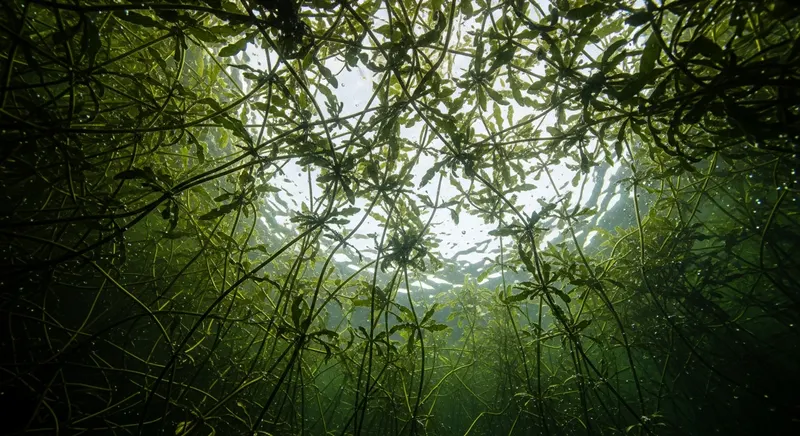
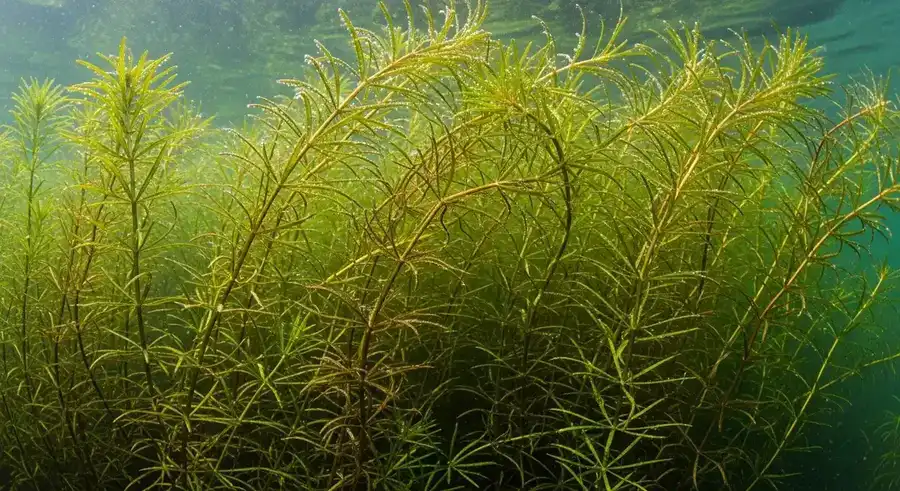
Najas species (water nymph, Najas spp.) are slender-stemmed, delicate submerged plants with narrow, opposite or pseudo-whorled leaves arranged along thin, much-branched stems. The overall appearance is fine and thread-like compared to coarser submerged weeds. Key features: leaves are very narrow (1–4 mm wide), 1–5 cm long, with margins that range from smooth to distinctly spiny or toothed depending on species. The stem is thin and wiry, branching frequently. Plants are typically olive-green to reddish-brown and can form loose, floating masses or be attached to sediment by fine roots.
The most management-significant species in the U.S. is spiny najas (Najas minor), an invasive from Eurasia that has established in the Northeast, Mid-Atlantic, and Great Lakes region. Spiny najas is distinguished from native najas by its distinctly spiny (sharp, rigid toothed) leaf margins — visible and felt under a hand lens — and its tendency to form dense monocultures. Native najas species (N. guadalupensis, N. flexilis) have smoother or more finely toothed margins and more open growth form. Identification guide →
Biology and Growth
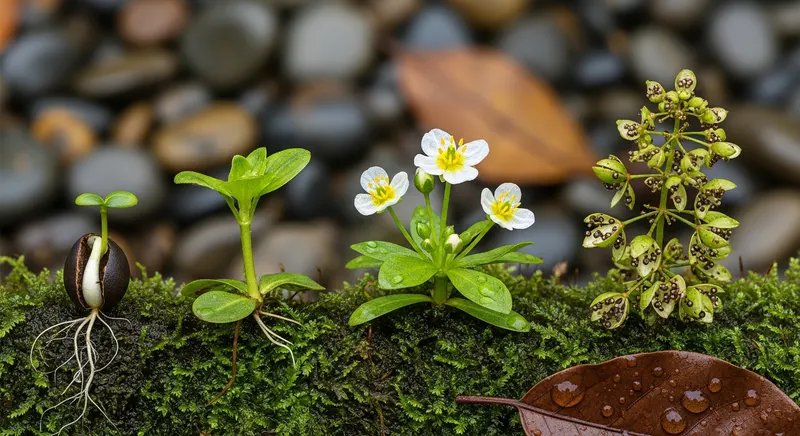
Najas species are annual plants that complete their lifecycle within a single growing season, unlike most other aquatic weeds which are perennial. They reproduce primarily by seed, producing small seeds (1–5 mm) that persist in the sediment for several years. This annual habit means populations can collapse completely in winter (when frost kills all aboveground plant material) and regenerate entirely from the seed bank in spring — creating boom-and-bust dynamics that make management timing critical.
Spiny najas shows strong late-summer growth, often becoming most abundant in August–September when other submerged plants may be declining. This late-season growth can create navigational problems in lakes where the species is abundant, just as the water body was naturally clearing from the midsummer growth period of other weeds.
Ecological Context
Native najas species are important components of North American freshwater ecosystems, providing fine-structure habitat for invertebrates and small fish, and food for diving ducks and other waterfowl. The fine texture of najas beds supports particularly dense invertebrate communities. Native najas is generally not a management concern. Spiny najas (invasive) forms denser monocultures that reduce native plant diversity and may impede navigation — it is the management target.
Distribution
Native najas species are found throughout North America. Spiny najas is established primarily in the northeastern U.S. — most documented infestations are in New York, New England, New Jersey, Pennsylvania, and the Great Lakes states. It is less widespread than hydrilla or milfoil but is spreading slowly westward.
Management
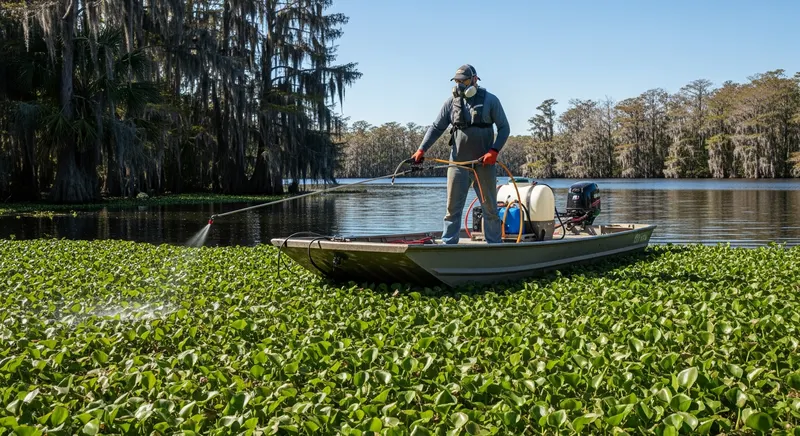
Spiny najas management options include fluridone, endothall, and diquat (label varies by state). The annual growth cycle provides a management window: treatment before seed set in late summer prevents seed bank replenishment. Accurate species identification (invasive vs. native najas) is essential before any treatment — treating native najas populations is counterproductive. Control options →
Frequently Asked Questions
How do I tell invasive spiny najas from native najas species?
The most reliable field character is the leaf margin: spiny najas (Najas minor) has distinctly rigid, sharp teeth (spines) on leaf margins that are visible and felt easily with a hand lens or fingernail. Native najas species have smoother to finely toothed margins that are less sharp and prominent. Stem examination also helps: spiny najas stems have small spines along the internodes that native species lack. If you are uncertain, preserve a sample in a sealed bag with water and consult your state DNR or university extension for identification assistance before taking any management action.
Ten-Year Lake Management Plan: Lake Wingra, WI
Lake Wingra, a 342-acre urban lake in Madison, WI, developed a comprehensive 10-year management plan coordinating the City of Madison, University of Wisconsin, and adjacent neighborhood associations. The plan addressed Eurasian watermilfoil, curly-leaf pondweed, and purple loosestrife through an integrated approach including targeted herbicide treatment, mechanical harvesting, native plant restoration, and public education.
Key outcome: The structured multi-agency planning process secured consistent funding across multiple budget cycles, a key advantage over ad hoc management. Native plant restoration efforts showed measurable progress in designated restoration zones within three years of initiation.
The ecological impact section helped our team explain to county commissioners why early intervention matters. The oxygen depletion data alone secured funding for our early-detection monitoring program.
Donna Whitfield State Wildlife Biologist, GA · Okefenokee regionWe used the integrated management framework from this site to structure our Eurasian watermilfoil control program. After three seasons we've reduced lake-wide coverage by 78% on our 340-acre water body.
Susan Thibodeau Lake District Manager, MN · Crow Wing County