Identification Features
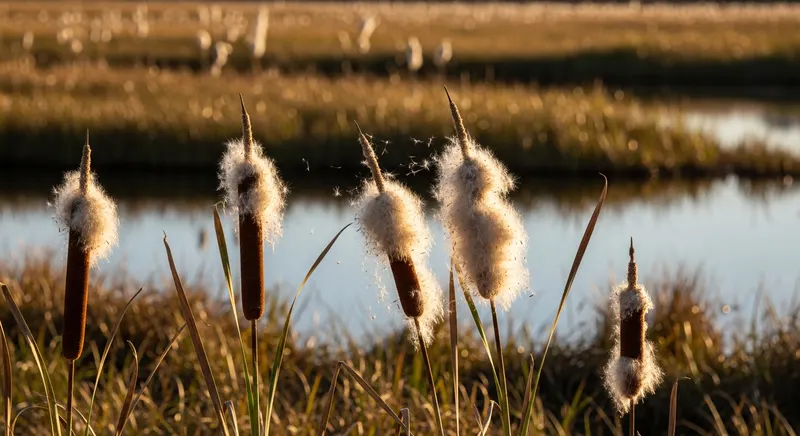
Cattails (Typha spp.) are among the most recognizable plants in North America. The brown, sausage-shaped seed head (technically a spike of thousands of tiny flowers) on a tall stalk is iconic and immediately distinctive. In North American water bodies, two species are most common: broadleaf cattail (T. latifolia) with overlapping male and female spikes on the same stalk (no gap between brown spike and tan pollen portion); and narrowleaf cattail (T. angustifolia) with a distinct gap between the male pollen-producing portion (above) and the brown female spike. Both are native to North America.
Leaves are flat, strap-shaped, 1–3 cm wide (broadleaf) or 0.5–1.5 cm wide (narrowleaf), sheathing the stem at the base. Plants grow 1.5–3 m tall in most conditions. A hybrid between the two species (T. × glauca) is common where both parents coexist and has been implicated in the aggressive monoculture formation seen in Great Lakes coastal wetlands and prairie potholes.
Ecological Role and the "Native Nuisance" Question
Native cattails play a fundamental role in North American wetland ecology. Dense cattail stands provide essential nesting habitat for marsh birds including red-winged blackbirds, marsh wrens, and American bittern. Muskrats, beavers, and multiple invertebrate species depend on cattail. The dead stems provide winter insulation for overwintering insects. And cattails actively filter and retain nutrients — cattail-dominated zones in wetland treatment systems effectively reduce nutrient loading to downstream water bodies.
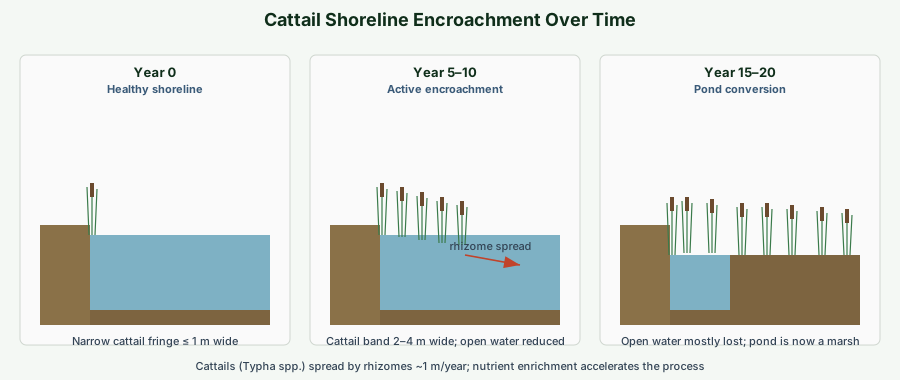
The management challenge arises when cattails — driven by nutrient enrichment of wetlands from agricultural runoff and atmospheric nitrogen deposition — expand beyond their natural ecological densities to form dense monocultures that displace the diverse native emergent plant communities of prairie potholes, coastal marshes, and lakeshore wetlands. In this expansion mode, they reduce biodiversity, impair waterfowl habitat quality, and in severe cases can fill in open water areas. The expansion is most severe in the Great Lakes region and the Prairie Pothole region of the Midwest, where landscape-scale nutrient loading has shifted conditions in favor of cattail dominance.
Biology
Cattails spread laterally through underground rhizomes (rootstocks) at rates of 1–4 meters per year under favorable conditions. Each plant also produces thousands of wind-dispersed seeds annually from the brown spike — each seed has a cottony parachute that allows long-distance wind dispersal. A combination of seed establishment in disturbed areas and rhizome spread from established colonies drives population expansion. The hybrid T. × glauca appears particularly aggressive in northern wetlands. Reproduction biology →
Distribution
Cattails are found in wetlands, lake margins, ditches, and roadside pond margins throughout all 50 U.S. states. T. latifolia has the broadest range; T. angustifolia is primarily in the northern and eastern U.S. The hybrid dominates in many Great Lakes wetlands.
Management
Cattail management requires a careful balance between restoring natural densities (desirable) and eliminating ecologically valuable habitat (undesirable). Nutrient reduction is the primary long-term solution for addressing the conditions driving expansion. Direct management options for restoration of native plant diversity include: fall/late summer herbicide application with imazapyr or glyphosate (systemic, kills rhizome network); water level manipulation (fall drawdown exposes rhizomes to freezing, reducing stand density); and mechanical removal combined with replanting of native alternatives. All chemical treatment requires state permits. Control methods →
How Cattails Spread Across Wetlands and Pond Margins
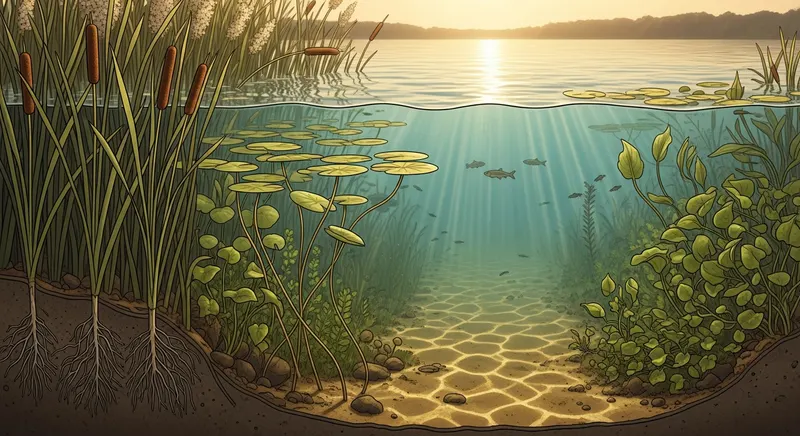
Cattails have two complementary reproductive strategies that drive both local expansion and long-distance colonization. Lateral rhizome spread is the dominant mechanism within established stands: thick, branching underground rhizomes extend 1–4 meters per year under favorable nutrient conditions, sending up new shoots from buds spaced every 15–30 cm along the rhizome. A single colony can expand by an acre or more per growing season in shallow, nutrient-rich wetlands. Rhizomes also store substantial carbohydrate reserves that allow recovery from cutting, grazing, or partial herbicide treatment — a key reason why one-time mechanical removal almost always fails.
Wind-dispersed seeds are the primary mechanism for colonization of new water bodies and disturbed shorelines. A single mature cattail spike produces 200,000–300,000 tiny seeds, each carried on a cottony pappus that can drift for miles on autumn winds. Seeds remain viable in sediment for several years and germinate readily on exposed mud — particularly on drawdown shorelines, newly dug pond margins, road-cut ditches, and freshly disturbed wetland fringes. The combination of prolific seed production, long-distance dispersal, and rapid rhizome spread once established is why disturbed wetlands in nutrient-enriched landscapes can shift to cattail dominance within 3–5 years. See the spread biology guide for the underlying mechanisms.
Water Quality Effects of Dense Cattail Monocultures
Cattails in their natural ecological role have neutral or beneficial effects on water quality — they actively filter nutrients, stabilize sediments, and are used deliberately in constructed wetland treatment systems precisely for these properties. The water-quality concern is specifically about dense expanding monocultures that develop in nutrient-enriched wetlands and pond margins, where the plant's normal benefits flip into long-term degradation drivers.
Dissolved oxygen effects in monoculture stands are pronounced in the warm season. Dense above-water biomass shades the underlying shallow water; respiration of root masses and decomposition of accumulated leaf litter consume oxygen faster than restricted circulation can replenish it. Late-summer dissolved oxygen in cattail-choked coves and pond margins frequently drops below 3 mg/L, and the slow decomposition of annual aboveground biomass — which collapses each fall but persists as standing dead material — adds a chronic oxygen demand that extends into spring.
Internal nutrient loading develops over multi-year timeframes as the accumulating litter layer mineralizes and releases stored nitrogen and phosphorus back to the water column. The classic eutrophication feedback loop can be especially pronounced in cattail-dominated wetlands: external nutrient inputs drive cattail expansion; cattail expansion accelerates internal nutrient cycling; and accelerated internal cycling makes the wetland more vulnerable to water-quality degradation and cyanobacterial blooms in the open-water portion. Long-term studies in the Prairie Pothole region and the Great Lakes coastal wetlands document this trajectory clearly.
Sediment accretion from the accumulating litter layer (often 5–20 cm per decade in undisturbed monocultures) gradually fills in shallow open water, converting hemi-marsh and pond margins to dry-end marsh and ultimately to wet meadow. While this is a natural successional process, dense cattail monocultures accelerate it dramatically.
Risks Posed by Cattail Expansion
Cattail expansion creates ecological, infrastructure, recreational, and fire risks that are sometimes overlooked precisely because cattail is native. The harm comes not from the species but from the monoculture pattern of expansion.
Biodiversity loss is the most-documented risk. Studies on the Great Lakes coastal wetlands and Prairie Pothole region show that hybrid cattail (T. × glauca) monocultures support 40–70% lower diversity of marsh-nesting birds, fewer amphibian species, and significantly reduced submerged plant communities compared with reference mixed-emergent marshes of similar size. Marsh wrens, least bitterns, and king rails — already declining across their ranges — show particularly steep losses in heavily cattail-dominated wetlands.
Waterfowl habitat impacts are significant despite the apparent abundance of vegetation. Most North American duck species require open-water foraging areas and emergent cover in a hemi-marsh mosaic (roughly 50% emergent cover, 50% open water); cattail monocultures that close in open water reduce brood-rearing habitat, foraging access, and overall waterfowl productivity. State wildlife agencies in Iowa, Minnesota, North Dakota, and Manitoba have documented these effects in detail.
Infrastructure risks include reduced flow conveyance in drainage ditches and stormwater retention basins (raising flood risk on adjacent agricultural land and developed areas), clogged culverts and overflow structures, and sediment accretion that reduces the volume of stormwater retention basins over time.
Fire risk in dense dry-end cattail stands is genuine and underappreciated. The standing dead biomass at the end of the growing season is highly flammable; managed wetlands in the Midwest and Great Plains experience occasional cattail fires that can spread to adjacent agricultural fields and structures. Conversely, prescribed fire is itself a valuable cattail management tool when applied at the right season.
Recreational risks are localized but real: dense cattail stands at boat ramps and along fishing-access shorelines impair use, and the dense root mats are difficult and unsafe to wade through.
Similar Native Emergent Species
Cattail identification is straightforward once mature spikes develop, but several other emergent plants — particularly in juvenile stages — can be mistaken for cattail in shallow wetlands. Accurate identification matters because management of native emergents requires different considerations than management of expansive cattail monocultures.
Cattail vs. bulrush (Schoenoplectus, Scirpus): Bulrush has round or triangular stems with clusters of small brown spikelets near the tip — no large sausage-shaped seed head. Bulrush leaves are reduced and largely confined to basal sheaths; cattail leaves are conspicuous flat straps. Both are native and ecologically valuable; bulrush is typically preferred over cattail in wildlife-managed wetlands and rarely requires management. See the bulrush profile for full comparison.
Cattail vs. invasive Phragmites (Phragmites australis, non-native lineage): Phragmites is much taller (3–5 m vs. cattail's 1.5–3 m), has hollow rigid bamboo-like stems, and produces large feathery silver-purple seed plumes very different from cattail's brown sausage spike. Invasive Phragmites is a significantly higher-priority management target than native cattail in most regions. See the phragmites profile.
Cattail vs. native iris (Iris versicolor, blue flag): Juvenile cattail shoots resemble iris foliage — both are flat, sword-shaped, and emerge from rhizomes at the water's edge. Iris leaves form a distinct flat fan from the base (equitant); cattail leaves emerge from a more cylindrical sheath. Iris produces conspicuous blue-purple flowers in early summer and never produces a cattail-like spike.
Cattail vs. yellow flag iris (Iris pseudacorus, invasive non-native): An aggressive invasive emergent that resembles native iris but with showy yellow flowers; juveniles can be confused with cattails. Yellow flag iris is a higher-priority management target than native cattail. See the identification hub for diagnostic side-by-side images of all common emergent species.
Seasonal Patterns and Timing of Management
Cattail follows a clear annual cycle that has direct implications for management timing. Spring emergence (April–May in the northern U.S., earlier in the South) produces a flush of new shoots from overwintering rhizomes. Growth is rapid through May and June, with most height attained by midsummer. Flowering and seed development occur in June and July, with mature spikes shedding seeds from late summer through winter. Fall senescence (October–November) kills aboveground tissue, leaving standing dead material that persists through winter; rhizomes remain fully viable below the sediment surface and resume growth the following spring.
Optimal management timing is determined by the plant's translocation patterns. Systemic herbicide applications (imazapyr, glyphosate) are most effective in late summer and early fall when carbohydrate translocation from leaves to rhizomes is at its peak, carrying herbicide deep into the rhizome network and producing the highest stand-mortality rates. Mid-summer applications are less effective; spring applications are generally ineffective because the plant is exporting carbohydrate from rhizomes rather than importing it. Mechanical cutting is most effective in late spring or early summer (May–June) before seed set, repeated mid-summer to deplete rhizome reserves. Water-level manipulation (fall drawdown to expose rhizomes to freezing) is most effective when timed to dewater the wetland just before sustained sub-freezing conditions arrive.
Management Considerations for Restoration vs. Removal
The defining question for cattail management — unlike most invasive plant management — is not whether to control but how much to control and toward what end state. Cattail is native; complete removal is rarely the ecologically correct goal. Successful programs explicitly define a target plant community structure (typically a hemi-marsh mosaic with 30–60% emergent cover and 40–70% open water and submerged vegetation) and manage toward it rather than toward eradication.
Nutrient source reduction is the long-term foundation. Because cattail expansion is driven primarily by nutrient enrichment, sustained reductions in agricultural runoff, atmospheric nitrogen deposition, and direct wastewater inputs are the only durable solution. Without nutrient reduction, even successful mechanical or chemical control will be temporary — the underlying conditions favor cattail re-establishment within a few growing seasons. Watershed-scale conservation programs (vegetated buffers, cover crops, manure management) are the most cost-effective long-term investment. See the management planning guide for prioritization frameworks.
Active control tactics include: late-summer/early-fall systemic herbicide application (imazapyr is most effective; glyphosate also widely used); fall drawdown combined with prescribed fire (highly effective in managed impoundments but requires water-control infrastructure); mechanical cutting below the water surface in late spring (depletes rhizome reserves over multiple seasons); and disking of dry-end stands during drawdown (effective but high-disturbance). Cutting followed by submersion (cut stems below water level so the cut hollow stems flood and drown the rhizomes) is a low-input alternative for small areas.
Avoid common management errors: one-time herbicide treatment without follow-up generally produces only 1–2 years of suppression; mechanical removal during dormancy provides almost no rhizome impact; removal of all cattails from a pond margin eliminates valuable wildlife habitat and increases shoreline erosion. Regulatory considerations include state permit requirements for aquatic herbicide application (universal), wetland-disturbance permits for mechanical work in jurisdictional wetlands (federal and state), and consultation with state wildlife agencies in areas supporting threatened or endangered wetland species. Lake associations, downstream landowners, and conservation easement holders should be consulted before substantial management work.
Hybrid cattail (T. × glauca) — increasingly dominant in Great Lakes wetlands and Prairie Pothole region — shows reduced herbicide sensitivity at standard doses and faster regrowth than either parent species; management programs in these regions are increasingly designed around the hybrid's distinct biology rather than treating all cattails as equivalent.
Frequently Asked Questions
Are cattails good for a pond?
In moderation, yes. A narrow band of native cattails along a pond margin provides wildlife habitat, shoreline stabilization, nutrient uptake, and nesting cover for waterfowl and marsh birds. Problems arise when cattails expand to cover large areas of a shallow pond, reducing open water, impairing recreational use, and displacing other native plant species. The appropriate management response depends on your goals — if you want to maintain open water and diverse native plants, limiting cattail coverage to 20–30% of the shoreline margin is a reasonable target for most small ponds.
Can I eat cattails?
Yes — cattails are edible, and multiple parts of the plant are used as food. Young shoots emerging in spring are eaten raw or cooked (similar to leek or asparagus). The pollen from the male flower spike (yellow, produced in early summer) can be collected and used as a flour supplement. The immature green female spikes can be cooked and eaten like corn-on-the-cob. The starchy rhizomes can be processed to extract flour. This edibility has been utilized by Indigenous peoples for thousands of years. Of course, only harvest from water bodies free of contamination.
Why are hybrid cattails (T. × glauca) more aggressive than native broadleaf cattail?
The hybrid between broadleaf cattail (T. latifolia) and narrowleaf cattail (T. angustifolia) combines characteristics of both parents — broader environmental tolerance, larger size, more vigorous rhizome production, and apparently greater nutrient-uptake capacity. In nutrient-enriched wetlands, the hybrid outcompetes both parents and forms dense persistent monocultures. Hybrid populations also show reduced sensitivity to standard herbicide doses, requiring adjusted treatment programs. The hybrid now dominates many Great Lakes coastal wetlands and prairie pothole wetlands where both parent species occur.
Should I remove cattails from my pond, or leave them?
A balanced approach works best for most ponds. Maintain a band of cattails along part of the shoreline (typically 20-40% of the perimeter) to provide wildlife habitat, shoreline stabilization, and nutrient uptake — but actively manage to prevent cattails from expanding to cover the entire pond margin or filling in shallow areas. Annual maintenance is usually less work than periodic complete clearing, and provides far better wildlife and water-quality outcomes.
Are cattails a sign that my pond water quality is poor?
A small native cattail stand at the edge of a healthy pond is normal and beneficial. An aggressively expanding cattail population — particularly if it has rapidly converted open water to dense emergent cover within a few years — is usually a sign of significant nutrient enrichment from external sources (runoff, septic, fertilizer, waterfowl) or internal cycling. The expansion is the symptom; the underlying nutrient loading is the problem. Address the nutrient source for durable resolution; cattail removal alone will be temporary.
When is the best time of year to treat cattails with herbicide?
Late summer to early fall (August through September in most of the U.S., later in the South) is the optimal window for systemic herbicide application. During this period, the plant is translocating carbohydrates from above-ground leaves down to the rhizomes for winter storage — and systemic herbicides like imazapyr or glyphosate are carried along with the carbohydrates, reaching the rhizome network and killing the plant rather than just the visible above-ground growth. Spring or early summer applications kill above-ground tissue but produce regrowth from rhizomes within weeks.
Ten-Year Lake Management Plan: Lake Wingra, WI
Lake Wingra, a 342-acre urban lake in Madison, WI, developed a comprehensive 10-year management plan coordinating the City of Madison, University of Wisconsin, and adjacent neighborhood associations. The plan addressed Eurasian watermilfoil, curly-leaf pondweed, and purple loosestrife through an integrated approach including targeted herbicide treatment, mechanical harvesting, native plant restoration, and public education.
Key outcome: The structured multi-agency planning process secured consistent funding across multiple budget cycles, a key advantage over ad hoc management. Native plant restoration efforts showed measurable progress in designated restoration zones within three years of initiation.
Running a golf course with three retention ponds means constant weed pressure. The prevention and best management practices guide gave us a systematic approach that replaced our reactive spray schedule.
Paul Esteban Golf Course Superintendent, SC · Myrtle Beach areaAs a lakefront property owner I was completely lost until I found AquaticWeed.org. The permit guidance alone saved me from making costly, potentially illegal treatment mistakes.
Gerald Renfrew Lakefront Landowner, WI · Vilas County