How We Use These Sources
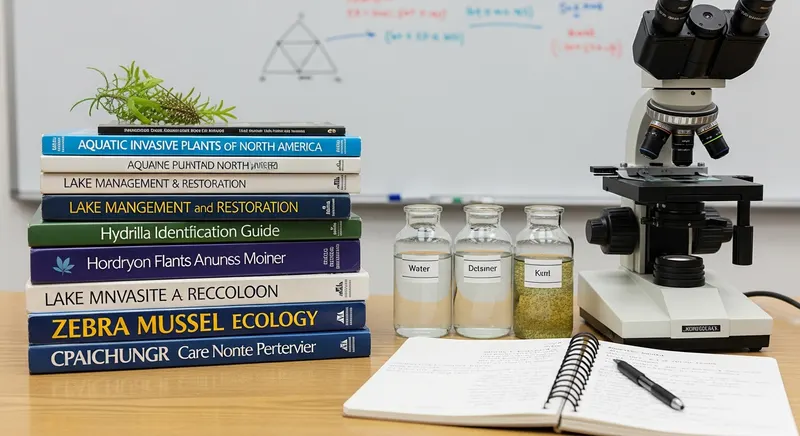
All content on AquaticWeed.org is grounded in the peer-reviewed literature and authoritative government and university sources listed on this page. When species biology, management efficacy, or ecological impact information is presented, it is derived from specific publications in these sources. Our research methodology page describes how we use these sources in the content development process.
Primary Peer-Reviewed Journals
The following journals publish the majority of the peer-reviewed aquatic plant science and management research cited on AquaticWeed.org:
Journal of Aquatic Plant Management
Published by the Aquatic Plant Management Society (APMS). The primary applied research journal for aquatic plant management in North America, covering herbicide efficacy trials, biological control programs, mechanical management, and integrated management case studies. Essential reading for practical management guidance. Available at apms.org/japm.
Aquatic Botany
An international journal covering the ecology, physiology, biology, taxonomy, and management of aquatic plants. Publishes fundamental research on macrophyte biology, competitive interactions, and responses to environmental stressors. Essential for understanding species biology and ecology.
Freshwater Biology
Covers all aspects of freshwater ecology, including aquatic macrophyte community dynamics, biodiversity effects of invasive plants, and the role of vegetation in freshwater food webs and nutrient cycling. Strong coverage of Great Lakes and temperate North American systems.
Hydrobiologia
International journal covering aquatic sciences broadly, with frequent publication of aquatic macrophyte research across a wide range of geographic contexts. Publishes special issues on invasive aquatic plants and lake restoration that are key references for our ecology content.
Lake and Reservoir Management
Published by the North American Lake Management Society (NALMS). Focuses specifically on applied lake management science, including vegetation management, water quality restoration, nutrient management, and monitoring programs. Direct applicability to real-world lake management decisions.
Invasive Plant Science and Management
Published by the Weed Science Society of America. Covers biology, ecology, management, and policy relating to invasive plant species — including aquatic invasives. Strong coverage of herbicide resistance, biological control, and integrated management programs.
Weed Technology
Covers herbicide science, weed management methods, and integrated pest management across terrestrial and aquatic systems. Key source for herbicide efficacy research, dose-response studies, and resistance monitoring.
Biological Invasions
Covers the introduction, spread, establishment, and management of invasive species across all taxa including invasive aquatic plants. Strong coverage of invasion mechanisms, propagule pressure, and the economic and ecological costs of biological invasions.
Ecological Applications
Publishes research on applications of ecological knowledge to management problems, including aquatic plant invasions, restoration ecology, and the ecological economics of management intervention.
Government Databases and Agency Resources
Federal and state agencies maintain the authoritative databases and regulatory information that form the factual foundation of distribution, legal status, and management guidance on AquaticWeed.org:
USDA PLANTS Database
The authoritative reference for plant taxonomy, native range, invasive status, and federal noxious weed designations for all species discussed on AquaticWeed.org. Plant names, native status, and federal designations on this site follow USDA PLANTS conventions.
USGS Nonindigenous Aquatic Species (NAS) Database
The national authoritative repository for distribution records of invasive aquatic species in the United States. Our distribution content and species range information are based on NAS occurrence data, which is continuously updated as new records are submitted from state agencies, researchers, and citizen scientists.
U.S. EPA Pesticide Registration Program
EPA registration documents, label requirements, and water use restrictions for all aquatic herbicides and algaecides referenced on AquaticWeed.org. Our chemical control content reflects current EPA registrations and label language.
U.S. Army Corps of Engineers — Aquatic Plant Control Research Program (APCRP)
APCRP Technical Notes and Research Documents are primary references for our control methods content. The program has produced decades of research on herbicide efficacy, mechanical control, biological control, and integrated management programs across a wide range of aquatic systems.
USDA APHIS Invasive Species Program
USDA APHIS administers the federal noxious weed list and regulates biological control agent approvals. Our legal status information and biological control content reflect current APHIS regulatory decisions.
University Programs and Extension Resources
University cooperative extension programs and research centers produce both the scientific research and the practical management guidance that directly informs on-the-ground management decisions. Key programs referenced on AquaticWeed.org:
- University of Florida IFAS — Center for Aquatic and Invasive Plants (CAIP): plants.ifas.ufl.edu — Species profiles, identification guides, and management publications. The Langeland & Burks aquatic plant identification manual is a foundational reference for our identification content.
- University of Wisconsin — Center for Limnology: limnology.wisc.edu — Foundational lake ecology research including aquatic plant community dynamics and the economics of lake management.
- University of Minnesota Extension: extension.umn.edu — Aquatic invasive species management guides for the Upper Midwest region, including Eurasian watermilfoil, curlyleaf pondweed, and hybrid watermilfoil.
- Cornell Cooperative Extension / NY Invasive Species Information: nyis.info — Identification, distribution, and management resources for Northeast invasive species including water chestnut, Eurasian watermilfoil, and Phragmites.
- Michigan State University Extension — Fisheries and Wildlife: canr.msu.edu/fisherieswildlife — Great Lakes region management guidance.
- Texas A&M AgriLife Extension — Aquatic Vegetation: Practical management resources for Texas and Gulf Coast aquatic weed problems including water hyacinth, hydrilla, and giant salvinia.
Key Books and Reports
- Langeland, K.A. and K.C. Burks (eds.). 1998. Identification and Biology of Non-Native Plants in Florida's Natural Areas. University of Florida IFAS Publication SP 257. Fundamental identification reference for southeastern species.
- Holm, L., J. Doll, E. Holm, J. Pancho, and J. Herberger. 1997. World Weeds: Natural Histories and Distribution. John Wiley & Sons. Comprehensive global coverage of major weed species including aquatic weeds.
- Madsen, J.D. 1998. Predicting invasion success of Eurasian watermilfoil. Journal of Aquatic Plant Management 36: 28–32. Foundational paper on milfoil invasion prediction.
- Schardt, J.D. and D.C. Schmitz (eds.). 1990. Proceedings of the 23rd Annual Meeting of the Aquatic Plant Control Research Program. U.S. Army Engineer Waterways Experiment Station.
- Cooke, G.D., E.B. Welch, S.A. Peterson, and S.A. Nichols. 2005. Restoration and Management of Lakes and Reservoirs. 3rd ed. CRC Press/Taylor & Francis. The comprehensive reference for lake restoration and management science.
- National Invasive Species Council (NISC). 2016. 2016–2018 National Invasive Species Management Plan. Washington, D.C. Current federal strategic framework for invasive species management.
Online Identification Tools
- iMapInvasives: imapinvasives.org — Citizen science mapping platform for invasive species occurrence records across North America.
- iNaturalist: inaturalist.org — Crowd-sourced species identification and occurrence mapping. Large aquatic plant species datasets available.
- GLEDN (Great Lakes Early Detection Network): Early detection reporting and verification for invasive species in the Great Lakes region.
Using These Sources in Your Own Research
Researchers, lake managers, and students who want to go beyond our summary content will find the sources above provide direct access to the primary literature. The Journal of Aquatic Plant Management back-issue archive at apms.org is an excellent starting point for applied management questions. For species biology, the Aquatic Botany journal database provides comprehensive mechanistic research. State extension publications — freely available from land-grant university extension websites — offer the most accessible, regionally specific practical guidance for management decision-making. For any species that is a Federal noxious weed, USDA APHIS Technical Notes provide authoritative baseline biology and management information at no cost.
For questions about specific citations or to suggest additional sources, contact us at [email protected]. See also our partners and resources page for additional institutional information.
Ten-Year Lake Management Plan: Lake Wingra, WI
Lake Wingra, a 342-acre urban lake in Madison, WI, developed a comprehensive 10-year management plan coordinating the City of Madison, University of Wisconsin, and adjacent neighborhood associations. The plan addressed Eurasian watermilfoil, curly-leaf pondweed, and purple loosestrife through an integrated approach including targeted herbicide treatment, mechanical harvesting, native plant restoration, and public education.
Key outcome: The structured multi-agency planning process secured consistent funding across multiple budget cycles, a key advantage over ad hoc management. Native plant restoration efforts showed measurable progress in designated restoration zones within three years of initiation.
The species identification guides on AquaticWeed.org are the most accurate I've used in 18 years of lake management. I now send all my new clients here first before we discuss treatment options.
Robert Harmon Certified Lake Manager, FL · Lake Okeechobee regionWe referenced the biological control pages extensively when evaluating our grass carp stocking proposal. The detail on stocking rates and target species specificity helped us present a credible case to our board.
Karen Ostrowski HOA Lake Committee Chair, MN · Lake Minnetonka association