Why Prevention Is the Highest-Value Aquatic Weed Management Strategy
Every management professional working in aquatic weed control will tell you the same thing: the most cost-effective management dollar is the one spent on prevention. Managing an established hydrilla or Eurasian watermilfoil infestation typically costs $50,000–$500,000 per year, every year, indefinitely — often for generations. Preventing a single introduction costs a few minutes of inspection time per boat launch. The return on investment from prevention programs is unmatched by any treatment approach, and the benefit of prevention is permanent rather than temporary.
The challenge is that prevention requires consistent behavior by every water user, every time — and the consequences of any lapse are irreversible. Once an invasive species establishes in a water body, eradication is extremely difficult, and management programs are typically permanent commitments measured in decades, not years. Understanding prevention as a management investment — not just a recreational courtesy — is the foundation of effective aquatic weed management programs.
When Prevention-Focused Programs Are Most Critical
Prevention programs are universally appropriate. But they are especially critical in these contexts:
- High-value water bodies currently free of invasive species. Pristine lakes and reservoirs with no established invasive species have everything to lose. Prevention programs — including watercraft inspections and educational outreach — are the primary tool for keeping them invasive-free indefinitely.
- Water bodies adjacent to heavily infested systems. Lakes and rivers downstream of or closely connected to heavily infested waters face persistent reintroduction pressure. Prevention efforts must be sustained indefinitely in these situations, not treated as a one-time program.
- High-traffic public boat launches. Public access points with high boat traffic volumes have the greatest introduction risk. Systematic inspection programs at these access points provide the highest return on prevention investment of any management action.
- Early detection response situations. Detection of a new introduction before it establishes a large population opens the eradication window — when rapid response can eliminate the population entirely. Rapid response programs acting within weeks of a new detection have documented eradication success rates far exceeding programs that respond only after populations become established.
The Clean, Drain, Dry Protocol
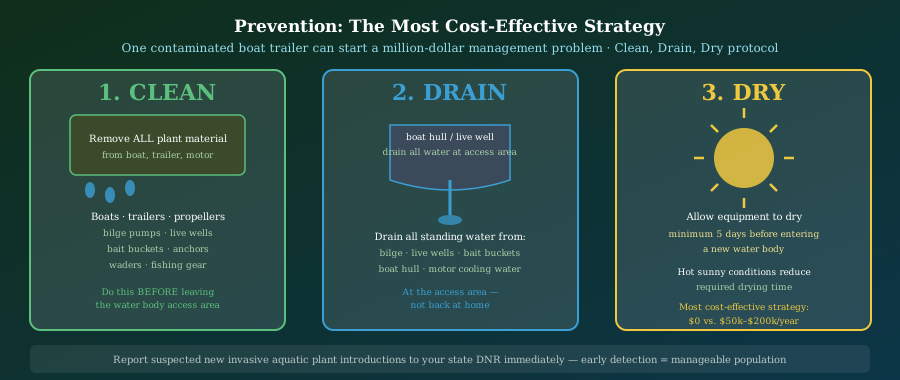
The Clean, Drain, Dry (CDD) protocol is the foundational personal action for preventing aquatic invasive species transport between water bodies. Every boater, kayaker, angler, and water user should follow this protocol every time they move equipment between water bodies:
- CLEAN: Remove all plant material, mud, and debris from all equipment that was in the water — boats, trailers, motors, waders, fishing gear, anchor lines, livewells, bilge areas, and any other equipment. Even small plant fragments and soil particles can harbor viable propagules. Check every surface, crevice, and compartment thoroughly before leaving the access area.
- DRAIN: Drain all water from the boat, motor, livewell, bait bucket, bilge, and any water-holding equipment before leaving the access area. Do not transport water from one water body to another in any container — drain all water on-site. Open all drain plugs and allow complete drainage.
- DRY: Allow all equipment to dry completely — ideally for 5 days or more — before entering a different water body. Drying destroys most aquatic plant fragments, algae, and invertebrates that survived the cleaning and draining steps. For equipment that cannot be dried completely, high-pressure washing with hot water (104°F / 40°C or higher) is effective. How plant fragments survive and spread →
Watercraft Inspection and Decontamination Programs
Voluntary CDD compliance rates are typically 40–70% among boaters even in areas with active educational outreach. Mandatory watercraft inspection programs at boat launches — staffed by trained inspectors or requiring permit-based self-inspection — significantly improve prevention effectiveness compared to voluntary programs alone. Key elements of effective programs:
- Trained inspectors: Inspectors who can identify common aquatic invasive plant fragments, recognize high-risk equipment configurations, and educate boaters on-site are far more effective than signage alone at achieving actual decontamination compliance.
- Decontamination infrastructure: Access to high-pressure hot water washing stations at or near boat launches enables decontamination of non-compliant watercraft before entry — turning awareness into action.
- Risk prioritization: Focus inspection intensity on boats arriving from heavily infested waters, boats with known multi-water-body travel histories, and boats that have not dried for at least 5 days since their last water body contact.
Advantages and Limitations
| Factor | Advantage | Limitation |
|---|---|---|
| Cost effectiveness | Minutes of inspection vs. decades of management cost — unmatched return on investment | Requires sustained compliance from all water users; a persistent human behavior challenge |
| Permanence | Prevents introductions permanently; avoids creating indefinite management obligations | Cannot remediate established infestations; must itself be maintained indefinitely |
| Community engagement | Empowers all water users as active participants in lake protection; builds stewardship culture | Requires ongoing outreach and education investment; compliance varies by community and access type |
| Early detection value | Regular monitoring catches new introductions before they become established infestations | Requires dedicated survey resources and trained observers to be effective |
Environmental Considerations
Prevention-focused management has essentially no negative environmental impact — it protects existing ecosystem integrity rather than modifying it. However, prevention programs should be designed with these considerations:
- Native species and natural transport. Not all plant fragments moving between water bodies are invasive — birds, water flow, and wildlife naturally disperse many species. Prevention programs focus on anthropogenic vectors (watercraft, equipment, intentional plantings) where human behavior change can make a measurable difference.
- Ecological context of early response. Rapid response to new introductions (manual removal, targeted small-scale treatment) must be designed to minimize disturbance to native species and substrate. Early-stage treatments — where the infestation is still small and localized — allow precision that is impossible in large-scale management programs.
- Pathway substitution risk. Aggressive inspection programs at primary boat launches can shift introduction pressure to less-inspected alternative access points. Comprehensive coverage of all significant access points, combined with angler outreach, is more effective than concentrated single-point programs that create pathway gaps. How invasive weeds spread →
Integration with Other Control Methods
Prevention is not a standalone strategy — it is the first component of a fully integrated management program:
- Prevention + early detection + rapid response: The most powerful prevention architecture. Prevention reduces introduction probability; monitoring detects any introductions that do occur; rapid response eliminates new populations before they establish. Eradication of an invasive species from a water body is achievable in this early window — it is not achievable later. Monitoring guide →
- Prevention + ongoing management: In water bodies already dealing with established invasives, prevention programs must continue to prevent reintroduction of species that have been suppressed and to prevent introduction of additional species not yet present. Each additional invasive species complicates management significantly.
- Prevention + public education: Angler outreach programs, dock and marina educational materials, and lake association communication channels are all components of effective prevention programs. The more water users who understand the ecological and economic stakes, the higher voluntary compliance rates will be. Management planning guide →
Frequently Asked Questions
Does the Clean Drain Dry protocol actually work?
Yes — CDD is one of the most evidence-supported prevention interventions available. Studies examining boats inspected at access points consistently find viable plant fragments and propagules on non-cleaned boats at rates high enough to establish new infestations. When boat inspections are combined with mandatory CDD completion before launch, the number of boats entering clean water bodies with viable fragments drops dramatically. The challenge is compliance — voluntary CDD rates are typically 40–70%, meaning 30–60% of boats in areas without inspection programs may be arriving non-compliant. Mandatory inspection programs at high-risk launches are significantly more effective than relying on voluntary compliance alone.
How do I report a potential new aquatic invasive species detection?
Most states have early detection reporting systems — typically through the state department of natural resources, environmental quality, or equivalent agency. Many have smartphone apps or online forms for reporting invasive species observations with photos and GPS coordinates. The key is to report quickly: early detection followed by rapid response has successfully eradicated new invasive species introductions from water bodies that would otherwise have become permanent management problems. If you are unsure of species identification, photograph the plant and submit to your state aquatic invasive species program or university extension service for identification. Time is critical — report the same day you make the discovery.
What aquarium and water garden plants are legal to own?
The legal status of aquatic plants for aquarium and water garden use varies significantly by state. Many common aquarium and water garden plants sold in pet stores and garden centers are listed invasive aquatic weeds — including hydrilla, water hyacinth, Brazilian waterweed, and various milfoil species. Some states have outright bans on possession, sale, and transport of listed invasive aquatic plants. Before purchasing any aquatic plant for an aquarium, pond, or water garden, check your state invasive species list. Never release aquarium or pond plants into any natural water body under any circumstances — this is a primary vector for new invasive plant introductions nationally.
References
- Rothlisberger, J.D., et al. (2010). Aquatic invasive species transport via trailered boats: what is being moved, who is moving it, and what can be done? Fisheries, 35(3), 121–132.
- Anderson, L.G., et al. (2015). The personal and social context of planning for boat decontamination. Biological Invasions, 17, 2867–2882.
- Leung, B., et al. (2002). An ounce of prevention or a pound of cure: bioeconomic risk analysis of invasive species. Proceedings of the Royal Society B, 269, 2407–2413.
- Simberloff, D., et al. (2013). Impacts of biological invasions: what's what and the way forward. Trends in Ecology and Evolution, 28(1), 58–66.
- U.S. Fish and Wildlife Service. (2012). Aquatic Invasive Species: Preventing Their Spread. USFWS Publication.
Relevant Species
This control approach is applied to the following aquatic weed species. See each species profile for species-specific guidance, herbicide rates, and optimal treatment timing:
Regulatory Notice: Most aquatic weed control activities require permits from your state's department of natural resources or environmental protection agency. Always verify permit requirements before taking any management action.