Identification Features
Giant salvinia (Salvinia molesta) is among the most distinctive — and most dangerous — floating aquatic invasive plants in the world. It is a fern, not a flowering plant. The identification features are unique: paired oval, bright green leaves (each 1–4 cm when young, up to 15 cm in dense mats) float at the surface; they have a distinctive eggbeater-shaped surface — each leaf is covered with rows of cage-like hairs made of four prongs that join at the tips, resembling miniature egg-beaters under magnification. This eggbeater hair structure is diagnostic and unique to Salvinia molesta among plants found in North America.
A third modified leaf hangs below each node as a submerged, root-like structure (actually a modified leaf, not a true root) that provides some anchoring function and nutrient absorption. In the earliest growth stage, leaves are flat and spread on the water surface. In the most mature, high-density stage, leaves fold upward along the midrib into a "chain" configuration, allowing plants to pack extremely densely. This chain configuration, combined with the eggbeater hairs, is immediately diagnostic for giant salvinia at high density.
| Growth Stage | Appearance |
|---|---|
| Primary (sparse) | Flat leaves, 1–2 cm, spread on water surface |
| Secondary (crowded) | Slightly folded, 2–5 cm, beginning to pack together |
| Tertiary (dense mat) | Strongly folded "chain" configuration, 5–15 cm, mat thickness up to 30 cm |
Biology and Growth
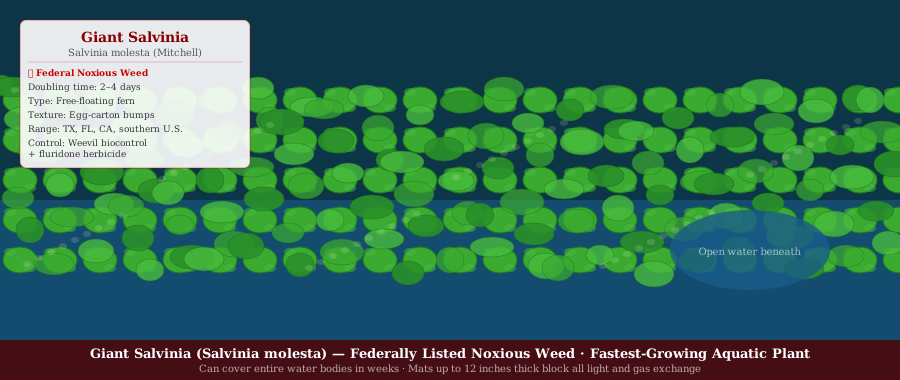
Giant salvinia holds the record for fastest biomass doubling time among all problematic aquatic weeds: under optimal conditions (warm water, high nutrients, full sun), biomass can double every 2–4 days. A single plant can generate a colony covering a hectare in three months. The species is triploid and sterile — it cannot produce spores or reproduce sexually. All reproduction is vegetative through stem fragmentation: every node with a leaf pair is capable of growing into a new plant. This sterility also means that the biological control weevil (Cyrtobagous salviniae) specifically targets it without affecting native ferns that can reproduce sexually.
The eggbeater hairs are not merely diagnostic — they are functional. They create a superhydrophobic (water-repelling) surface that traps a layer of air against the leaf, maintaining buoyancy even when physically submerged by wave action. This makes giant salvinia resistant to submersion by flooding or turbulence that would sink other floating plants.
Ecological Impacts and Legal Status
Giant salvinia is a federally listed noxious weed in the United States under the Federal Noxious Weed Act. Interstate transport, sale, and possession are prohibited. It is listed on the USDA Federal Noxious Weed List and is federally prohibited across all 50 states. State listings add additional penalties and permit requirements.
Dense salvinia mats — which can reach 30 cm or more in thickness — completely eliminate light to the water beneath, causing rapid fish kills, oxygen depletion, and collapse of native subaquatic plant communities. The mats also impede boat traffic, block irrigation intakes, and create ideal mosquito breeding habitat. In the southeastern U.S., infestations have been severe enough to devastate commercial fisheries, disable irrigation systems, and require emergency state and federal management responses.
Distribution
Giant salvinia is established in Texas, Louisiana, Florida, Georgia, South Carolina, North Carolina, Mississippi, Alabama, Hawaii, and California. It is native to southeastern Brazil and was spread globally through the aquarium trade. It requires frost-free conditions for year-round establishment but can survive mild frosts as dormant material. Southeast distribution →
Control
An integrated approach combining biological control and chemical treatment is most effective for salvinia management. Cyrtobagous salviniae, a weevil from Brazil, is USDA-approved and available through some state programs — it provides effective long-term suppression over 2–3 years of establishment in warm-climate states. Herbicides including diquat, penoxsulam, florpyrauxifen-benzyl (ProcellaCOR), and topramezone are effective for rapid biomass reduction. All use requires state aquatic herbicide permits. Report new infestations to your state aquatic invasive species program immediately. Control methods →
Frequently Asked Questions
Is giant salvinia the same as common salvinia?
No. Common salvinia (Salvinia minima) is also an invasive species in the southeastern U.S. but is smaller and less aggressive than giant salvinia (S. molesta). The easiest visual distinction is the hair structure: S. molesta has the distinctive joined eggbeater hairs; S. minima has individual hair prongs that do not join at the tips. Both species are listed as federally noxious weeds. If you encounter any salvinia in a natural water body, report it to your state invasive species program regardless of species.
Does giant salvinia turn brown and die in winter?
Giant salvinia dies back in response to frost — freezing temperatures kill floating material. However, it can persist in sheltered microhabitats (near warm-water discharges, in deep mats that insulate bottom layers), and plant fragments may survive as dormant material in mild winters. In Texas, Louisiana, and Florida, year-round populations persist. In states with cold winters, the species may be killed back annually but reestablishes from surviving material or new introductions in warm seasons. The frost sensitivity is a natural constraint that limits its range compared to what it would be in a warmer world.