Identification Features
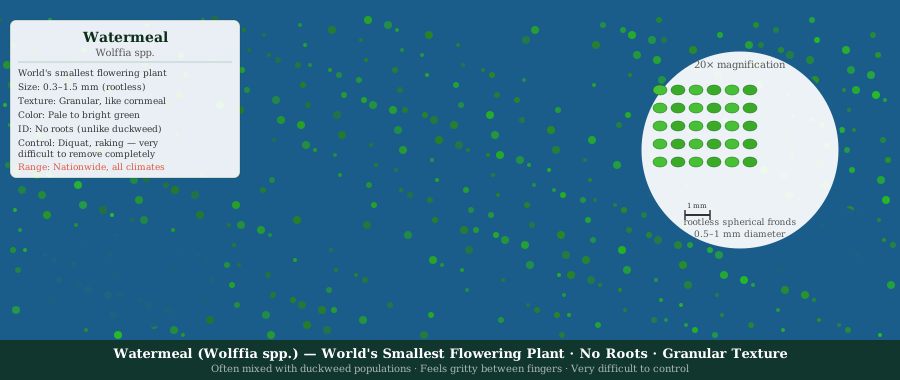
Watermeal (Wolffia spp.) holds the distinction of being the world's smallest flowering plant. Individual plants (technically fronds, not leaves) are spherical to oblong, 0.3–1.5 mm in diameter — smaller than a grain of rice — rootless, and floating just at the water surface. Mats of watermeal have a distinctive texture often described as finely grained, granular, or like floating cornmeal or green sand. Up close, the individual fronds resemble tiny green peas or spheres.
The most important identification distinction: watermeal lacks roots entirely, while duckweed has one root per frond. This is easiest to confirm by scooping a sample into a clear container with water and observing whether any root filaments hang below the fronds. The smaller frond size (< 1.5 mm vs. 1.5–5 mm for Lemna minor) is the field-observable character. Two species commonly encountered in the U.S. are Wolffia columbiana (slightly larger, 0.7–1.5 mm) and W. brasiliensis (smaller, 0.3–0.9 mm). Species-level identification requires microscopic examination and is usually not necessary for management decisions.
Biology and Growth
Watermeal grows by vegetative division — the same process as duckweed — and achieves extremely rapid population growth under warm, nutrient-rich conditions. Doubling times of 2–3 days have been documented under optimal conditions, faster than duckweed. Like duckweed, watermeal is a native plant with legitimate ecological roles in small numbers, but can become a nuisance when nutrient loading enables exponential growth to complete coverage.
Because watermeal has no roots and is extremely small, it is more resistant to wind disturbance than larger floating plants and more difficult to physically remove — fine-mesh nets capture some fronds but many pass through or cling to the container and drip back into the water. Watermeal also lacks the aerenchyma tissue and structural specializations of water hyacinth or salvinia; its buoyancy is maintained simply by the surface tension of water and its small mass.
Overwintering in cold climates occurs through the formation of dense, starch-filled fronds that sink to the sediment and remain dormant until spring temperatures rise. These dormant fronds (analogous to turions in other aquatic plants) can survive several years and reestablish populations after the apparent disappearance of surface growth.
Ecological Impacts
Dense watermeal mats cause the same cascade of ecological impacts as duckweed — light exclusion, oxygen depletion, disruption of gas exchange — but are generally more difficult to manage because of their smaller frond size and resistance to physical removal. Mixed infestations of watermeal and duckweed are very common and can be particularly severe. In heavily eutrophic ponds, watermeal mats can completely obscure the water surface from late spring through fall.
The granular texture of watermeal mats is often mistaken for algae by pond owners, leading to inappropriate management responses. Correctly identifying watermeal (vs. algae) is important because herbicide registrations differ — products effective against algae may not be labeled for aquatic vascular plants and vice versa. Identification guide →
Distribution and Habitat
Watermeal species are found throughout the eastern United States and across much of the South and Midwest. They are most abundant in sheltered, nutrient-rich ponds, slow-moving ditches, and lake bays with minimal wind exposure. Consistent with their lack of roots, they cannot persist in even moderate current. They are absent from high-elevation, oligotrophic, or consistently wind-disturbed water bodies.
Control
Watermeal management follows the same integrated approach as duckweed: address nutrient loading first, then use physical removal and targeted chemical treatment. Fluridone, diquat, and copper sulfate (for algae-watermeal mixed mats) are sometimes used with state permits. Grass carp and some tilapia species consume watermeal but efficacy varies. See control methods hub →
Frequently Asked Questions
Is watermeal native to North America?
Yes, all Wolffia species found in the U.S. are native to North America. Like duckweed, watermeal is a native plant that becomes a nuisance when anthropogenic nutrient loading drives population densities well above natural levels. This native status means that management is generally focused on nutrient control and physical/chemical suppression rather than eradication — the goal is to restore natural, low-density conditions, not to eliminate the species from the ecosystem.
Why is my pond covered in green 'sand' that I can't remove with a net?
The granular, sandy appearance is characteristic of dense watermeal coverage. The fronds are too small for most standard nets — they pass through the mesh or stick to the wet net and drip back into the water. Fine-mesh fabric (cheesecloth, fine-mesh strainer) can physically capture some biomass, but complete physical removal is effectively impossible for large infestations. Focus on the underlying cause: nutrient reduction, increased water movement, and potential chemical treatment are more effective for large-scale watermeal management.
Does watermeal flower?
Yes — Wolffia species are the world's smallest flowering plants. The flowers are microscopically small, visible only with magnification. They appear as tiny structures at the surface of the frond. Flowering and seed production are rarely observed in dense field populations, but do occur. The seeds can persist in sediment and contribute to population reestablishment after management. This seed bank persistence makes addressing the nutrient source (rather than just removing current plants) essential for long-term management.