Overview
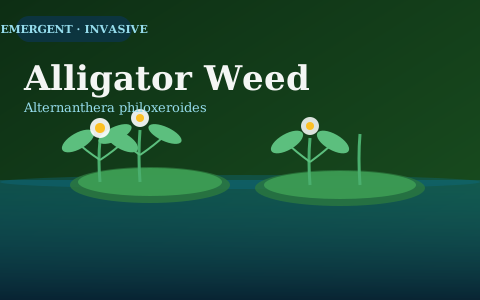
Alligator weed is an invasive semi-aquatic plant native to South America that is federally listed as a noxious weed in the United States. It grows in dense mats along shorelines and in shallow water, spreading from the bank onto the water surface and forming impenetrable stands that choke waterways, impede drainage, damage crops, and provide ideal mosquito breeding habitat. Its remarkable amphibious nature — thriving as both an aquatic and terrestrial plant — makes it one of the most challenging aquatic weeds to manage.
Identification Characteristics
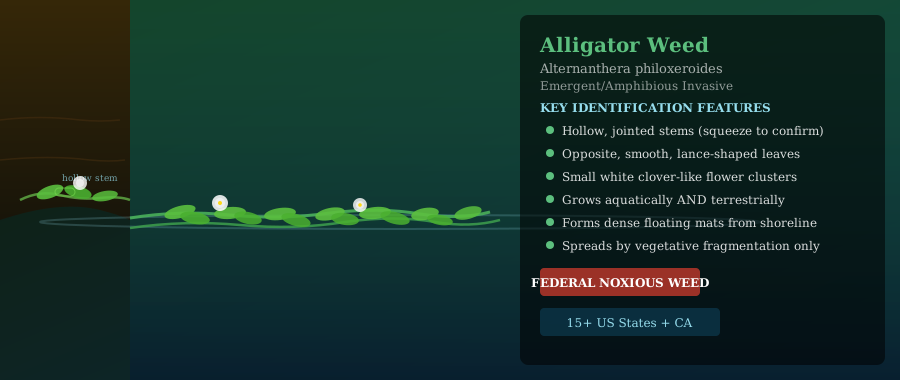
Alligator weed is recognized by several distinctive features. Its opposite, smooth, lance-shaped leaves are 2–4 inches long, arranged on hollow, jointed stems. The hollow stems are the most diagnostic identification feature — when squeezed between the fingers, you can feel that the stem is hollow. This hollow stem characteristic is unique among common aquatic weeds in the Southeast and is an immediate identification confirmation.
Small, white, clover-like flowers are produced in rounded clusters (capitula) on short stalks. The flower clusters are about 1 cm in diameter and resemble miniature clover flowers. The plant forms dense, tangled mats along shorelines and across the water surface, with stems that root at nodes when floating on water.
The amphibious nature creates two distinct growth forms: in water, the plant forms floating mats with hollow-stemmed branches extending across the water surface; on land, it grows more upright with a somewhat more compact form. Both forms share the distinctive hollow stems and opposite leaf arrangement. The plant can reach 1–3 feet in height in terrestrial form.
Growth Habit & Ecology
Alligator weed reproduces almost entirely through vegetative means in the United States — seeds are rarely produced in North America, and even when produced, they are generally not viable. This means every alligator weed plant is a clone or fragment from an existing plant. Remarkably, even small stem fragments can root and establish new plants, making fragmentation during flood events, mechanical removal, or boat traffic a significant spread mechanism.
The plant colonizes by extending floating mats from the bank over the water surface. These mats are buoyed by the hollow stems and can extend 30 feet or more from the shore. Where mats eventually reach the bank or substrate on the other side of a waterway, plants root and establish new terrestrial populations. Flooding events that detach mat fragments are a primary natural spread pathway.
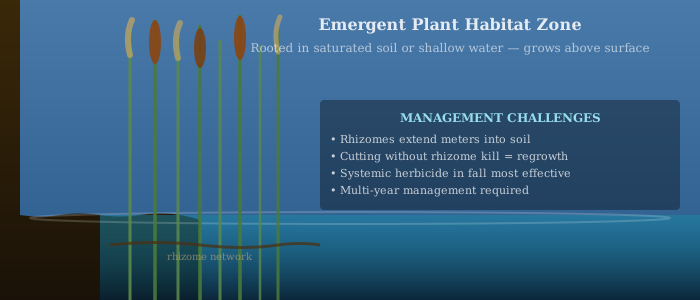
Its amphibious nature is ecologically unusual and practically significant. Most aquatic weed management tools — herbicides registered for aquatic use — may not reach or be legally applied to terrestrial populations, and herbicides registered for terrestrial use cannot be applied in or near water. Management must address both growth forms simultaneously, complicating control efforts considerably.
Habitat Preferences
Alligator weed is one of the most habitat-versatile aquatic weeds, capable of thriving in both fully aquatic and terrestrial environments. In the United States, it is most abundant in the Gulf South — Florida, Louisiana, Texas, Mississippi, Alabama, Georgia, and South Carolina — where warm year-round temperatures enable continuous active growth. It has also established significant populations in California and scattered locations in other southeastern states.
In aquatic habitats, alligator weed forms dense floating mats in shallow lakes, bayous, slow rivers, irrigation canals, drainage ditches, and rice paddies. The floating mat growth form is particularly effective at spreading across open water, with hollow-stemmed branches extending laterally across the surface. In terrestrial habitats, it colonizes moist soils along banks, roadsides, and field margins, growing as an upright to sprawling plant.
Temperature is the primary limiting factor: alligator weed requires warm growing-season temperatures (optimal 77–95°F) and is frost-sensitive. Sustained freezing kills aerial stems and significantly reduces the root crown. This temperature sensitivity explains why alligator weed is a far more severe problem in the Gulf South than in the Southeast interior, and why biological control efforts are less effective in California — the biocontrol flea beetle requires warmer winters to maintain populations. In California, alligator weed inhabits the Sacramento Valley and Central Coast regions, where mild winters permit its persistence.
Spread Mechanisms
Alligator weed spreads almost exclusively through vegetative fragmentation — its primary and most significant spread mechanism. The hollow, jointed stems break apart easily under physical stress, and each fragment can root at nodes and establish a new plant. Fragments are remarkably viable and resistant to drying; stem sections can remain viable for days to weeks out of water, allowing dispersal on equipment, vehicles, and livestock that contact infested areas.
Flooding is the most important natural long-distance spread vector. High-water events detach mat sections and carry them downstream through connected waterways and drainage systems, seeding new colonies. The Gulf South's network of interconnected bayous, canals, and coastal marshes provides extensive flooding corridors. Storm events that lift and relocate mats to adjacent agricultural fields or roadsides have contributed significantly to terrestrial spread.
Agricultural and water management equipment — dredges, mowers, tractors working in or near infested waterways — cuts plants into fragments and distributes them across the work area. Livestock that wade through infested water carry fragments on their hooves. Boats in infested waterways carry stem sections on propellers and hulls.
Alligator weed does not spread effectively by seed in the United States; the species rarely produces viable seed in North America. This means that prevention focuses on preventing fragment dispersal through equipment decontamination, hygiene protocols around flood events, and early detection in new areas.
Seasonal Growth Pattern
Alligator weed's seasonal growth pattern varies significantly by climate. In frost-free regions of the Gulf South (coastal Florida, Louisiana, southern Texas), alligator weed grows continuously year-round, maintaining dense mat cover throughout winter. There is no natural seasonal control — management must continue year-round in these areas.
In regions with occasional frost (inland Gulf South, northern Florida, Georgia piedmont), aerial stems die back when temperatures drop below freezing, but root crowns in the sediment and soil survive. Resprout occurs rapidly in spring as temperatures rise above 50°F. The plant's recovery from light frost is vigorous — even a heavily frosted stand can resume aggressive growth within weeks.
In areas with more severe winters (California interior, upper Southeast), winter die-back is more complete, but established root systems typically survive and resprout each spring. The growing season extends from approximately March–April through October–November.
Summer peak growth (June–September) represents the period of most aggressive mat expansion. Aquatic mats can double their coverage area rapidly in warm, calm water, and terrestrial growth can advance at visible rates along moist roadsides. This is the period when unmanaged infestations cause the most severe drainage obstruction, mosquito breeding enhancement, and competitive displacement of native vegetation.
For management planning, summer peak growth defines the treatment urgency window. Both chemical and biological control should be initiated in spring and early summer — before the population reaches its full summer peak — to avoid managing the largest, most established mats. Biological control with the alligator weed flea beetle (Agasicles hygrophila) is most effective when established before summer growth peaks, as the beetle needs time to build population densities sufficient to cause visible defoliation before the plant's most active growth period.
Ecological Impact
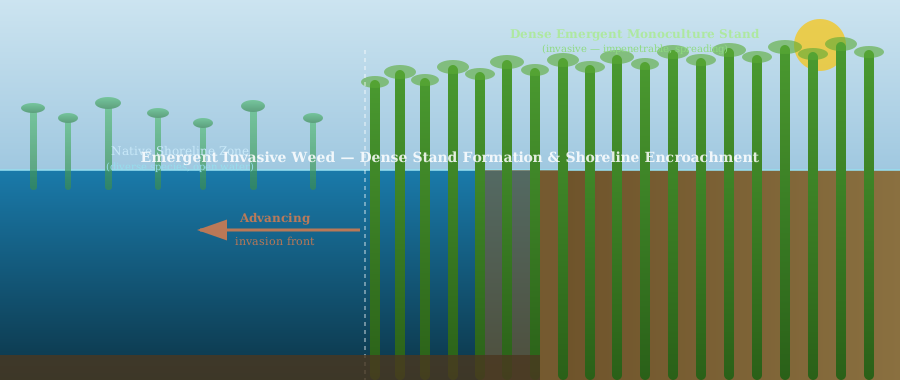
Alligator weed's impact extends across aquatic, riparian, and agricultural systems. Dense aquatic mats impede water flow in drainage channels and irrigation ditches, contributing to flooding in low-lying agricultural areas. In the Deep South, alligator weed infestations in drainage canals have caused significant flooding damage to agricultural lands.
The mats shade out native aquatic and riparian vegetation, reducing plant diversity and the habitat quality for native wildlife. Shallow, stagnant water trapped under alligator weed mats is ideal mosquito breeding habitat, with public health implications in regions where mosquito-borne diseases are concerns.
In agricultural settings, alligator weed can invade flooded rice fields and other water-intensive crops. It competes directly with crops and can clog irrigation systems. In the livestock industry, it is unpalatable to most livestock. The combination of agricultural, ecological, and public health impacts led to the plant's designation as a Federal Noxious Weed and prompted one of the earliest and most extensive biological control programs in U.S. history.
Control Methods
Alligator weed has been the subject of one of the most successful biological control programs in U.S. history. Three biological control agents from South America were introduced beginning in 1964: the flea beetle (Agasicles hygrophila), thrips (Amynothrips andersoni), and stem borer moth (Arcola malloi). The flea beetle has been particularly successful in the Deep South — subtropical and tropical climates where it thrives — and has significantly reduced alligator weed densities in the Gulf States.
Biological control is least effective in cooler climates (California, Pacific Northwest) where flea beetle populations cannot overwinter. In these regions, greater reliance is placed on herbicide and mechanical management.
Herbicide control with 2,4-D, imazapyr, or imazamox can effectively control alligator weed but must address both aquatic and terrestrial growth forms. Two separate treatments may be needed — one using an aquatically-registered product for floating mats, and one using a terrestrially-registered product for bank populations.
Mechanical control by cutting or mowing provides temporary relief but can spread fragments and stimulate regrowth. Where mechanical control is used, fragments must be carefully removed and composted.
Important: Always obtain required permits before applying any aquatic herbicide or introducing biological control agents. Requirements vary by state. Contact your state department of natural resources or environmental protection agency for guidance.
Distribution in the United States
Alligator weed is established throughout the Gulf Coast and Southeastern states, with core populations in Florida, Georgia, Alabama, Mississippi, Louisiana, Texas, South Carolina, and North Carolina. It has significant populations in California's Sacramento Valley and Delta — where biological control is less effective and management costs are high.
The plant was first recorded in the United States in the early 20th century in Virginia, likely arriving in ship ballast water. Subsequent introductions occurred along the Gulf Coast, and the plant spread through waterways and agricultural channels. It is present in at least 15 states. Successful biological control by the flea beetle has substantially reduced alligator weed in the Deep South, where infestations that once covered thousands of miles of waterways now require less intensive management. California populations have not responded as well to biological control and remain a management challenge.
Frequently Asked Questions
Can alligator weed grow on land as well as in water?
Yes — this amphibious nature is one of alligator weed's most distinctive and problematic characteristics. It grows as a floating aquatic mat in water and as an upright terrestrial plant on moist banks and agricultural land. Management must address both growth forms, since aquatic herbicides cannot be used on terrestrial populations and terrestrial products cannot be used in water.
Why is alligator weed so difficult to control in California?
In the U.S. Southeast, the biological control flea beetle (Agasicles hygrophila) thrives in warm, subtropical climates and provides significant long-term control. In California, cooler temperatures limit flea beetle populations, making biological control much less effective. California populations require more intensive herbicide and mechanical management, which is more costly and less sustainable.
How did alligator weed get its name?
The common name 'alligator weed' likely refers to the plant's association with alligator habitat in the southeastern United States — both alligators and alligator weed favor the warm, slow-moving waterways of the Gulf South. The dense floating mats of alligator weed are also characteristic of the swampy, marshy habitats favored by American alligators.
References & Further Reading
- Center, T.D. & Spencer, N.R. (1981). The phenology and growth of water hyacinth (Eichhornia crassipes) in a eutrophic north-central Florida lake. Aquatic Botany 10:1–32.
- Buckingham, G.R. (1996). Biological control of alligatorweed, Alternanthera philoxeroides, the world's first aquatic weed success story. Castanea 61:232–243.
- USDA APHIS (2022). Federal Noxious Weed Program: Alternanthera philoxeroides Factsheet. Animal and Plant Health Inspection Service.