Identification Features
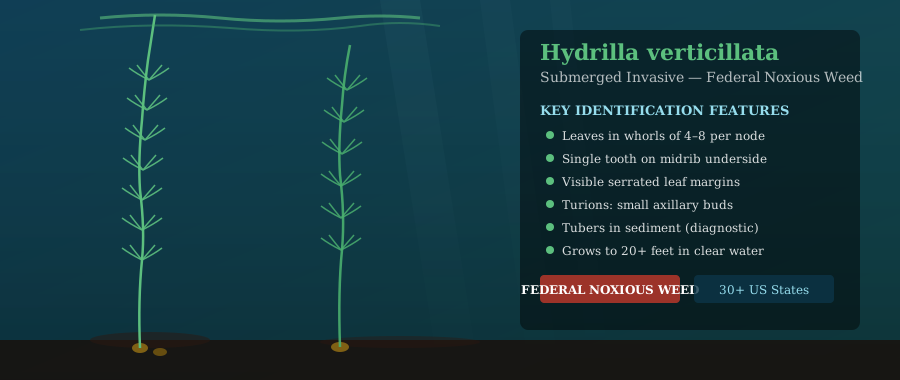
Hydrilla (Hydrilla verticillata) is the most notorious submerged aquatic weed in the United States, and its identification is critical because it closely resembles several native plants that must not be treated. The four diagnostic features that together confirm hydrilla: (1) whorled leaves, typically 5 per node (range 4–8); (2) distinctly serrated (saw-toothed) leaf margins, visible to the naked eye on mature specimens; (3) small white potato-like tubers in the sediment at the plant base; (4) tiny axillary turions (bead-like dormancy buds) at leaf nodes in late season. No other common North American submerged plant has all four features.
The critical comparison is with native elodea (Elodea canadensis): elodea has consistently 3 leaves per whorl with smooth margins; hydrilla has 4–8 leaves per whorl with serrated margins. Never apply aquatic herbicide to a suspected hydrilla population without confirming this leaf count and margin character. See weeds vs. native plants →
| Feature | Hydrilla | Native Elodea (for comparison) |
|---|---|---|
| Leaves/whorl | 4–8 (usually 5) ★ | 3 |
| Leaf margin | Distinctly serrated ★ | Smooth |
| Tubers in sediment | Present ★ | Absent |
| Legal status | Federal noxious weed | Native, ecologically valuable |
Biology and Reproduction
Hydrilla reproduces through four distinct mechanisms, which is the primary reason it is so difficult to eradicate: (1) vegetative stem fragmentation — every node is a potential new plant; boat propellers are a major fragmentation and dispersal vector; (2) sediment tubers — small, starchy, white tubers at the plant base can survive in anoxic sediment for over 7 years, regenerating after control ceases; (3) axillary turions — dormancy buds that detach and drift to new areas; (4) seed production (mainly in the dioecious biotype). The tuber bank is the primary reason why hydrilla is considered effectively impossible to eradicate from a large water body once fully established — even after killing all aboveground growth, the tuber bank regenerates the population. Turion and tuber biology →
Hydrilla is uniquely adapted for low-light environments, able to photosynthesize at light levels as low as 1% of surface irradiance (compared to 5–10% for most other submerged plants). This allows it to colonize deeper zones and to survive under dense weed mat canopies — it effectively out-competes native submerged plants even in conditions unfavorable for most submerged vegetation.
Ecological Impacts
Hydrilla forms dense canopies at the water surface that eliminate light to native plants below, reducing native plant diversity from 15–30 species to near-monoculture hydrilla. Fish spawning habitat is disrupted. Boat propellers are damaged and recreational use is severely impaired. In lakes managed for bass fishing, dense hydrilla growth can temporarily improve largemouth bass fisheries (bass use thick vegetation as ambush habitat) but then crashes the fishery when oxygen depletion occurs. The balance of costs vs. temporary bass fishing benefits consistently favors management in all documented case studies. Full ecological impact overview →
Distribution
Hydrilla is established in over 30 U.S. states, including throughout Florida, the Gulf Coast states, Mid-Atlantic, Northeast, and parts of the Pacific Coast. Two biotypes occur: the dioecious biotype (southeastern U.S. + Pacific Coast) and the monoecious biotype (northeastern U.S., Pacific Northwest). Southeast distribution | Northeast distribution
Control
Effective hydrilla management requires multi-year programs that address both growing plants and the tuber bank. Primary tools: fluridone (systemic, season-long application — most effective for whole-lake treatment); endothall (fast-acting contact treatment); diquat (fast-acting for spot treatments); ProcellaCOR (florpyrauxifen-benzyl — highly effective, newer option). Biological control via triploid grass carp provides ongoing suppression with state permit. All chemical treatment requires state aquatic herbicide permit. Report new infestations immediately. Control methods →
Frequently Asked Questions
Is there any water body where hydrilla has been eradicated?
Yes, eradication has been achieved in a limited number of cases — primarily small, isolated water bodies where the infestation was detected early and treated aggressively before a large tuber bank established. California has achieved eradication from some irrigation canals through rapid herbicide response. Some northeastern states have eradicated isolated lake infestations detected in early stages. The critical window for eradication is during the first 1–2 years of infestation, before the tuber bank builds to the point where sustained multi-year tuber regeneration overwhelms control. After 3+ years of establishment in a large lake, eradication shifts from feasible to effectively impossible.
Why does hydrilla keep coming back after treatment?
Hydrilla returns after treatment primarily because the sediment tuber bank is not eliminated by herbicide treatments that kill aboveground growth. Tubers are protected from herbicides by the anoxic sediment environment. When aboveground control is successful, tubers germinate and regenerate the population. Effective hydrilla management requires multi-year treatment programs designed to deplete the tuber bank gradually — each year of treatment prevents tuber formation while existing tubers germinate and are killed. The USDA estimates that depleting a hydrilla tuber bank to management levels requires 3–7 years of sustained management.
Full Species Authority Page: For the complete hydrilla identification guide, detailed biology, distribution maps, control program design, and FAQ, visit the Hydrilla authority page →