Winter Survival: The Biology of Aquatic Weed Dormancy
The ability of aquatic weeds to survive winter conditions and regenerate each spring is one of the most critical aspects of their biology for management purposes. The mechanisms by which different species survive winter are diverse — from complete metabolic shutdown in sediment-buried propagules, to reduced-rate active growth under ice, to survival of root and rhizome systems while above-ground tissue dies. Each survival mechanism requires a different management response, and failing to account for overwintering biology leads to management programs that appear successful in summer but see full population recovery the following spring.
Dormancy via Sediment Propagules: Turions and Tubers
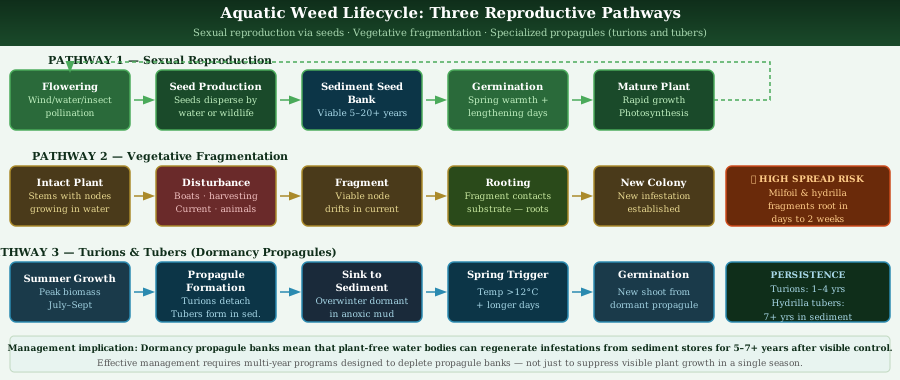
The most ecologically significant overwintering mechanism for management purposes is the accumulation of dormant propagules (turions and tubers) in the sediment. Unlike above-ground plant tissue, which is killed by winter cold, these structures survive overwinter in a metabolically reduced state and germinate the following spring, regenerating the population from the bottom up. Full turion and tuber guide →
Key overwintering propagule characteristics:
- Metabolic suppression: During dormancy, carbohydrate catabolism is reduced to the minimum required to maintain cellular integrity and avoid membrane damage from cold-induced phase transitions. This minimal metabolic activity allows propagules to survive for months (turions) to years (hydrilla tubers) without photosynthesis or nutrient uptake.
- Temperature and photoperiod sensing: Dormancy is broken not by a single threshold but by an integration of warming temperature (typically above 10–12°C for hydrilla turions), increasing photoperiod, and changes in the CO₂/O₂ ratio at the sediment surface as microbial activity changes with temperature. This multi-factor dormancy break prevents premature germination during brief warm spells in late winter.
- Depth protection: Propagules deposited at the lake bottom are insulated from the coldest near-surface temperatures by the overlying water column. Lake bottom temperatures rarely fall below 3–4°C even when surface water freezes, providing a thermal refuge that maintains propagule viability through even severe winters.
Rhizome and Root Crown Dormancy in Emergent Species
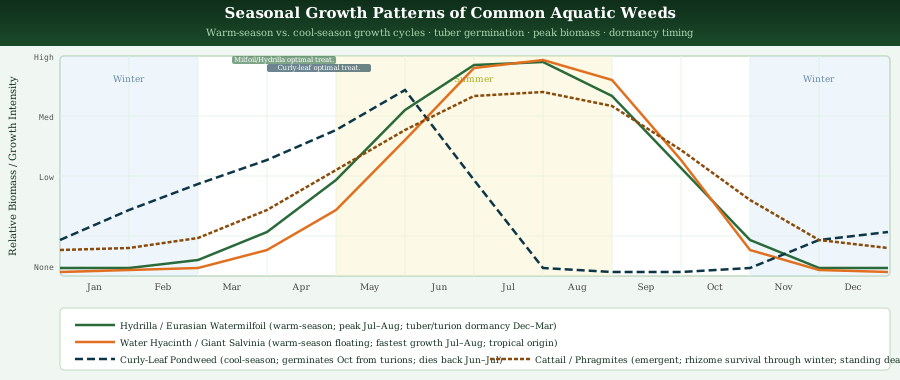
Emergent aquatic weeds — cattails (Typha spp.), Phragmites australis, alligator weed (in warm regions) — survive winter primarily through extensive underground rhizome and root crown systems. Above-ground stems die back in autumn (producing the characteristic standing-dead stems visible in winter wetlands), but the rhizome system remains alive in the sediment, insulated by the overlying soil. Rhizome carbohydrate reserves accumulated during the growing season fuel the following spring's rapid resprouting.
The management implication is direct and consistently underestimated: cutting or burning emergent weed stands does not kill the plant. Phragmites and cattail stands that are cut at ground level in autumn will produce dense, vigorous regrowth the following spring from the undisturbed rhizome system. Effective long-term control requires either systemic herbicide treatment (applied to living foliage and translocated to the rhizome), or combinations of cutting and herbicide that prevent rhizome recharge before winter. Emergent weed herbicide strategies →
Reduced Metabolic Activity in Perennial Submerged Species
Perennial submerged species that persist as minimal vegetative tissue through winter (some Potamogeton species, coontail) maintain a low level of metabolic activity throughout winter in the sediment or near the lake bottom. Growth essentially stops, but the plant does not die. In spring, warming triggers rapid resumption of growth from the surviving vegetative tissue. This survival strategy does not involve specialized dormancy structures — it relies on the temperature stability of deep water (which rarely freezes at the lake bottom) and the cold tolerance of basal stem and root tissue. Management implications: winter drawdown that exposes and freezes the lake bottom can be effective against these species, but must achieve frost penetration to the depth of the surviving tissue.
Cool-Season Growth: An Inverse Dormancy Strategy
Curly-leaf pondweed (Potamogeton crispus) has evolved an inverse growth strategy: it germinates in autumn from turion-like propagules, grows actively during winter (including under ice in northern states), and achieves maximum biomass in April–May — the period when all its warm-season competitors are still dormant or just emerging. After reaching peak biomass in spring, curly-leaf pondweed undergoes its own summer die-back as water temperatures exceed its thermal optimum of approximately 22°C. This counter-seasonal strategy means that curly-leaf pondweed is maximally susceptible to management in early spring (the optimal treatment window) rather than midsummer. Curly-leaf pondweed management →
Winter Management: The Underused Opportunity
The dormancy period represents both the lowest management impact season and a missed management opportunity in many programs. Activities that can only be effectively deployed in winter:
- Winter drawdown: Lowering water levels in reservoirs with water level infrastructure to expose shallow rooted vegetation and tubers to freezing temperatures. Most effective at latitudes where sustained freezing temperatures below -10°C occur and persist for weeks; less effective in the South where frost rarely penetrates the sediment to tuber depth. Management planning for drawdown →
- Baseline surveys: Winter is the optimal time to map infestation boundaries and prepare permit applications for the following growing season, when plants are absent or minimal and lake bottom features are more visible. Survey methods →
- Early spring treatment windows: Curly-leaf pondweed must be treated in early spring before die-back; planning and permitting for these treatments must be completed during the prior winter.
Frequently Asked Questions
If aquatic weeds die in winter, why do they come back every year?
Most aquatic weeds come back each year from one of three sources: dormancy structures in the sediment (tubers, turions) that survive winter and regenerate the population in spring; perennial root systems (rhizomes, root crowns) that survive in the sediment and resprout; or re-introduction from connected water bodies or waterfowl transport. The visible die-back of above-ground tissue in winter is often misleading — for species like hydrilla and milfoil, the plant's reproductive capacity is stored in the sediment, fully intact and ready to regenerate. This is why annual treatments during the growing season alone cannot 'cure' a water body of established invasive weeds; multi-year programs targeting propagule bank depletion are required.
Does cold weather help control aquatic weeds?
Cold weather suppresses growth but does not eliminate most established invasive species. Winter cold is directly lethal to propagules only when water body drawdown exposes root zones and turions to sustained freezing temperatures — a situation requiring either reservoir water level control infrastructure or natural drying conditions. For most natural lakes without drawdown capability, winter cold reduces but does not eliminate the propagule bank in the sediment. In northern states, severe winters can reduce turion viability somewhat and provide modest management benefit. In the southern U.S., winter temperatures are rarely cold enough to kill tubers at sediment depth, providing essentially no frost benefit for hydrilla management.
References
- Spencer, D.F., et al. (2000). Seasonal growth of Egeria densa Planch. in relation to dissolved inorganic carbon and the management of aquatic weeds. Aquatic Botany, 68(3), 267–278.
- Magnuson, J.J., et al. (2000). Historical trends in lake and river ice cover in the Northern Hemisphere. Science, 289, 1743–1746.
- Gettys, L.A., et al. (2014). Biology and Control of Aquatic Plants: A Best Management Practices Handbook, 3rd ed. Aquatic Ecosystem Restoration Foundation.
- Cooke, G.D., et al. (2005). Restoration and Management of Lakes and Reservoirs, 3rd ed. Taylor & Francis, Boca Raton, FL.