Overview: National Distribution Patterns
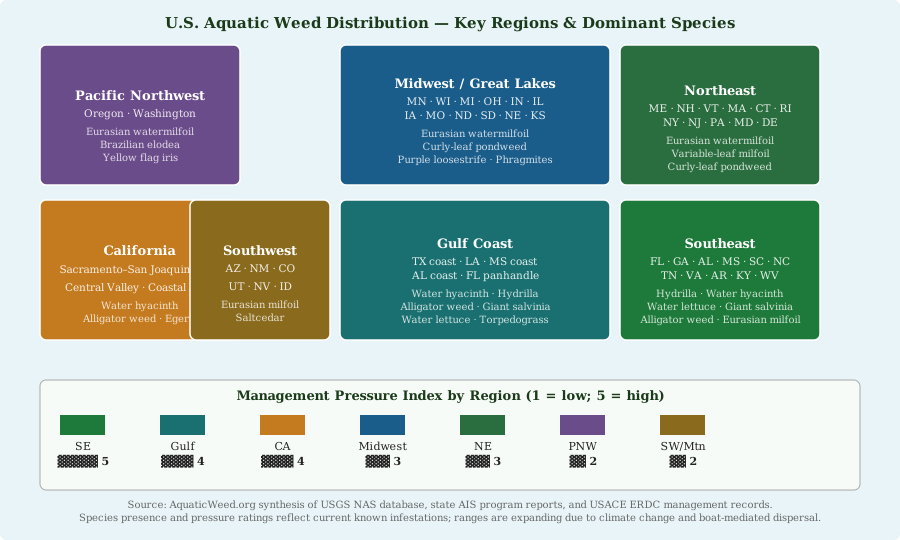
Invasive aquatic plant distribution in the United States is shaped by several overlapping factors: climate (particularly winter temperatures that limit warm-water invasive species), introduction history (where species were first introduced and from where they spread), water body connectivity (how readily species can move between water bodies through natural and human pathways), and management intensity (aggressive management programs in some regions have prevented the spread documented in others).
Several broad national patterns are significant:
- Hydrilla is established in more than 30 U.S. states and territories, with the most severe infestations in Florida, Georgia, Texas, and the mid-Atlantic states. It is generally absent from the northern Great Plains and mountain west but continues to expand its range northward.
- Eurasian watermilfoil is established in all contiguous U.S. states — truly a national problem. It reaches nuisance densities in thousands of lakes across the Northeast, Midwest, Pacific Northwest, and Mid-Atlantic.
- Curly-leaf pondweed is distributed across most of the northern tier of states and is particularly severe in Minnesota, Wisconsin, Michigan, and other Great Lakes states.
- Water hyacinth is primarily a warm-climate problem, most severe in Florida, Texas, Louisiana, and California's Sacramento-San Joaquin Delta. Populations cannot overwinter in states with hard freezes.
- Giant salvinia is established in the Gulf South (Louisiana, Texas, Florida, Georgia) and spreading. It is federally listed as a noxious weed.
- Invasive Phragmites is established in virtually every state, with the most severe coastal wetland impacts in the Northeast, Great Lakes, and Mid-Atlantic regions.
The aggregate picture is one of national vulnerability to aquatic invasive plants, with regional variation in severity and species mix rather than any region being free of significant management challenges.
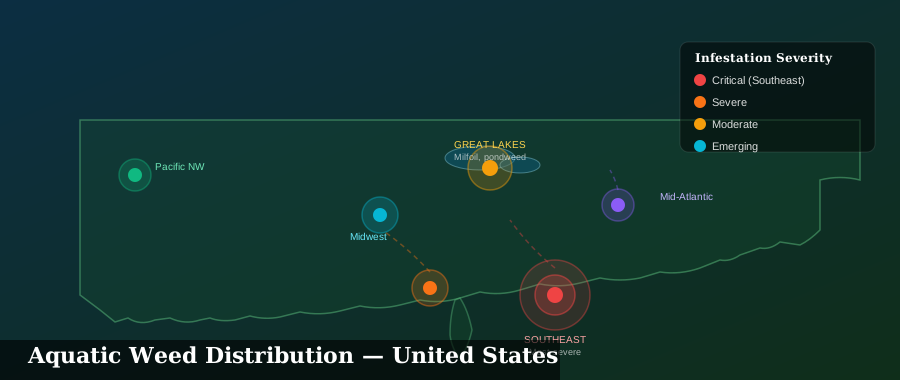
The Southeast: Most Severe Infestation Zone
Florida, Georgia, Alabama, North Carolina, South Carolina, Virginia, and surrounding southeastern states collectively represent the most severe aquatic weed management challenge in the United States. Several factors combine to create this regional intensity:
- Climate: Florida's subtropical to tropical climate means that warm-water invasive species like water hyacinth, hydrilla, water lettuce, and torpedo grass can grow year-round with minimal cold-temperature limitation. Even in northern Florida, winter temperatures rarely limit aquatic plant growth for more than brief periods.
- Water body diversity: The Southeast has an extraordinary diversity of water body types — blackwater rivers, spring-fed lakes, eutrophic coastal plain lakes, agricultural drainage canals, and phosphate mine reclamation ponds — each providing habitat for different invasive species.
- Introduction history: Florida has been the entry point for many aquatic invasive species — both through the aquarium and ornamental plant trades (a major industry in South Florida) and through port activity. The Florida Legislature has been funding aquatic plant management since 1947 — longer than any other state.
Florida spends approximately $30–40 million annually managing aquatic plants in public waters through the Florida Fish and Wildlife Conservation Commission (FWC). Despite this substantial investment, hydrilla, water hyacinth, water lettuce, and Eurasian watermilfoil remain significant management challenges across the state. Southeast regional guide →
The Gulf Coast
Texas, Louisiana, Mississippi, and Alabama share the Gulf Coast's subtropical climate and warm, nutrient-rich waterways. Water hyacinth is particularly severe across the region, with significant infestations in the Texas Gulf Coast waterways, Louisiana's Atchafalaya Basin, and Mobile Delta. Alligator weed, established from ship ballast water introductions in the mid-20th century, is widespread across all Gulf Coast states. Hydrilla is a major problem in Texas and Louisiana lakes and reservoirs. Giant salvinia has established in Texas and Louisiana and is actively spreading.
The Gulf Coast's extensive system of navigable waterways, agricultural drainage canals, and rice production areas creates extensive habitat for aquatic weeds and multiple pathways for spread between water bodies. Management programs in Texas are administered by the Texas Parks and Wildlife Department; Louisiana's program is managed through the Louisiana Department of Wildlife and Fisheries. Gulf Coast regional guide →
The Great Lakes and Midwest
The Great Lakes basin — including Minnesota, Wisconsin, Michigan, Illinois, Indiana, Ohio, New York, and Ontario — faces a distinctive suite of aquatic invasive plant challenges shaped by cool-climate conditions, intense recreational boating pressure, and the massive shared water body of the Great Lakes themselves.
Eurasian watermilfoil is the dominant submerged invasive weed across the region, established in thousands of lakes in Minnesota, Wisconsin, and Michigan alone. Curly-leaf pondweed — a cool-season species that thrives in the region's water temperature regime — is a major management challenge in Minnesota and Wisconsin. Purple loosestrife, while not exclusively aquatic, has invaded wetlands throughout the region and is subject to active management with biological control.
Invasive Phragmites has had a dramatic impact on Great Lakes coastal wetlands, replacing diverse native emergent plant communities across significant portions of the Lake Erie, Lake Michigan, and Lake Huron coastlines. Research has documented 37% fewer bird species and dramatically reduced waterfowl densities in Phragmites-dominated coastal wetlands compared to native-dominated habitats. Minnesota alone has invested $50+ million in aquatic invasive species management over two decades, with watermilfoil as the primary target. Great Lakes and Midwest regional guide →
The Northeast and Mid-Atlantic
New England and the Mid-Atlantic states (Maine through Virginia) face significant aquatic weed challenges in their thousands of recreational lakes, the Chesapeake Bay watershed, and coastal wetlands. Eurasian watermilfoil is the dominant submerged invasive weed, established in major recreational lakes in every northeastern state. Variable-leaf watermilfoil (Myriophyllum heterophyllum), native to some parts of the South but invasive in the Northeast, adds complexity to identification and management in the region.
The Chesapeake Bay watershed has been subject to extensive research on submerged aquatic vegetation — both invasive species that degrade SAV communities and efforts to restore native SAV (particularly eelgrass and native pondweeds) as bay water quality improvements allow. Northeast regional guide →
Pacific Coast: California and the Pacific Northwest
California's unique combination of warm Central Valley climate, extensive water delivery infrastructure (the largest system in the world), and diverse Mediterranean and semi-arid landscapes creates a distinctive aquatic weed management context. The Sacramento-San Joaquin Delta is one of the most heavily managed water hyacinth infestations in the world — the Department of Water Resources has managed hydrilla, water hyacinth, water primrose, and Egeria densa in the Delta for decades.
The Pacific Northwest — Oregon and Washington — faces significant management challenges from Eurasian watermilfoil in lakes and rivers, Brazilian elodea (Egeria densa) in the Columbia River system, and yellow flag iris in coastal wetlands. The region's reliance on salmon and steelhead fisheries gives aquatic plant management a cultural and economic dimension beyond recreation alone. California regional guide → | Pacific Northwest regional guide →
How Aquatic Weeds Spread: National Vectors
Understanding how aquatic weeds move across the landscape is essential for prevention programs. The primary national spread vectors are:
- Recreational boating: By far the dominant spread vector for submerged aquatic weeds. Plant fragments attached to boat hulls, propellers, trailers, bilge pumps, and live wells are transported when boats move between water bodies. The recreational boating network connects thousands of water bodies across every state, providing an efficient distribution pathway for invasive plants.
- Commercial water garden and aquarium trades: Several invasive species were introduced through the ornamental trade — water hyacinth, Egeria densa, cabomba, salvinia, and others are all sold legally or illegally as pond plants or aquarium plants. Some states have banned the sale of specific invasive species; others have not.
- Waterfowl: Migratory waterfowl carry plant fragments, seeds, and turions on their feathers and in their digestive systems along flyways, providing natural dispersal between isolated water bodies.
- Water body connections: Flood events, irrigation canals, drainage ditches, and interbasin water transfers can move aquatic plant material between water bodies that are not directly accessible by boat.
The most effective national-scale prevention strategy is consistent application of Clean, Drain, Dry protocols by all recreational water users. State inspection programs at boat access points, mandatory drain-down requirements, and education campaigns have all been shown to reduce the frequency of contaminated boat travel between water bodies. Prevention best practices →
Regional Distribution Guides
- → Southeast — Most severe national infestation zone; year-round warm-climate species; Florida at the epicenter
- → Gulf Coast — Water hyacinth, alligator weed, giant salvinia; subtropical waterways
- → California — Sacramento-San Joaquin Delta; water delivery infrastructure; diverse species
- → Pacific Northwest — Eurasian watermilfoil, Egeria densa; Columbia River system
- → Great Lakes and Midwest — Milfoil, curly-leaf pondweed, Phragmites; thousands of recreational lakes
- → Northeast and Mid-Atlantic — Milfoil dominant; Chesapeake Bay watershed; coastal wetland Phragmites
- → Major Invasive Aquatic Weeds by State — State-by-state reference to dominant problem species
Frequently Asked Questions
Which state has the worst aquatic weed problem in the U.S.?
Florida is generally considered to have the most severe and diverse aquatic weed management challenge in the United States. Year-round warm temperatures allow tropical and subtropical invasive species to grow continuously; the state has a large number of interconnected water bodies; the aquarium and water garden trades (major industries in South Florida) have introduced multiple invasive species; and the sheer size of the management program — $30–40 million annually through FWC — reflects the scale of the challenge. However, states like Texas, Louisiana, California, Minnesota, and Wisconsin also have severe regional challenges that are significant by any measure.
Is hydrilla present in my state?
Hydrilla has been documented in over 30 U.S. states and territories, including all southeastern states, most Atlantic coastal states, Texas, California, Oregon, Washington, and many interior states. It is generally absent from the northern Great Plains and mountain west states. The most comprehensive and current distribution data is maintained by the USDA PLANTS Database and state departments of natural resources. Many states maintain early detection networks and report new hydrilla finds publicly. If you suspect hydrilla in a new location, report it to your state DNR immediately — early detection is critical to prevent establishment.
Are aquatic weeds spreading to new states?
Yes. Most major invasive aquatic plants are still expanding their U.S. range. Giant salvinia is spreading northward from Texas and Louisiana. Hydrilla continues to establish in new water bodies and new states. Eurasian watermilfoil has expanded its known range in several states in recent years. Climate warming is expected to enable warm-water species to establish in northern states where cold winters previously prevented establishment. Early detection programs in states at the leading edge of invasive species' ranges are critical for catching new introductions before they establish and spread.
What resources are available for reporting invasive aquatic plants?
Most states have dedicated invasive species reporting portals through their department of natural resources or department of agriculture websites. The federal iMapInvasives database and the USGS Nonindigenous Aquatic Species (NAS) database (nas.er.usgs.gov) accept public reports and provide current distribution maps for all invasive aquatic plants. The iNaturalist app with the "Invasive Species" project enables GPS-tagged photo submissions. For confirmed invasive species that require rapid management response, direct contact with the state DNR is always the most effective path to triggering action.
How are invasive aquatic plants tracked nationally?
The primary national database for invasive aquatic species distribution is the USGS Nonindigenous Aquatic Species (NAS) database, which collects occurrence records from state agencies, universities, federal programs, and public reports. The USDA PLANTS database provides additional range information. State agencies typically maintain their own distribution records and share data with federal databases. University monitoring programs, volunteer early detection networks (particularly for lakes), and mandatory dealer reporting programs in some states contribute additional data. Distribution maps are frequently updated as new records are added.
References and Further Reading
- USGS Nonindigenous Aquatic Species Database. (2024). Invasive Species Occurrence Database. U.S. Geological Survey, Gainesville, FL. nas.er.usgs.gov
- Thayer, D.D., et al. (2008). "Aquatic Plant Management in Florida: A History." Journal of Aquatic Plant Management, 46, 13–22.
- Minnesota DNR. (2023). Aquatic Invasive Species Program Report. Minnesota Department of Natural Resources, St. Paul.
- Galatowitsch, S.M., et al. (1999). "Invasiveness in wetland plants in temperate North America." Wetlands, 19(4), 733–755.
- Mehrhoff, L.A. (1996). "Reintroducing the native Phragmites to the New England landscape." Phragmites australis: A Shared Challenge. Symposium Proceedings.
- Center, T.D., et al. (1999). "The Imperative for Biological Control of Invasive Non-Indigenous Plants in the United States." Biological Control, 16, 3–16.