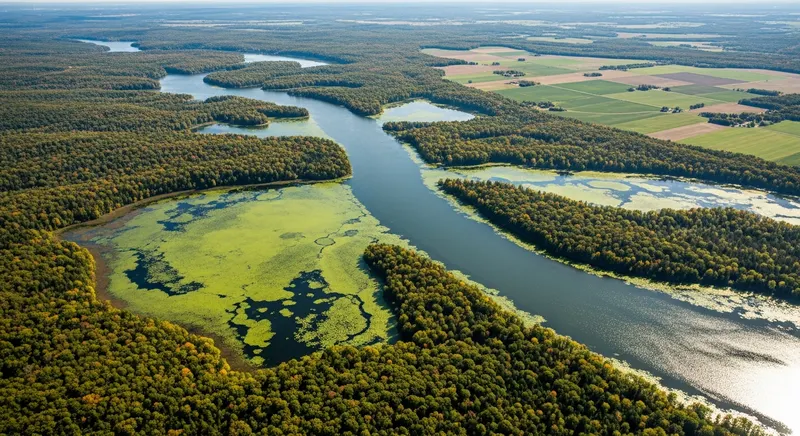
The Great Lakes and Agricultural Heartland
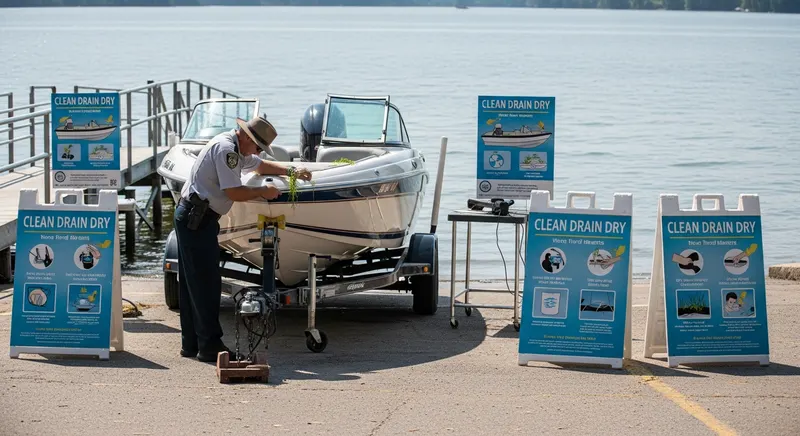
The Midwest — the Great Lakes states (Minnesota, Wisconsin, Michigan, Ohio, Indiana, Illinois) plus Iowa, Kansas, Nebraska, and Missouri — faces a mix of invasive aquatic plant challenges driven by its unique combination of the world's largest freshwater lake system, thousands of glacially formed inland lakes, highly productive agricultural landscapes with significant nutrient runoff, and intense recreational boating activity.
Eurasian Watermilfoil: The Dominant Recreational Lake Problem
Eurasian watermilfoil is present in approximately 1,000 Minnesota lakes, 400+ Wisconsin lakes, and hundreds of Michigan lakes — making it the primary aquatic weed management challenge for recreational lake managers across the Midwest. The scale of the problem drives a significant lake management industry: lake associations, professional aquatic plant management companies, state grant programs, and university research programs all focused on milfoil in this region.
Wisconsin, Minnesota, and Michigan all have well-funded aquatic plant management programs with lake-specific management grants, technical assistance, and research partnerships with universities (University of Wisconsin, University of Minnesota, Michigan State University). The Wisconsin DNR's lake management program is frequently cited as a model for other states. Eurasian milfoil profile →
Curly-Leaf Pondweed
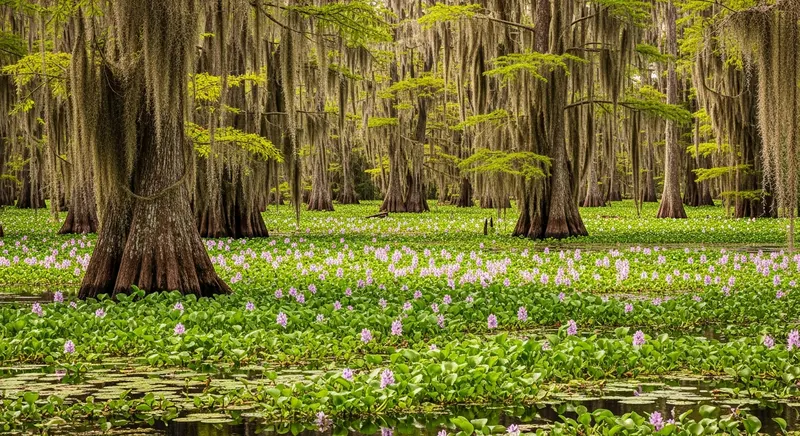
Curly-leaf pondweed is widespread throughout Midwestern lakes and is often co-infested with Eurasian milfoil. Its cool-season growth pattern creates spring management challenges, with dense mats impeding early-season boating and fishing. The late-spring die-off of curly-leaf pondweed releases nutrients that fuel summer cyanobacterial blooms — a well-documented cause of blue-green algae problems in Midwestern lakes. Curly-leaf pondweed profile →
Invasive Phragmites in Great Lakes Coastal Wetlands
Invasive Phragmites has dramatically altered the Great Lakes coastal wetland landscape over the past 50 years. Satellite studies have documented the replacement of diverse native coastal wetlands with Phragmites monocultures across large areas of Lakes Erie, Ontario, Michigan, and Huron. The Great Lakes coastal wetlands are critical habitat for multiple rare and declining species, and Phragmites invasion is one of the primary drivers of their degradation. Multi-million-dollar Great Lakes restoration programs include Phragmites management as a major component. Phragmites profile →
Agricultural Runoff: The Root Driver
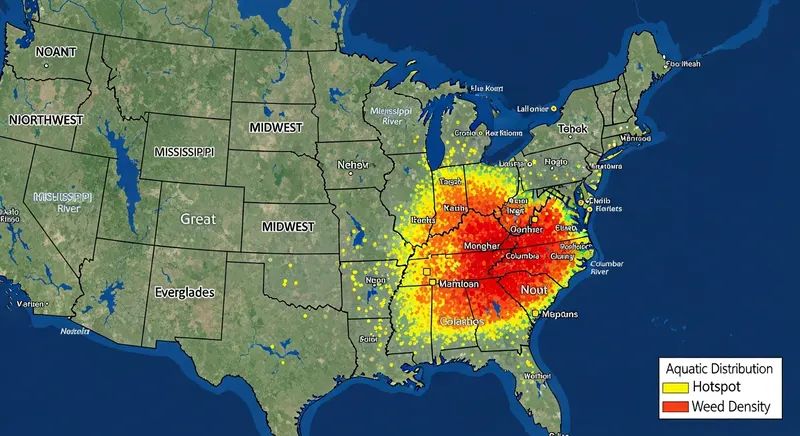
The Midwest's aquatic weed problems are inseparable from its agricultural land use context. The Corn Belt states (Iowa, Illinois, Indiana, Ohio) contribute among the highest per-acre phosphorus and nitrogen loads to surface water nationally, primarily from row crop fertilizers, tile drainage, and livestock feedlot runoff. These nutrient loads fuel not only the Gulf of Mexico dead zone via the Mississippi River but also the eutrophication of Midwest lakes and reservoirs that drives nuisance plant growth. Management programs that focus only on plant control without addressing underlying nutrient loading achieve only temporary suppression — the nutrient-enriched conditions that sustain invasive species remain unchanged. Nutrient loading and eutrophication →
The Great Lakes as Vectors
The Great Lakes system serves as both a recipient of aquatic invasive species and a distribution hub for their spread into tributary water bodies throughout the Midwest. Eurasian watermilfoil was first documented in the Great Lakes basin in the 1950s and has since spread to tens of thousands of lakes throughout the region via boat traffic. Curly-leaf pondweed, common reed (Phragmites australis), and flowering rush (Butomus umbellatus) have similarly used the Great Lakes and their tributary systems as invasion corridors. The Great Lakes Commission coordinates invasive species programs across eight states and two Canadian provinces. Distribution overview →
Frequently Asked Questions
How does Wisconsin manage milfoil in so many lakes?
Wisconsin's approach relies on a combination of: state-funded lake management grants that reimburse lake associations for approved management activities; mandatory watercraft inspection at certain boat launches; an active lake monitoring volunteer network (the Wisconsin Lake Leaders program); and university research partnerships that advance management practices. The system works because it combines regulatory tools (noxious weed regulations, permit requirements), financial incentives (grants), technical assistance (state aquatic plant management specialists), and community engagement (lake associations). Other states have modeled similar programs on Wisconsin's framework.
Climate Influence on Midwest Aquatic Weed Growth
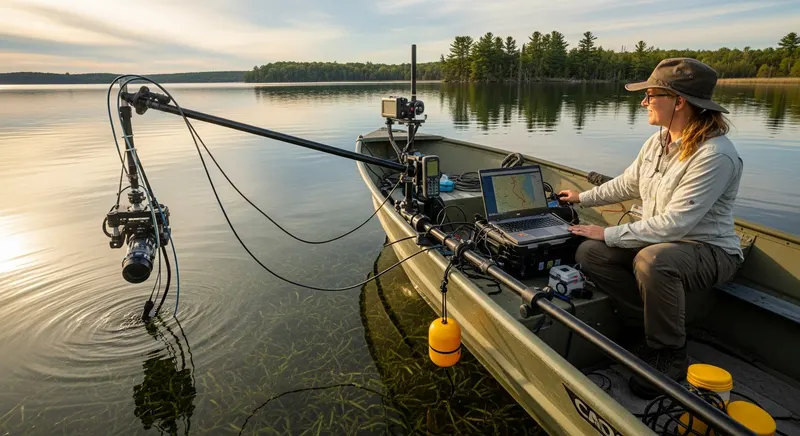
The Midwest's continental climate creates sharply defined growing seasons that structure the entire aquatic weed management calendar. In Minnesota and Wisconsin, lake ice-out occurs from mid-April (southern lakes) to late May (northern lakes), and water temperatures reach 20°C by late June. The warm growing season is compressed into June–September — roughly 90–110 days of peak aquatic weed growth. This short but intense season means management programs must be precisely timed to catch target species in the optimal treatment window.
Cold winters are a natural management tool: air temperatures regularly reaching -20 to -30°C kill above-ground biomass completely, reducing vegetative carryover. However, overwintering propagules — hydrilla tubers, milfoil root crowns, curly-leaf pondweed turions — survive in the sediment and water column, resetting the infestation each spring. The cold winters thus reduce management effectiveness of mechanical methods but do not eliminate established invasive populations with robust propagule banks.
The Great Lakes create a unique microclimate zone: lake-effect precipitation moderates air temperatures along the shorelines of Lakes Michigan, Superior, Erie, and Ontario, extending the growing season and reducing the frequency of damaging late spring frosts. Great Lakes tributary streams carry fragments from upstream infestations into the lakes themselves, making invasive plant management in Great Lakes nearshore areas particularly challenging.
Management Timing in the Midwest
| Species | Optimal Treatment | Key Timing Note |
|---|---|---|
| Eurasian watermilfoil | May–mid-June | Critical window before canopy formation; systemic herbicides most effective |
| Curly-leaf pondweed | Apr–early May | MN: permit applications must be submitted Feb–Mar for spring treatment |
| Phragmites | Aug–Sept | Pre-frost foliar imazapyr or glyphosate; mowing in early summer as pre-treatment |
| Purple loosestrife | Jun–Aug | Galerucella biocontrol beetles widely deployed; herbicide for large infestations |
State-Level Variation in the Midwest
Minnesota has approximately 2,500 lakes with documented invasive aquatic plant infestations, the most of any state north of the Sun Belt. The Minnesota DNR coordinates a comprehensive lake management program through its Invasive Species Program, including intensive lakeshore inspection stations and decontamination requirements for all watercraft. Minnesota has successfully managed several early-detected hydrilla infestations before establishment.
Wisconsin operates one of the most citizen-science-driven lake management programs in the nation through the Wisconsin Lakes program, with over 1,000 trained volunteer lake monitors conducting annual weed surveys. Lake management plans are required for most chemical treatment permits in Wisconsin.
Michigan focuses heavily on Great Lakes nearshore management, with particular concern about invasive species spreading from inland lakes into the Great Lakes themselves via tributaries. The Michigan DEQ has aggressive early detection protocols for new invasive species sightings in Great Lakes connecting waters.
Ohio, Indiana, and Illinois face significant Phragmites management issues in Lake Erie wetlands and Great Lakes coastal marshes, as well as milfoil and curly-leaf pondweed in inland lakes and reservoirs.
Key Species and Management Links
- Eurasian watermilfoil — the Midwest's dominant invasive
- Curly-leaf pondweed — cool-season management timing
- Phragmites management in Great Lakes wetlands
- Minnesota and Wisconsin lake management planning
- Galerucella biocontrol for purple loosestrife
Ten-Year Lake Management Plan: Lake Wingra, WI
Lake Wingra, a 342-acre urban lake in Madison, WI, developed a comprehensive 10-year management plan coordinating the City of Madison, University of Wisconsin, and adjacent neighborhood associations. The plan addressed Eurasian watermilfoil, curly-leaf pondweed, and purple loosestrife through an integrated approach including targeted herbicide treatment, mechanical harvesting, native plant restoration, and public education.
Key outcome: The structured multi-agency planning process secured consistent funding across multiple budget cycles, a key advantage over ad hoc management. Native plant restoration efforts showed measurable progress in designated restoration zones within three years of initiation.
The ecological impact section helped our team explain to county commissioners why early intervention matters. The oxygen depletion data alone secured funding for our early-detection monitoring program.
Donna Whitfield State Wildlife Biologist, GA · Okefenokee regionWe used the integrated management framework from this site to structure our Eurasian watermilfoil control program. After three seasons we've reduced lake-wide coverage by 78% on our 340-acre water body.
Susan Thibodeau Lake District Manager, MN · Crow Wing County