Why Accurate Identification Is Non-Negotiable
Before any management action is taken, the target species must be correctly identified. This is not merely good practice — in many states, it is legally required before any herbicide treatment or biological control introduction. Beyond regulatory requirements, the practical stakes are high:
- Different species require different treatments: The herbicide effective against hydrilla may be ineffective against Eurasian watermilfoil, and vice versa. Applying the wrong product wastes money and may promote resistance.
- Native plants must not be treated: Many beneficial native aquatic plants closely resemble invasive species. Treating native aquatic vegetation can cause fish kills, destroy wildlife habitat, trigger algal blooms, and violate state environmental protection statutes.
- Early detection requires accurate ID: Many states have early detection programs for invasive species. Reporting a suspected invasive species requires accurate identification to trigger the appropriate management response.
- Management timing depends on biology: Herbicide treatments are most effective at specific growth stages that vary by species. Knowing the species tells you the optimal treatment window.
The goal of this hub is to give lake managers, property owners, biologists, and recreationists the tools to identify aquatic plants with confidence. For borderline cases, consulting your state's department of natural resources or university extension service is always the right decision before any management action.
The Five-Step Identification Process
Reliable aquatic plant identification follows a systematic process. Work through these steps in order, gathering observations at each stage before proceeding to species-specific guides.
Step 1: Determine Growth Position
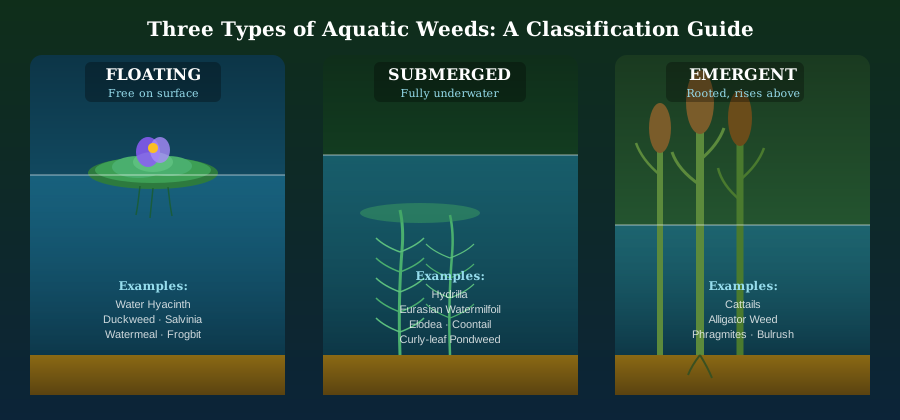
The first and most important question is where the plant grows relative to the water surface. This immediately narrows your identification to one of three categories:
- Floating: Plant drifts on or just below the surface with leaves and/or roots visible above or below the waterline. Roots hang freely in the water column (water hyacinth, duckweed) or are absent entirely (duckweed, coontail in some conditions, watermeal).
- Submerged: Plant grows entirely beneath the water surface, anchored to the sediment by roots or free-floating. Stems may reach the surface but leaves remain underwater. Pulling up a stem reveals the full plant structure.
- Emergent: Plant is rooted below the waterline but extends stems and leaves above the surface. Found in shoreline margins and shallow water. Leaves above water are typical; some species may also have floating leaves.
Some species span categories — water hyacinth is primarily floating but can root in shallow sediment; alligator weed grows emergent, floating, or terrestrially. See: Floating vs. Submerged vs. Emergent →
Step 2: Examine Leaf Structure
Leaf shape, arrangement, size, texture, and margin characteristics are the primary diagnostic features for most aquatic weed species. Key attributes to note:
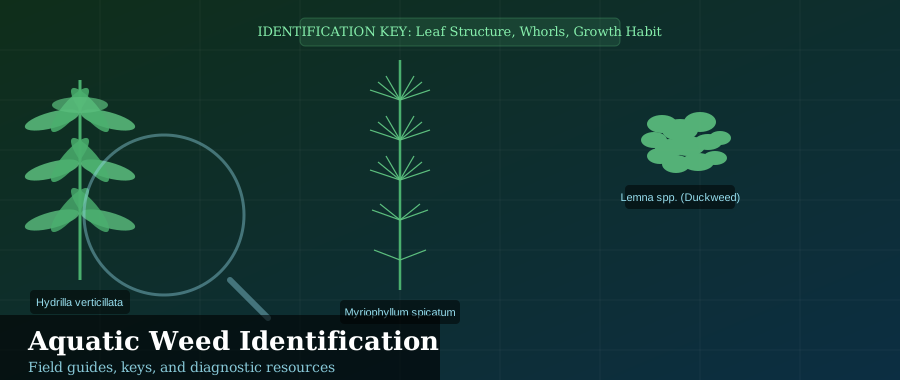
- Leaf arrangement: Are leaves opposite (in pairs), alternate (one per node), or whorled (three or more per node)? Hydrilla has distinctive whorls of 4–8 leaves; Eurasian watermilfoil has whorls of 4 with finely divided leaflets; elodea has opposite or whorled strap-shaped leaves.
- Leaf shape: Are leaves linear/strap-shaped, lance-shaped, oval, round, feathery/pinnately divided, or small fronds? Water hyacinth has round, swollen-petiole leaves; duckweed has oval 1–5mm fronds; Eurasian watermilfoil has pinnately divided feathery leaves.
- Leaf margin: Are leaf edges smooth, toothed/serrated, or wavy? Under a hand lens, hydrilla leaves show prominent serrations; curly-leaf pondweed has distinctively wavy-crinkled leaf margins.
- Leaf texture: Is the leaf smooth, rough, or hairy? Giant salvinia has distinctive eggbeater-shaped surface hairs. Chara has rough, calcium-encrusted surfaces.
See the complete visual guide: Common Aquatic Weed Leaf Shapes →
Step 3: Examine Stem and Root Structure
Stem and root characteristics provide crucial confirming evidence. Is the stem round, flattened, or triangular in cross-section? Is it hollow or solid? Does the plant have true roots anchored in sediment, or hanging roots in the water column, or no roots at all?
Coontail (Ceratophyllum demersum) is rootless — a key diagnostic feature. Water hyacinth has distinctive hollow, spongy, bulbous petioles that serve as flotation organs. Hydrilla produces small tubers in the sediment and axillary turions on stems. Chara has a distinctive brittle, calcium-encrusted texture and a strong garlic-like odor when crushed. See: Root Structures → and Stem and Growth Patterns →
Step 4: Note Habitat and Region
Many aquatic plant species are geographically restricted or have strong habitat preferences. Knowing your location — state, water body type, water depth, and water quality characteristics — can immediately rule out many species and confirm others.
Giant salvinia is primarily established in the Gulf South (Texas, Louisiana, Florida). Hydrilla is absent from most of the upper Midwest and mountain west. Purple loosestrife thrives in wetlands throughout the north but is absent from the deep South. Curly-leaf pondweed is a cool-season species most visible in late fall through spring. Identification by Habitat → | U.S. Distribution Hub →
Step 5: Check Flowers, Fruits, and Season
Flowers, fruits, and seeds provide definitive identification evidence when present. Water hyacinth produces striking lavender-blue flowers with a yellow spot on the upper petal — unmistakable. Curly-leaf pondweed produces distinctive spiky red-brown fruiting structures in late spring. Eurasian watermilfoil produces small 4-petaled flowers on spike-like racemes that extend above the water surface in summer.
Seasonal timing also matters for identification. Curly-leaf pondweed reaches peak growth in April–May and dies back in summer. Hydrilla grows most aggressively in warm water (summer) and forms turions in fall. Understanding seasonal growth patterns helps explain why a plant may be highly visible in one month and nearly absent in another. Identification by Season →
Commonly Confused Species Pairs
Several aquatic plant species are frequently misidentified, with serious management consequences. These common confusion pairs require particular attention:
- Hydrilla vs. Elodea (Waterweed): Both are submerged with whorled leaves, but hydrilla has serrated leaf margins with a single midrib tooth on the underside; elodea has smooth margins. Hydrilla tubers in the sediment are diagnostic. Compare hydrilla → | Compare elodea →
- Eurasian Watermilfoil vs. Native Milfoils: Several native watermilfoils (Myriophyllum sibiricum, M. pinnatum) closely resemble Eurasian watermilfoil. Eurasian milfoil typically has 12–21 pairs of leaflets per leaf; native species usually have 5–12 pairs. A cross-section of the stem tip (rake test) can help — Eurasian milfoil typically collapses limply. Genetic testing is definitive. See the eurasian milfoil profile →
- Curly-leaf Pondweed vs. Clasping-leaf Pondweed: Both have wavy leaf margins, but curly-leaf pondweed has distinctly reddish-green crinkled leaves in fall/spring; clasping-leaf pondweed has broader leaves that wrap around the stem. The former is invasive; the latter is native and beneficial.
- Duckweed vs. Watermeal: Duckweed (Lemna minor) has flat, oval fronds 2–5mm with a single root; watermeal (Wolffia) is even smaller (0.5–1.5mm), rootless, and granular in texture. Both form surface mats but are controlled differently.
- Phragmites (Invasive vs. Native): Non-native invasive Phragmites (Phragmites australis subsp. australis) and native Phragmites look nearly identical. Invasive Phragmites typically has darker, more persistent stems, denser stands, and specific genetic markers. Consult your state extension service for definitive identification.
Identification Guides in This Hub
How to Identify Aquatic Weeds
Step-by-step field methodology for identifying unknown aquatic plants.
Floating vs. Submerged vs. Emergent
The three growth form categories — the first step in every identification.
Common Leaf Shapes
Visual guide to leaf forms across all major aquatic weed species.
Root Structures
How root systems — or their absence — distinguish key species.
Stem and Growth Patterns
Stem structure, branching, node features for diagnostic use.
Weeds vs. Native Plants
Distinguishing invasive species from ecologically valuable natives.
Identification by Habitat
Species found in lakes, ponds, rivers, canals, and wetlands.
Identification by Season
Seasonal appearance changes and which species are active when.
Frequently Asked Questions
What is the single most important step in aquatic weed identification?
Determining whether the plant is floating, submerged, or emergent is the most important first step — it immediately limits your identification to one of three categories with distinct species and management implications. After that, leaf structure (shape, arrangement, margin) is the most diagnostically valuable characteristic. Photograph or collect samples for examination on land, and use a hand lens for close inspection of margin details.
How do I tell hydrilla apart from native waterweeds?
Hydrilla (Hydrilla verticillata) is most often confused with elodea (Elodea canadensis). The key distinguishing features of hydrilla are: (1) leaves arranged in whorls of 4–8 (elodea typically in pairs or threes); (2) serrated leaf margins visible to the naked eye; (3) a single tooth on the underside of the midrib; (4) small tubers in the sediment at the roots; (5) small axillary turions visible on stems in summer and fall. Elodea has smooth leaf margins. When in doubt, contact your state's DNR — hydrilla is a reportable invasive in most states.
Can I identify aquatic plants without taking a sample out of the water?
Floating and emergent plants can often be identified in the water using binoculars and photography. Submerged plants are much harder to identify in situ — they often need to be carefully collected for examination on land, where leaf structure, stem cross-section, and root/rhizome features can be clearly observed. Wear gloves when collecting samples and decontaminate equipment thoroughly before moving between water bodies (Clean, Drain, Dry protocol). Do not transport plant material away from the site in a way that could spread invasive species.
Are there apps or tools that can identify aquatic plants from photos?
Several plant identification apps (iNaturalist, PlantNet, Seek) can suggest aquatic plant identifications from photos, and iNaturalist has an active aquatic plant identification community. However, photo-based AI identification of aquatic plants is significantly less reliable than for terrestrial plants, particularly for submerged species and easily confused pairs. Always confirm app-generated identifications through this site's species guides, state extension resources, or professional consultation before taking management action.
What should I do if I find what I think is an invasive aquatic plant in a new location?
Document it thoroughly with photographs from multiple angles. Note the GPS location, water body name, and date. Report it immediately to your state department of natural resources or department of agriculture — most states have dedicated invasive species reporting portals. Do not disturb the plant or attempt any management before consulting with authorities. Do not move any plant material, water, or equipment out of the site. Early detection and rapid response are the most cost-effective defense against new invasive plant establishment.
References and Further Reading
- Crow, G.E., and C.B. Hellquist. (2000). Aquatic and Wetland Plants of Northeastern North America, Vols. 1–2. University of Wisconsin Press.
- Fassett, N.C. (1957). A Manual of Aquatic Plants. University of Wisconsin Press, Madison, WI.
- Langeland, K.A., et al. (2008). Identification and Biology of Nonnative Plants in Florida's Natural Areas. 2nd ed. University of Florida IFAS.
- Muenscher, W.C. (1944). Aquatic Plants of the United States. Comstock Publishing Associates, Ithaca, NY.
- Illinois-Indiana Sea Grant. (2020). Field Guide to Submerged Aquatic Vegetation: Identification and Ecology. IISG-19-63.
- USACE (U.S. Army Corps of Engineers). (2022). Aquatic Plant Identification Handbook for the Upper Midwest. ERDC/EL SR-22-3.