Why Season Matters for Identification
Aquatic plants are not static, year-round entities. Their appearance, density, and even their presence as visible aboveground tissue changes dramatically across seasons in response to water temperature, day length, nutrient availability, and the timing of their reproductive cycles. A skilled aquatic plant manager plans surveys and identification efforts around these seasonal patterns — visiting a water body at the right time of year to find the target species in its most identifiable state.
Seasonal awareness also has critical implications for management timing. Many aquatic herbicides achieve maximum efficacy when applied to actively growing plants with full leaf surface area — applying herbicide to a dormant species or a species at its seasonal peak density are very different propositions in terms of cost and outcome. Understanding each species' seasonal growth cycle directly informs the most cost-effective treatment window.
Spring: The Critical Survey Window
Spring (broadly March–May in most of North America) is one of the most important identification and management windows for several key species:
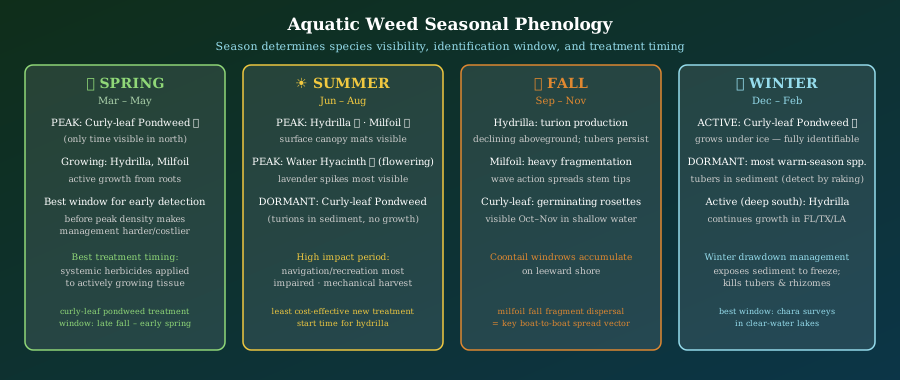
Curly-leaf pondweed reaches its peak biomass in late spring (April–May) and is most visible and identifiable during this period. It germinates in fall, grows through winter under ice in northern states, and reaches its maximum canopy extent just as water temperatures warm into the 60s°F. By June–July, the plants produce turions and die back, leaving the sediment loaded with turions for next season's germination. This means that if you miss the spring survey window, you will see no aboveground curly-leaf pondweed tissue until the following fall or winter.
Most invasive species in their northern range are beginning active growth in spring as water temperatures rise above 55–60°F. Hydrilla, Eurasian watermilfoil, and elodea all show vigorous apical growth during spring. This is the period when early-detection surveys of water bodies at risk for new infestations should be conducted — before populations grow to the densities that complicate management. Spring is also the optimal application window for systemic herbicides targeting actively growing tissue.
Emergent plants begin pushing new shoots in spring from their rhizome reserves. Alligator weed, cattails, and Phragmites produce visible new green growth as soil temperatures warm. Early-spring survey allows confirmation of emergent plant boundaries before they achieve full-season height, making survey more physically accessible.
Summer: Peak Density and Surface Canopy Formation
Summer (June–August) is the season of maximum growth for most warm-season aquatic weeds and the season when impacts on recreation and navigation are most severe. It is also the season when most lake residents and property owners first become aware of a weed problem they have had in their water body for years.
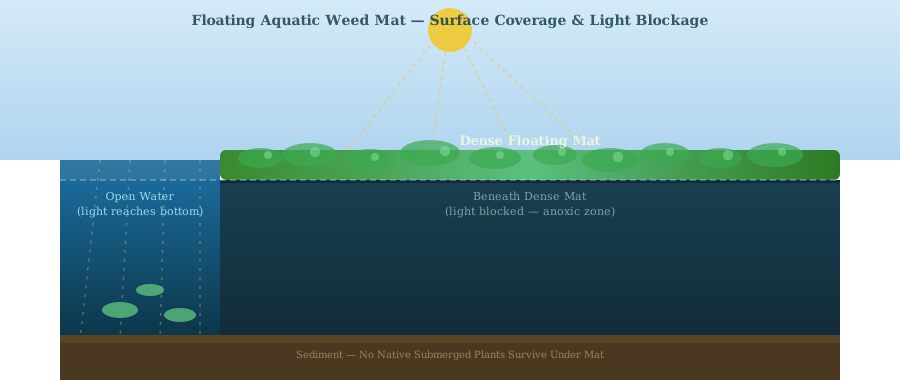
Hydrilla is a warm-season species that achieves explosive growth rates during summer months when water temperatures are above 68–77°F. By midsummer, hydrilla can form a complete surface canopy in infested lakes, growing at rates up to 3 cm per day at the stem tips. The canopy mat is immediately visible and navigation-impairing — but by the time it reaches the surface, the population has usually been growing for months. Summer is the least cost-effective time to begin a new hydrilla management program because of the massive plant biomass that must be addressed.
Eurasian watermilfoil also achieves peak summer density, typically forming surface canopy mats by July–August. The characteristic emergent flower spikes — pink-red, visible above the water surface — are diagnostic and highly visible during the flowering period (July–August). Summer is an excellent identification period for milfoil in flower.
Water hyacinth, duckweed, and other floating plants achieve maximum summer growth under warm water temperatures. Water hyacinth flowers most prolifically in summer — the lavender flower spikes are unmistakable and make summer the easiest season for visual identification from shore. Dense duckweed mats are most problematic in summer when algal conditions in the water column are also at their worst.
Fall: Dormancy Transition and Turion Production
Fall (September–November) is a transitional season characterized by declining water temperatures and day lengths that trigger dormancy in most warm-season aquatic weed species — and simultaneously trigger germination in the cool-season species.
Hydrilla produces axillary turions in fall as water temperatures drop. The main plant mass begins to decline in October–November in most of its North American range, though it may persist through mild winters in the deep South. Turions sink to the sediment and survive winter, providing next year's inoculum. In northern states, hydrilla may die back almost completely by November, leaving a water body that appears weed-free through winter despite a fully loaded tuber bank in the sediment.
Eurasian watermilfoil fragments heavily in fall — wind-driven wave action breaks stem tips that drift and establish new plants. Fall fragment dispersal by boats is a major mechanism of milfoil spread between water bodies. Fall herbicide treatments targeting milfoil take advantage of the plant's active growth before cold-induced dormancy.
Curly-leaf pondweed turions, produced in late spring, begin germinating in late summer to fall as water temperatures cool below 50–55°F. New rosettes of curly-leaf pondweed are visible at the sediment surface in October–November, growing slowly through the winter and preparing for spring bloom.
Emergent weeds (alligator weed, cattails, Phragmites) lose their green aboveground biomass in fall in most of their range, leaving dead stems that persist through winter. The standing dead biomass is still identifiable — Phragmites dead stems are distinctive — but confusable with native emergent species. Root and rhizome structures are the most reliable identification features during dormancy.
Winter: Dormant and Cool-Season Species
Winter (December–February) is a low-activity period for most warm-season aquatic weeds, but is the period of active growth for cool-season species and the best time to survey water bodies that appear weed-free in summer for the presence of dormant warm-season species.
Curly-leaf pondweed is unique among the major aquatic weeds in growing actively through winter under ice in northern states. It is fully identifiable in December–February for regions where it is present — the wavy, reddish-green, ribbon-like leaves are visible in shallow water even under ice. This winter growing season — when no competing warm-season species are active — is central to curly-leaf pondweed's competitive success.
Hydrilla in southern states (Florida, Texas, Louisiana) continues slow growth through mild winters, never fully losing its aboveground tissue. In the extreme south, winter surveys for hydrilla are practical and recommended. In colder states, winter surveys for hydrilla use sediment sampling to detect tubers — the only reliable evidence of presence when aboveground tissue is absent.
Chara is often most visible in late fall and early spring in northern states, growing in clear, cold water where few competing plants are active. Winter chara surveys of clear-water lakes can detect chara mats that are covered by blooms of other species in summer.
Seasonal Phenology Reference Table
| Species | Spring | Summer | Fall | Winter |
|---|---|---|---|---|
| Hydrilla | Growing | Peak ★ | Turion production; declining | Dormant (tubers in sediment) |
| Curly-leaf Pondweed | Peak ★ | Dormant (turions in sediment) | Turion germination; rosettes | Active growth under ice |
| Eurasian Watermilfoil | Growing rapidly | Peak; flowering ★ | Fragmentation; declining | Dormant |
| Water Hyacinth | Growing | Peak; flowering ★ | Declining in cool climates | Frost-sensitive; dormant N of zone 9 |
| Duckweed | Resuming growth | Peak ★ | Declining; turion formation | Turions dormant in sediment |
| Coontail | Growing | Peak ★ | Fragmentation; windrows | Reduced; may persist in south |
| Alligator Weed | Regrowth from rhizomes | Peak; flowering ★ | Slowing growth | Dormant in north; active in deep south |
★ = peak growth/visibility season. Cool-season species (curly-leaf pondweed) peak in spring; warm-season species peak in summer. All timing is approximate and varies by latitude and local water temperature.
Matching Survey Timing to Management Goals
Effective aquatic plant management programs plan survey and treatment activities around the seasonal phenology of target species:
- Early-detection surveys: Conduct in spring (April–May) when newly growing plants are small but detectable, before populations reach unmanageable densities. This is especially important for warm-season invasives in their northern expansion range.
- Herbicide treatment timing: Apply systemic herbicides (fluridone, triclopyr) during active growth phases when the plant is transporting photosynthates through its vascular system — not during dormancy or peak heat stress. For curly-leaf pondweed, the optimal treatment window is late fall to early spring when the plant is actively growing. For hydrilla and milfoil, the optimal window is spring through early summer, before peak density.
- Mechanical harvesting: Most effective during summer peak density when there is maximum biomass to remove and maximum navigation/recreation benefit from clearing. However, summer harvest of fragmenting species (milfoil) requires stringent containment to prevent dispersal of fertile fragments.
Frequently Asked Questions
Why can't I find the aquatic weeds in my lake in summer that were there in spring?
You are likely dealing with curly-leaf pondweed — the only major aquatic weed in North America that peaks in spring and completely dies back in summer. Curly-leaf pondweed germinates in fall, grows through winter, reaches peak biomass in April–May, then produces turions and senesces as water temperatures rise above 65–70°F. By July, there is typically no visible aboveground tissue. The turions sink to the sediment and wait until fall to germinate again. If you missed the spring window, conduct a sediment survey in fall to detect germinating turion-derived rosettes.
What is the best time of year to identify an unknown submerged aquatic plant?
Late spring through early summer (May–July in most of North America) is generally the best identification window for most submerged aquatic weeds. Plants are actively growing, have full leaf coverage and characteristic node spacing, and in many cases are approaching or beginning their flowering period — which provides additional diagnostic features. Water clarity in many lakes is also better in spring before summer algal blooms reduce Secchi depth, making underwater viewing easier. For curly-leaf pondweed, the spring window (April–May) is the only time of year when aboveground tissue is present in most of the northern U.S.
Do aquatic herbicide applications work in cold water?
Most aquatic herbicides are less effective in cold water for two reasons: plant metabolic activity is lower in cold water, reducing uptake and translocation of systemic herbicides; and many herbicide molecules degrade or bind to sediment more quickly in cold water, reducing active concentration in the water column. However, curly-leaf pondweed is actively growing in cold water (the plant germinates and grows at temperatures as low as 34–37°F), and fall treatments targeting actively growing curly-leaf pondweed using labeled herbicides (endothall, fluridone) can be effective at cool water temperatures. Always follow label timing recommendations for the target species.
Can winter drawdown help control aquatic weeds?
Yes — winter water level drawdown is an effective management tool for several aquatic weed species in water bodies where water levels can be controlled (managed lakes, reservoirs, farm ponds). Drawing down the water level in late fall exposes the littoral zone sediment to freezing temperatures, which can desiccate and kill hydrilla tubers, milfoil root crowns, and emergent weed rhizomes. The efficacy of winter drawdown depends on the duration and depth of freezing, with temperatures below 20°F sustained for several weeks being most effective. Drawdown must be planned carefully to avoid impacts on fish populations and native plant communities.
When is alligator weed easiest to identify?
Alligator weed is most definitively identifiable during its summer flowering period (June–September), when the characteristic small white clover-like flowers are visible on the emergent stems. However, vegetative features are sufficient for confident identification year-round: the hollow stem (confirmed by cutting), opposite lance-shaped leaves with smooth margins, and characteristic growth habit (floating mat on water or emergent on banks). In fall and winter, the aboveground tissue dies back in northern states, but dead stems with opposite leaf scars remain identifiable, and the rhizome system can be excavated from the shoreline sediment for examination.