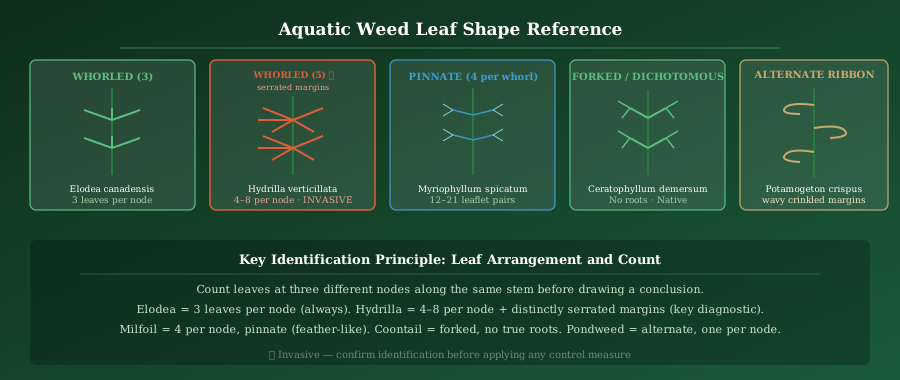
Why Leaves Are the Key to Aquatic Weed Identification
Unlike terrestrial plants, aquatic weeds rarely persist in a flowering state long enough for flowers to serve as the primary identification feature. Submerged plants often flower briefly and inconspicuously, with tiny flowers at or just above the water surface that are easily overlooked. Floating plants may flower seasonally or may not flower at all in cool climates. This makes vegetative features — especially leaf characteristics — the practical foundation of aquatic plant identification.
The four leaf features with the highest diagnostic value are: (1) arrangement at the stem node (whorled, opposite, or alternate); (2) number of leaves per whorl for whorled species; (3) margin texture (smooth, serrated, or toothed); and (4) leaf shape and division (undivided, pinnately divided, or forked). Knowing these four features for a sample plant typically narrows identification to one or two candidate species, which can then be confirmed with stem and root examination.
Whorled Leaf Arrangements
Whorled leaf arrangement — multiple leaves radiating outward from a single node on the stem — is the single most distinctive feature shared by the most common submerged aquatic weed species. Knowing the leaf count per node within this category is the key diagnostic step:
- 3 leaves per whorl (whorls of 3): Elodea (Elodea canadensis) is the primary species with consistently 3 leaves per node. Leaves are oblong, 6–12 mm long, with rounded tips and smooth or very finely toothed margins.
- 4 leaves per whorl (whorls of 4): Eurasian watermilfoil (Myriophyllum spicatum) has 4 leaves per whorl, each finely divided into 12–21 pairs of thread-like segments (pinnate leaflets). The pinnate division is immediately diagnostic — no other common aquatic weed has this combination of 4-leaf whorls and finely divided pinnate leaves.
- 5–8 leaves per whorl: Hydrilla (Hydrilla verticillata) typically has 5 leaves per whorl in most U.S. populations (range 4–8). Leaf margins are distinctly serrated (saw-toothed), visible to the naked eye or under a hand lens. This serration, combined with whorl count greater than 4, is diagnostic for hydrilla in North America.
- Forked, antler-like leaves (effectively whorled): Coontail (Ceratophyllum demersum) has stiff, forked leaves that radiate in a whorled pattern. The leaves are not flat and ribbon-like — they fork into Y-shapes and feel rough due to tiny teeth along the fork margins. Coontail is the only rootless submerged plant with this leaf structure.
Opposite and Alternate Leaf Arrangements
Opposite leaves (two per node, one on each side of the stem) are characteristic of alligator weed (Alternanthera philoxeroides), water purslane (Ludwigia palustris), and some cabomba species among the commonly encountered aquatic weeds. Opposite leaves are generally more common in emergent and floating plants than in submerged ones.
Alternate leaves (one per node, alternating sides) are characteristic of the pondweed family (Potamogetonaceae). Curly-leaf pondweed (Potamogeton crispus) has alternate, stiff, ribbon-like leaves with distinctly wavy, crinkled margins and three prominent parallel veins. This combination — alternate arrangement, ribbon shape, crinkled margins, 3 veins — is diagnostic. Water hyacinth also has alternate leaves, but these are round, glossy, and arranged in floating rosettes with inflated petioles.
Leaf Shape and Division
After arrangement, the overall shape and degree of leaf division provides the next level of diagnostic information. The major categories encountered in aquatic weed identification:
- Undivided ribbon-like leaves: Pondweeds (Potamogeton spp.), najas (Najas spp.), and wild celery (Vallisneria americana). These are narrow, strap-shaped, and may be very long (several centimeters to over 30 cm in some pondweeds). Margin texture (smooth vs. serrated vs. toothed) distinguishes species within this group.
- Pinnately divided (feather-like) leaves: Watermilfoil species (Myriophyllum spp.). Leaves look like tiny green feathers or combs, with paired thread-like segments along a central axis. Count the pairs of segments for species-level distinction: Eurasian watermilfoil has 12–21 pairs; Northern watermilfoil has 5–9 pairs.
- Forked (dichotomously branched) leaves: Coontail (Ceratophyllum demersum). Leaves fork once or twice into Y-shaped segments. The entire leaf arrangement forms a cluster that resembles a raccoon's tail — the source of the common name.
- Oval to round undivided leaves: Water hyacinth, frogbit, and the floating leaves of most pondweeds. These are broad, firm (not collapsing in air), often waxy or glossy on the upper surface, and positioned at or above the water surface.
- Very small or scale-like leaves (fronds): Duckweed and watermeal. These are among the simplest of all vascular plant structures — flat, oval, green fronds only 1–10 mm in size. The presence or absence of a root hair hanging below is important: duckweed has one root per frond; watermeal has no roots.
Leaf Margin Texture
Leaf margin texture — the edge of the leaf — is most useful in distinguishing species with similar overall shapes and arrangements. Observe this feature with a hand lens (10× magnification) for best results:
- Smooth margins (entire): Elodea, most floating leaves of pondweeds, water hyacinth.
- Serrated margins (saw-toothed): Hydrilla (distinctly serrated, diagnostic). Curly-leaf pondweed (finely serrated). Najas species (variable — smooth to sharply toothed).
- Wavy or crinkled margins: Curly-leaf pondweed — the wavy, ruffled margin is the source of the common name and is visible to the naked eye.
- Rough or spiny margins on forked segments: Coontail — the fork margins have tiny teeth that give the leaf a rough, rasping feel when pulled through the fingers.
Quick Species-to-Leaf Diagnostic Table
| Species | Arrangement | Per Node | Shape | Margin |
|---|---|---|---|---|
| Hydrilla | Whorled | 4–8 (usually 5) | Narrow lance-shaped | Distinctly serrated |
| Elodea | Whorled | 3 | Oblong, rounded tip | Smooth to finely toothed |
| Eurasian Watermilfoil | Whorled | 4 | Pinnate (12–21 pairs) | Smooth (thread-like segments) |
| Coontail | Whorled (forked) | 6–12 | Dichotomously forked | Rough (tiny teeth on forks) |
| Curly-leaf Pondweed | Alternate | 1 | Ribbon-like, 3 prominent veins | Wavy / crinkled, finely serrated |
| Water Hyacinth | Alternate (rosette) | — | Round to kidney-shaped, glossy | Smooth |
| Duckweed | Frond (no true leaf) | — | Oval frond, 1–8 mm | Smooth |
| Alligator Weed | Opposite | 2 | Lance-shaped to oval | Smooth |
Leaf Margin Close-Up: Smooth vs. Serrated vs. Wavy
Leaf margin texture is the single most reliable feature for separating hydrilla from elodea — the most consequential species-pair distinction in North American aquatic plant management. Both have whorled, narrow leaves and grow fully submerged, but their margins are clearly different under 10× magnification. The three margin types you will encounter most often:
Leaf Shape in Floating Aquatic Weeds
Floating aquatic weeds display a completely different suite of leaf shapes compared to submerged species — shapes adapted for maximum sun exposure and mechanical support at the water surface rather than flexibility in moving water:
- Round to kidney-shaped, inflated petiole: Water hyacinth (Eichhornia crassipes) has round to kidney-shaped leaves on short, inflated, bulbous petioles that act as flotation chambers. The petiole inflation is the single most diagnostic morphological feature. Leaves are deep green, glossy, and slightly cupped at the center. → Floating Aquatic Weeds Hub
- Small oval fronds (1–10 mm): Duckweed (Lemna minor) is technically not a leaf but a thallus (frond) — a simplified plant body that serves as both stem and leaf. Each frond is flat, oval, 1–8 mm, mid-green, with one root hanging below. Three fronds are usually connected in small clusters. Watermeal (Wolffia spp.) is even smaller (0.5–1.5 mm) and rootless.
- Triangular to arrow-shaped leaves on long petioles: Water lettuce (Pistia stratiotes) — a warm-climate invasive — has soft, velvety, ribbed leaves in a rosette arrangement. The ribbing and soft, velvety texture are immediately distinctive from all other common floating weeds.
Floating leaf shapes are generally simpler to identify than submerged ones because they are visible without entering the water and have more obvious distinctive features. The main challenge is distinguishing floating leaves of submerged species (pondweeds, water primrose) from dedicated floating plants — use the stem: if the floating leaf has a long stem reaching down to rooted sediment, it is a floating leaf of a rooted plant, not a free-floating species.
Species Hub Cross-Reference
- Hydrilla — 5+ whorled, serrated
- Elodea — 3 whorled, smooth
- Eurasian Milfoil — 4 whorled, pinnate
- Coontail — whorled, forked
- Curly-leaf Pondweed — alternate, wavy
- Chara — whorled branchlets
- Water Hyacinth — round, inflated petiole
- Duckweed — oval frond, 1 root
Frequently Asked Questions
What does 'whorled' mean in aquatic plant identification?
Whorled means that three or more leaves attach at the same node on the stem, radiating outward in all directions like the spokes of a wheel. This is one of the most immediately recognizable features of many submerged aquatic weeds. Hydrilla, Eurasian watermilfoil, and elodea all have whorled leaf arrangements. The number of leaves in each whorl — 3 for elodea, 4 for milfoil, 5+ for hydrilla — is diagnostic at the species level.
Do submerged leaves look different from floating leaves on the same plant?
Yes, significantly so on many species. Pondweeds (Potamogeton spp.) are the most dramatic example: submerged leaves are narrow, ribbon-like, and translucent, while floating leaves on the same plant are broader, oval, opaque, and firm. This leaf heterophylly (having two different leaf forms) is an adaptation to the different environments above and below the water surface. Always examine both leaf forms before attempting identification.
How do I examine leaf margins in the field?
For species with large leaves (pondweeds, alligator weed, water hyacinth), leaf margins can be examined with the naked eye or with a 10× hand lens. For smaller-leaved species like hydrilla and elodea, a hand lens is essential. Hold the leaf gently between your fingers and look along the edge from a low angle — serrations appear as a jagged, saw-tooth silhouette. For the roughness of coontail, simply pull a stem slowly between two fingers — the forked leaf teeth create a rasping sensation.
Can I identify aquatic weeds from photographs alone?
For many species, yes — high-quality photographs of the leaf arrangement, node detail (showing leaf count per whorl), and margin texture are sufficient for confident identification. The key is to photograph the right features: a single distant photo of a plant mat rarely provides enough detail. Close-up images of nodes, leaf tips, leaf margin texture, and any reproductive structures (turions, flowers, fruits) significantly improve identification accuracy from photographs alone.
What species might be confused with duckweed?
Watermeal (Wolffia spp.) is the most common confusion species — it forms similar green surface coatings but the individual fronds are much smaller (0.5–1.5 mm) and rootless. Azolla (water fern) forms similar surface mats but is readily distinguished by its reddish-purple color in bright sunlight, the paired overlapping leaves visible under magnification, and its texture (soft, velvety). Algal blooms can superficially resemble duckweed mats from a distance but have no individual plant structure when examined up close.