Why Growth Form Is the First Question
Every identification guide for aquatic plants — from university extension manuals to USDA field keys — begins the same way: Where does the plant grow relative to the water surface? This is not a technicality. Growth form determines gas exchange strategy, light access, reproduction mechanisms, dispersal pathways, and vulnerability to different control methods. A floating weed cannot be controlled with a bottom-barrier; a submerged weed cannot be sprayed with a contact herbicide applied to the water surface. Getting the growth form right first prevents wasted effort and misdirected treatment.
There are three primary growth form categories: floating, submerged, and emergent. A fourth category — algae (including charophytes like Chara) — is distinct from true vascular plants, though it is managed similarly. Understanding these four categories, and the exceptions that blur boundaries, gives you the foundation to correctly identify nearly any aquatic plant you encounter.
Floating Aquatic Plants
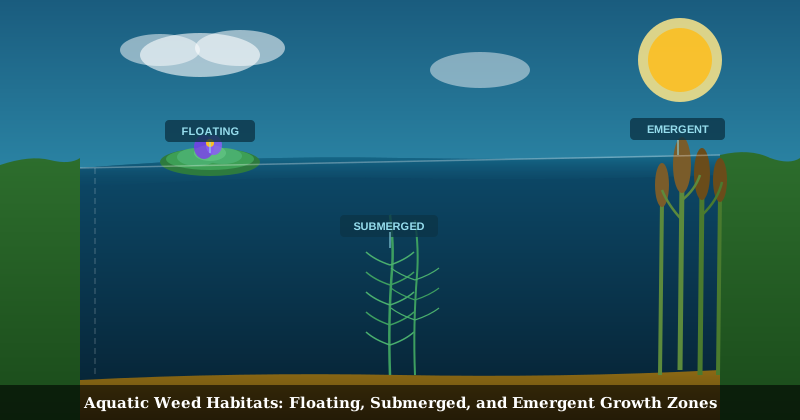
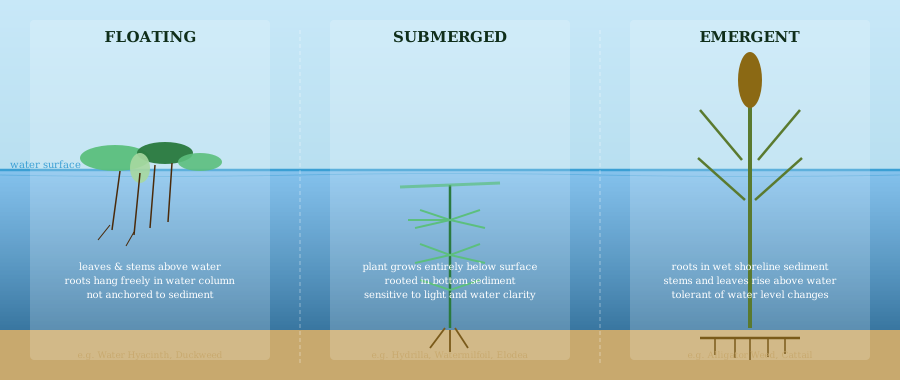
Floating plants live on the water surface with their leaves and stems exposed to air and their roots hanging freely in the water column. They are not anchored to the bottom sediment, which allows them to drift with wind and current — accelerating dispersal. This surface position gives them maximum access to sunlight and atmospheric carbon dioxide, enabling extraordinarily rapid growth rates under warm, nutrient-rich conditions.
The most ecologically damaging floating weeds in North America include water hyacinth (Eichhornia crassipes), which can double its population every 12 days, and giant salvinia (Salvinia molesta), which can double its biomass every 2–4 days. Common duckweed (Lemna minor) is native and widespread but can form nuisance mats in eutrophic water bodies. Watermeal (Wolffia spp.) — the world's smallest flowering plant — forms granular, bright-green surface coatings that are often mistaken for algae.
Key identification characteristics:
- Leaves, stems, and flowers at or above the water surface
- Roots hanging freely into the water column (or absent, as in watermeal)
- Plant moves freely with wind and current — not attached to the bottom
- Can form dense, impenetrable surface mats within days to weeks
- Inflated or spongy tissue often present (water hyacinth petioles; frogbit leaf bases)
Management note: Dense floating mats block sunlight penetration, reduce gas exchange at the water surface, and deplete dissolved oxygen — especially as mats decompose. Contact herbicides must reach the leaf surface. Systemic herbicides are absorbed and translocated through the plant. Physical fragmentation during removal can spread the infestation; containment booms are essential during mechanical harvest. Explore all floating aquatic weeds →
Submerged Aquatic Plants
Submerged plants grow entirely (or nearly entirely) below the water surface, most often rooted in bottom sediment. They photosynthesize using dissolved CO₂ in the water column and must access light that has been filtered and attenuated through the water itself. This makes them highly sensitive to water clarity, depth, and turbidity — and explains why they thrive in clear-water lakes and slow rivers but struggle in turbid conditions.
The most problematic submerged aquatic weeds include hydrilla (Hydrilla verticillata) — the most competitive submerged aquatic plant in North America — and Eurasian watermilfoil (Myriophyllum spicatum), which forms dense canopy mats at the water surface. Curly-leaf pondweed is unusual in being a cool-season species that peaks in late winter and spring. Coontail (Ceratophyllum demersum) is unique among submerged plants in being rootless — it simply wedges into sediment with modified basal leaves. Chara is a charophytic alga that resembles a vascular plant, grows completely submerged, and has a distinctive garlic odor when crushed.
Key identification characteristics:
- Entire plant (or nearly all of it) below the water surface
- Usually rooted in bottom sediment — pull a sample to check for roots and any tubers or turions
- May produce emergent flower spikes during reproductive season
- Leaves often limp, feathery, ribbon-like, or finely divided — adapted to the underwater environment
- Stems frequently break off cleanly at nodes, each fragment capable of becoming a new plant
Management note: Submerged weeds require herbicides that can penetrate the water column or be applied as granules that settle to the sediment. Aquatic herbicides registered for submerged use include fluridone (slow-acting, systemic), endothall, and triclopyr. Mechanical harvesting cuts the aboveground biomass but leaves roots intact; bottom barriers smother the entire plant. Explore all submerged aquatic weeds →
Emergent Aquatic Plants
Emergent plants are rooted in submerged or saturated sediment along the shoreline (littoral zone), with their stems and leaves rising above the water surface into the open air. They essentially combine aquatic and terrestrial characteristics: they absorb water and nutrients through submerged roots while photosynthesizing in open air. Most emergent species are highly tolerant of water level fluctuations — an adaptation that allows them to persist through seasonal droughts and flood events.
The most management-significant emergent weeds in North America include alligator weed (Alternanthera philoxeroides), invasive Phragmites (Phragmites australis subsp. australis), cattails (Typha spp. — some native, some aggressively invasive), and purple loosestrife (Lythrum salicaria), which is a major wetland invader in the northern United States and Canada.
Key identification characteristics:
- Roots in submerged or saturated sediment at the shoreline edge
- Stems and leaves above the water — often stiff, erect, and woody or reed-like
- Typically grow in the littoral zone (shoreline band) of lakes and ponds, or in wetlands
- Tolerant of water level changes; often maintain vigorous rhizome systems underground
- Flowers and seed heads are usually conspicuous and above water level
Management note: Emergent plants require foliar herbicide application (to exposed leaves and stems) or stem injection for larger woody species. Cutting and pulling are effective for small infestations but require follow-up because rhizomes regenerate vigorously. Many emergent weeds require multi-year management programs before populations are reduced to manageable levels. Explore all emergent aquatic weeds →
Species That Cross Category Boundaries
Several species resist simple categorization and require careful observation of the whole plant in context. Alligator weed, for example, grows as a floating mat on open water, as a rooted emergent at the shoreline, and as a fully terrestrial plant on banks and roadsides — all of which can occur within the same infestation. Water primrose (Ludwigia spp.) produces both submerged leaves (ribbon-like) and floating or emergent leaves (broader, oval) on the same stem, making a single plant look like multiple species.
Several pondweed species (Potamogeton spp.) produce both submerged leaves (thin, ribbon-like) and floating leaves (broader, oval to lance-shaped) on the same plant. Identifying these species correctly requires examining both leaf types together. Similarly, water primrose may have one growth form predominate depending on water depth and season.
The practical implication: always observe the entire plant — not just the portion visible at the surface or shoreline — before classifying it and selecting a control strategy. Collect a complete sample including roots, stems, and all leaf types when seeking expert verification.
Quick-Reference Comparison
| Feature | Floating | Submerged | Emergent |
|---|---|---|---|
| Position in water | On the surface | Below surface | Above surface |
| Anchored to bottom? | No — free-floating | Yes (usually) | Yes — shoreline |
| Light access | Full sunlight | Water-filtered | Full sunlight |
| CO₂ source | Atmosphere | Dissolved in water | Atmosphere |
| Common control | Contact/systemic foliar | Aquatic herbicide; granular | Foliar spray; stem injection |
| North American examples | Water hyacinth, duckweed, salvinia | Hydrilla, milfoil, elodea, coontail | Alligator weed, Phragmites, cattail |
Frequently Asked Questions
What is the easiest way to tell if a plant is floating, submerged, or emergent?
Observe where the leaves and stems are relative to the water surface. Floating plants have leaves at or above the surface and are not attached to the bottom — they move with wind and current. Submerged plants are entirely (or nearly entirely) underwater, often only detectable by pulling a sample. Emergent plants have stems and leaves clearly above the water surface, rooted in shallow sediment along the shoreline.
Why does growth form matter for control?
Growth form determines which control methods can physically reach the plant and which herbicide formulations and application methods are appropriate. A contact foliar herbicide sprayed at the water surface cannot control a fully submerged plant. Conversely, an aquatic granular herbicide applied to the water column is not appropriate for an emergent plant whose roots are not in water. Misidentifying growth form leads to wasted treatment cost and potential harm to non-target native plants.
Can a single species have more than one growth form?
Yes. Several species are plastic in their growth form. Alligator weed grows as floating, emergent, or terrestrial depending on conditions. Several pondweed species produce both submerged and floating leaves on the same stem. Water primrose displays submerged, floating, and emergent leaves simultaneously. Always examine the whole plant — not just the visible portion — before determining growth form.
Are submerged aquatic plants always invasive?
No. Many submerged aquatic plants are native and ecologically valuable — they provide oxygen, habitat structure, and food for fish, waterfowl, and invertebrates. Elodea, coontail, and chara are examples of native submerged plants that are ecologically beneficial in most circumstances. The problem arises when native plants become overabundant (nuisance status) or when non-native invasive species like hydrilla or Eurasian watermilfoil outcompete native plant communities. Always identify the species before deciding whether management is appropriate.
What tools do I need to identify a submerged aquatic plant?
The minimum toolkit for field identification of submerged aquatic plants includes: a raking pole or aquatic plant rake for retrieving samples from the bottom; a white bucket or tray for observing plant structure in water (which helps preserve the leaf arrangement); a hand lens or loupe (10× magnification) for examining leaf margins and surface texture; a waterproof camera or smartphone for documenting the sample; and a ruler for measuring leaf dimensions and whorl spacing. These tools, combined with our species profiles, allow confident field identification of most common aquatic weed species.