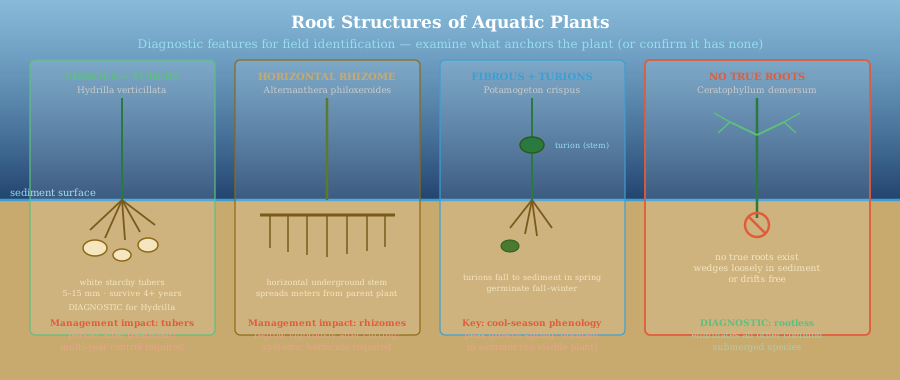
Why Root Structures Matter for Identification
The root system of an aquatic plant is not merely an anchoring mechanism — it is a set of anatomical features shaped by millions of years of adaptation to specific ecological niches. For the aquatic plant biologist and the field manager alike, root examination often resolves ambiguous identifications that leaf and stem features alone cannot settle. Three species illustrate why root examination is essential:
Hydrilla (Hydrilla verticillata) produces small, white, potato-like tubers in the sediment at the base of the plant. These tubers are so persistent — able to survive for years in anoxic sediment — that they are one of the primary reasons hydrilla is so difficult to eradicate. No other common submerged aquatic weed produces sediment tubers with this morphology. Finding a hydrilla tuber in a water body sediment confirms hydrilla presence even if no aboveground plant is visible — a critically important fact for management planning.
Coontail (Ceratophyllum demersum) is unique among submerged aquatic plants in having no true roots whatsoever. It is anchored loosely in sediment by modified basal leaves that grip the substrate, or it drifts freely in the water column entirely unattached. No other common submerged weed species lacks roots entirely. This rootless condition is the single most diagnostic feature of coontail — it eliminates essentially all other submerged plant species from consideration.
Curly-leaf pondweed (Potamogeton crispus) produces distinctive turions — compact, bud-like winter survival structures that break off from the stem, sink to the sediment, and remain dormant through summer heat. Finding these structures in the sediment in late summer or fall can confirm curly-leaf pondweed presence in the water body even after the main plant mass has died back.
Fibrous Root Systems
Most rooted submerged and floating aquatic weeds — including elodea, Eurasian watermilfoil, water hyacinth, and most pondweed species — have conventional fibrous root systems. The main stem terminates in a cluster of fine, hair-like roots that penetrate the upper sediment layer to anchor the plant and absorb nutrients. In eutrophic water bodies with high nutrient levels in the water column, some floating plants (notably water hyacinth and duckweed) absorb a substantial fraction of their nutrients directly through hanging roots — a characteristic that makes them effective in wastewater treatment applications but also an indicator of water body nutrient status.
Fibrous roots in most submerged weeds are relatively shallow — confined to the upper few inches of sediment — and are not particularly persistent after the plant dies. This contrasts sharply with rhizome systems, which can persist in the sediment for many years.
Rhizome Systems
Rhizomes are horizontal underground stems that grow through the sediment, producing new vertical shoots at intervals. They are the primary mechanism by which emergent aquatic weeds — and some submergeds — spread and maintain their presence even after aggressive management efforts that remove the aboveground biomass.
Alligator weed (Alternanthera philoxeroides) is one of the most rhizome-dependent aquatic weeds in North America. Its extensive horizontal rhizome network can reach several meters from the parent plant and produces new shoots from any node on the rhizome. This means that mechanical removal operations that fail to excavate the rhizome network will be followed by vigorous regrowth within weeks.
Invasive Phragmites and cattails (Typha spp.) similarly depend on extensive rhizome systems for both persistence and spread. A single Phragmites clone can occupy several hectares and produce tens of thousands of culms from a single rhizome network. Control strategies that address only the aboveground biomass will not succeed against rhizome-dependent species.
Tubers: Hydrilla's Persistent Reserve
Hydrilla is the only common submerged aquatic weed in North America that produces small, white, starchy tubers in the sediment at the plant's base. These tubers — technically modified stem tips — range from 5 to 15 mm in diameter and resemble miniature potatoes. They serve as carbohydrate reserves and as a regenerative structure: each tuber can sprout a new plant when conditions are favorable, even if the parent plant above has been completely killed by herbicide treatment.
The persistence of hydrilla tubers in sediment is extraordinary — studies have documented viable hydrilla tubers remaining dormant for up to 4 years in anoxic sediment. This is the primary reason that multi-year herbicide programs (particularly with systemic herbicides like fluridone that reduce tuber viability over time) are necessary for effective hydrilla management. Single-year treatments that kill aboveground biomass but fail to deplete the tuber bank will be followed by resurgence within one to two growing seasons.
To confirm hydrilla identification, rake a sample from the sediment near the base of the plant and carefully rinse away the mud. Small white tubers 5–15 mm in size, resembling tiny potatoes or irregular beads, confirm the presence of hydrilla even when leaf examination alone is inconclusive.
Turions: Dormant Winter Buds
Turions are compact, bud-like dormancy structures produced by several aquatic plant species that break off from the parent plant and sink to the sediment to survive winter cold or summer heat. They are distinct from tubers in being stem-derived rather than root-derived, and in being designed for dispersal and temporal dormancy rather than long-term survival in the sediment bank.
Curly-leaf pondweed produces turions in late spring (May–June) before the main plant mass dies back in summer. These turions — compact, bud-like structures 1–3 cm in size — settle to the sediment and germinate in fall, initiating the plant's characteristic winter growing season. Finding curly-leaf pondweed turions in sediment samples during summer confirms its presence even when no living aboveground tissue is visible.
Hydrilla produces axillary turions on its stems — small, compact buds that break off and can be dispersed by currents and waterfowl before sinking and germinating. These axillary turions are distinct from the subterranean tubers and are less persistent, but serve as an important dispersal mechanism for establishing new infestations in connected water bodies.
Root Structure Summary by Species
Use this reference table when examining root samples in the field or laboratory. Each row shows the root system type, presence of special structures, and management implications for the most commonly encountered aquatic weed species in North America.
| Species | Growth Form | Root System Type | Special Structures | Persistence in Sediment | Management Implication |
|---|---|---|---|---|---|
| Hydrilla | Submerged | Fibrous roots in sediment | White starchy tubers (5–15 mm) + axillary turions | Up to 4 years (tubers) | Multi-year systemic herbicide program needed to deplete tuber bank |
| Coontail | Submerged | No true roots | Modified basal leaves grip sediment | None — detaches and drifts | Harvesting effective; no root bank to regenerate |
| Curly-leaf Pondweed | Submerged | Fibrous roots | Turions (1–3 cm) on stems | Turions survive summer | Fall germination from turions; spring treatment window critical |
| Eurasian Watermilfoil | Submerged | Fibrous roots, shallow | None (fragments regenerate) | Low — roots not persistent | Fragmentation control critical; each stem node can regenerate |
| Elodea | Submerged | Fibrous roots | None | Low | Native; management usually not appropriate |
| Water Hyacinth | Floating | Hanging fibrous roots (water column) | Inflated petiole floats the plant | None — no sediment roots | Systemic foliar herbicide; contain fragments to prevent spread |
| Duckweed | Floating | 1 hanging root per frond | None | None | Contact/shading; nutrients are root-absorbed from water column |
| Alligator Weed | Floating/Emergent | Extensive rhizome network | Rhizomes spread horizontally meters from plant | Years — rhizomes very persistent | Must address rhizomes; cutting alone fails |
| Chara | Submerged (alga) | Rhizoids (not true roots) | Calcium-encrusted exterior | Moderate | Often outcompeted by vascular plants when nutrients rise |
Frequently Asked Questions
What is the most diagnostic root feature for distinguishing hydrilla from other submerged weeds?
The presence of small, white, potato-like tubers in the sediment at the plant's base is the most diagnostic root feature for hydrilla. These tubers are 5–15 mm in diameter and are not produced by any other common submerged aquatic weed in North America. To check for tubers, use a rake to pull up a sediment sample from the plant's root zone and rinse away the mud in a white bucket. Even when aboveground tissue is ambiguous, the presence of hydrilla tubers confirms the identification.
What does it mean that coontail has no roots?
Coontail (Ceratophyllum demersum) is evolutionarily rootless — it has no true roots and never has had them in its evolutionary history. It either wedges loosely in sediment using modified basal leaves, or it drifts freely in the water column. This rootless condition is the single most diagnostic feature of coontail and immediately distinguishes it from all other submerged aquatic weeds. In terms of management, the rootless structure means that herbicides must be absorbed through leaf surfaces rather than root uptake, and mechanical harvesting is more effective because there is no root system to regenerate after cutting.
How do rhizomes affect aquatic weed management?
Rhizomes — horizontal underground stems that produce new shoots at nodes — are the primary reason why many emergent aquatic weeds are so difficult to control with single-application management programs. Mechanical cutting or chemical treatment that removes only the aboveground biomass leaves the rhizome network intact and vigorous regrowth follows within weeks. Effective management of rhizomatous species (alligator weed, Phragmites, cattail) requires either systemic herbicides that are translocated to the rhizomes, or physical excavation of the rhizome network, or both — repeated over multiple growing seasons.
Can turions be a problem after treatment?
Yes. Turions are dormancy structures that survive herbicide treatment, drought, and freezing — the same stresses that kill aboveground plant tissue. For curly-leaf pondweed, turions in the sediment will germinate in fall even after successful summer treatment kills all aboveground plants. For hydrilla, axillary turions (on the stems) can detach and be dispersed by current or waterfowl before herbicide treatment takes effect, establishing new plants elsewhere in the water body. Management programs for turion-producing species must account for the turion bank and typically require multiple years of treatment to achieve sustained control.
Do aquatic plant roots absorb nutrients from the water or from the sediment?
Both, depending on the species. Most rooted submerged and emergent aquatic weeds absorb the majority of their nutrients through their roots from the sediment, where nutrients (especially phosphorus) are bound to sediment particles. Floating plants, whose roots hang in the water column, absorb nutrients primarily from the water. Emergent plants typically use both pathways. The source of nutrient uptake has significant implications for management: adding fertilizer to water to stimulate water column algae (which shades out submerged weeds) works differently depending on whether the target species relies primarily on sediment or water column nutrients.