The Case for Rigorous Documentation
Aquatic weed management programs that maintain rigorous mapping and documentation consistently outperform programs that do not. The reasons are practical: documented baselines allow you to measure progress; georeferenced maps allow treatment targeting that avoids native plant beds; records of treatment dates, products, and rates support regulatory compliance; and multi-year documentation reveals trends (expanding infestations, recovering native plant areas) that are invisible to annual observation alone.
GPS Mapping of Aquatic Plant Distributions
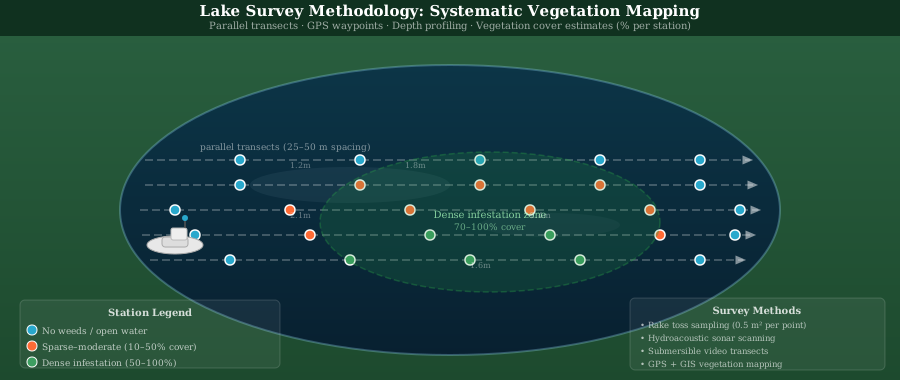
GPS-referenced aquatic plant maps are the most valuable documentation tool for management programs. A boat-based survey using a handheld GPS or a GPS-connected tablet allows surveyors to record the boundaries of each species' distribution, density zones, and point-intercept sampling locations directly as georeferenced features. This data can be imported into GIS software (ArcGIS, QGIS) to create professional distribution maps that document changes over time.
Consumer smartphone apps (including several developed by state DNR programs) can also be used for basic GPS plant mapping and are free or low-cost alternatives to professional GIS tools for small ponds and simple management situations. The key requirement is consistent methodology year to year — maps collected at different times of year or using different methods cannot be directly compared. Document the date, methodology, water conditions, and observer experience level for every survey.
Photographic Documentation
Geotagged photographs taken at fixed, documented locations provide a powerful qualitative record of weed coverage and appearance changes over time. Establish a set of 8–12 standard photo stations around the perimeter of the water body (marked with GPS coordinates), photograph from the same position and direction each year, and compile the resulting time series into a photographic record. This visual evidence is compelling for communicating management progress to stakeholders, property owner groups, and regulatory agencies, and is a valuable complement to quantitative survey data.
Treatment Records
Complete treatment documentation must include: the date, time, and weather conditions of each treatment; the specific products applied (brand name, active ingredient, EPA registration number); application rates (concentration in ppm for water column applications, pounds active ingredient per acre for foliar); the GPS-referenced treatment area boundary; the name and license number of the applying professional; and any water use restrictions imposed following treatment. This documentation is legally required for chemical treatments and is essential for permit compliance and regulatory audits. Regulatory requirements →
Remote Sensing and Technology Tools
Recent technological advances have expanded the mapping toolkit available to lake managers. Consumer drone platforms equipped with multispectral or RGB cameras can acquire aerial imagery of small to medium-sized water bodies at low cost, enabling rapid detection of floating mat species (water hyacinth, salvinia) and identification of dense submerged weed canopies visible from above. Commercial satellite imagery (Planet Labs, Maxar) provides multi-temporal monitoring of large water bodies at resolutions sufficient to track coverage changes over time.
Acoustic surveys using depth finders or dedicated hydroacoustic survey equipment detect submerged vegetation below the surface on a transect basis — producing depth profiles that show vegetation height and density information not visible from surface mapping. These tools are particularly valuable for documenting the three-dimensional distribution of submerged species in deeper water. Combining GPS-based point-intercept surveys (primary quantitative data for management decision-making) with drone overflights (rapid spatial coverage assessment between formal survey events) is the most information-efficient approach for active management programs. Monitoring methods →
Documentation for Regulatory Compliance
Many states require documentation of aquatic plant species composition and distribution as part of permit applications for management activities. Annual mapping records also satisfy regulatory reporting requirements for long-term management permits — demonstrating that management is achieving measurable results and that the management approach remains appropriate for the species and infestation documented. Maintaining a consistent documentation format across years, with dated field notes, GPS data exports, and annotated maps, provides the regulatory defensibility that protects management programs when questioned. Permit and documentation requirements →
Frequently Asked Questions
What software should I use to manage aquatic plant mapping data?
For small programs, a simple spreadsheet with GPS coordinates, species records, and date/conditions is adequate. For programs managing larger water bodies or multiple sites, free GIS software like QGIS allows you to import GPS data, create distribution maps, and compare data across years. State-specific aquatic plant management programs sometimes provide standardized data entry forms and GIS templates — contact your state DNR program to ask what formats they prefer for data submission.