What Are Floating Aquatic Weeds?
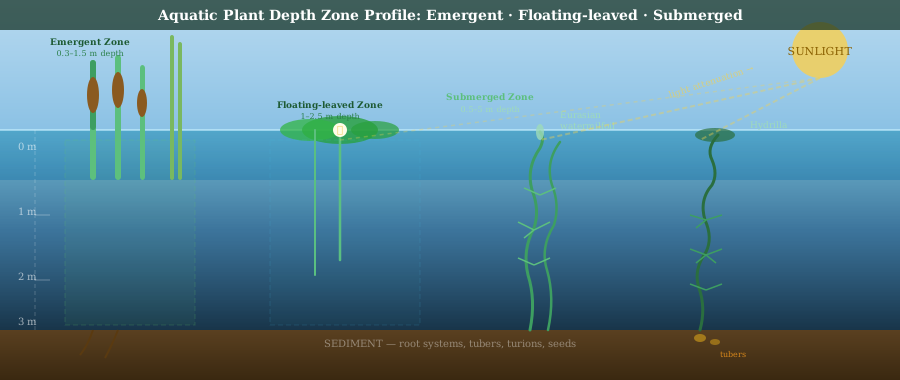
Floating aquatic plants live entirely on the water surface, with their leaves and stems above the waterline and their roots hanging freely in the water column below. Unlike submerged or emergent plants, they are not anchored to the bottom sediment — they drift freely with wind and current, which allows them to spread rapidly and blanket entire water surfaces within weeks.
Their surface position gives floating weeds a decisive competitive advantage: they have direct access to atmospheric carbon dioxide and maximum sunlight with no light attenuation through the water column. Under warm temperatures and nutrient-rich conditions, floating weeds can achieve growth rates that are essentially unmatched in the plant kingdom. Water hyacinth, the most studied floating aquatic weed, has a maximum intrinsic rate of population increase (r) of 0.17 per day — meaning a single plant can generate enough offspring to cover a hectare of water in less than a year.
This category includes some of the most economically damaging aquatic invasive plants in the world. The U.S. Army Corps of Engineers, USDA, state management agencies, and international organizations collectively spend tens of millions of dollars annually managing floating aquatic weeds in the United States alone. Beyond economic costs, uncontrolled floating weed mats cause cascading ecological damage that can persist for years after control.
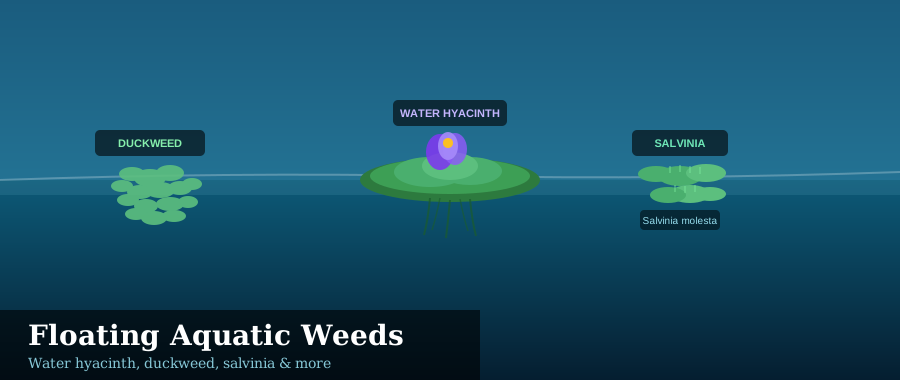
Floating weeds range enormously in scale and structure: from water hyacinth — a large plant with rosettes of glossy leaves, swollen spongy petioles, and conspicuous lavender flowers — to duckweed and watermeal, which are among the smallest vascular plants on earth. Despite this size variation, all floating weeds share the ability to reproduce vegetatively and exponentially under favorable conditions.
Biology and Growth Mechanisms
The biology of floating aquatic weeds explains both their ecological success and their management challenges. Several adaptations are particularly significant:
Flotation Structures
Most floating aquatic plants possess specialized structures that maintain buoyancy. Water hyacinth (Eichhornia crassipes) has distinctive bulbous, spongy petioles (leaf stems) filled with air-filled aerenchyma tissue that serve as natural flotation bladders. Frogbit has spongy leaf bases. Salvinia leaves are covered with hydrophobic hairs arranged in a distinctive eggbeater shape that trap air and maintain surface position even when partially submerged.
Duckweed and watermeal are so small and light that surface tension alone maintains their position at the air-water interface. Their rootless or single-rooted structure means there is no tethering to the bottom — pure free-floating mobility.
Vegetative Reproduction
All floating aquatic weeds reproduce primarily through vegetative fragmentation — the production of daughter plants from the parent. Under ideal conditions, this is far faster than sexual reproduction via seeds. Water hyacinth can double its population in 12 days. Salvinia can double its biomass in 2–4 days under optimal warm-water, high-nutrient conditions. Even duckweed — small as it is — can completely cover a still-water surface within days under eutrophic conditions.
This rapid vegetative reproduction means that physical fragmentation during control operations (e.g., manual removal, mechanical harvesting) can actually spread the problem if plant material is not contained and properly disposed of. Every fragment is a potential new plant. Comprehensive containment and removal protocols are essential during any mechanical control operation. See mechanical control guidance →
Ecological Impacts of Floating Weeds
Dense floating weed mats create multiple simultaneous ecological problems that compound each other. The primary impacts include:
- Light exclusion: A thick mat of water hyacinth or salvinia can reduce light penetration below the mat by 90% or more, killing all submerged vegetation beneath. This destroys habitat structure, eliminates food sources for native herbivores, and alters the thermal profile of the water column.
- Oxygen depletion: During daylight hours, floating plants produce oxygen above the surface but the mat prevents oxygenation of the water column below. At night, the decomposing mat consumes oxygen from the water, and dense mats can drive dissolved oxygen to near-zero levels, triggering fish kills. Summer die-offs of large floating weed mats are a primary cause of fish kills in Florida, Texas, and Louisiana.
- Navigation and recreation impairment: Mats of water hyacinth or salvinia can entangle and stall boat motors, making water bodies impassable. Even duckweed — individually tiny — forms mats that can be several inches thick and create significant drag. Water used for swimming, fishing, and boating becomes inaccessible.
- Mosquito and disease vector habitat: Still water beneath floating weed mats is ideal mosquito breeding habitat. In regions where mosquito-borne diseases (West Nile virus, Eastern equine encephalitis) are concerns, floating weed infestations represent a public health consideration in addition to an ecological one.
- Water quality degradation: As floating weed biomass decomposes, it releases nutrients stored in plant tissue back into the water column, fueling algal blooms and further eutrophication — a positive feedback loop that makes the underlying problem worse over time.
The combined ecological impact of floating aquatic weeds can effectively convert a healthy, productive aquatic ecosystem into a stagnant, anoxic, low-diversity environment within a single growing season. Recovery — even after successful weed control — can take multiple years. Explore all ecological impacts →
Species Profiles
- → Water Hyacinth Eichhornia crassipes — World's most productive floating weed; federally listed noxious weed; most problematic in the Gulf South. Full profile →
- → Common Duckweed Lemna minor — Most widespread floating plant on Earth; native but nuisance in eutrophic water bodies. Full profile →
- → Watermeal Wolffia spp. — World's smallest flowering plant; rootless, granular mats; difficult to detect until coverage is extensive.
- → American Frogbit Limnobium spongia — Native; miniature water-lily appearance; European frogbit is invasive in the Great Lakes region.
- → Giant Salvinia Salvinia molesta — Federally listed noxious weed; doubles biomass every 2–4 days; one of the world's worst aquatic invasive plants.
- → Azolla (Water Fern) Azolla spp. — Small floating fern; red-purple coloration; nitrogen-fixing symbiont; both native and non-native species occur.
How Floating Weeds Spread
Floating weeds spread both naturally and through human-assisted pathways. Understanding dispersal is essential for prevention programs:
- Boat transport: Plant fragments attached to hulls, trailers, propellers, and anchor chains are carried between water bodies by boaters. Giant salvinia infestations have been traced to single contaminated boat trailers in multiple documented cases.
- Waterfowl: Ducks, geese, herons, and other waterbirds regularly carry plant fragments and seeds on their feathers, feet, and in their digestive systems between water bodies.
- Flooding and water connections: Connected water bodies share floating plant populations during flood events. Drainage ditches, canals, and streams can rapidly distribute floating weeds across large areas.
- Horticulture trade: Water hyacinth, frogbit, and azolla are sold as ornamental pond plants. Illegal or irresponsible disposal of water garden plants into natural water bodies is a significant introduction pathway. Most U.S. states prohibit possession or transport of listed invasive aquatic plants.
Prevention — keeping all floating weed species out of new water bodies — is far more cost-effective than post-establishment management. Practicing Clean, Drain, Dry protocols after every water body visit is the single most important preventive action. Prevention and best management practices →
Control Methods
Floating aquatic weeds are managed using mechanical, chemical, biological, and integrated approaches. Each has specific strengths and limitations:
- Mechanical: Hand removal and mechanical harvesters can provide immediate relief for small to moderate infestations, but regrowth is rapid and containment of fragments is critical. Harvesters must be thoroughly cleaned to prevent spread.
- Chemical: EPA-registered aquatic herbicides including diquat, flumioxazin, and endothall are effective against water hyacinth and many other floating species. State permits are required. Water use restrictions (swimming, irrigation, drinking water) may apply following treatment. Professional application is strongly recommended.
- Biological: USDA-approved weevils (Neochetina eichhorniae and N. bruchi) provide long-term suppression of water hyacinth in warm-climate states but are ineffective in cold climates and do not provide rapid control. A moth (Niphograpta albiguttalis) is also used. Salvinia has an effective biocontrol weevil (Cyrtobagous salviniae) approved in Australia and tested in the U.S.
- Nutrient management: Addressing the underlying eutrophication that fuels floating weed growth is the only long-term solution for native nuisance species like duckweed. Reducing phosphorus and nitrogen inputs through best management practices in the watershed is essential for sustained management success.
Complete control methods guide → | Aquatic herbicide guide → | Biological control options →
Additional Resources
- Benefits and Risks of Floating Plants
- How Floating Weeds Spread
- U.S. Distribution by Region →
- Aquatic Weed Biology Hub →
Frequently Asked Questions
How fast can floating aquatic weeds spread?
Extremely fast. Water hyacinth doubles its population every 12 days under optimal conditions. Giant salvinia can double its biomass every 2–4 days in warm, nutrient-rich water. Duckweed, starting from a fraction of the surface area, can completely cover a still pond in less than a week. These rates mean that by the time a floating weed problem is noticed, significant population growth has already occurred. Early detection and rapid response are critical — a small new infestation is exponentially easier and cheaper to control than a large one.
Is duckweed always a problem?
Not always. Duckweed is native to most of North America and in small densities serves ecological functions — it provides food for waterfowl (mallards and wood ducks eat duckweed heavily), cover for small fish, and some nutrient uptake. The problem emerges when eutrophic conditions allow duckweed to achieve complete or near-complete surface coverage, blocking light and oxygen exchange. In those cases, the underlying water quality issue — typically excess nitrogen and phosphorus — is the root cause that must be addressed for any control to be lasting.
What is the difference between duckweed and watermeal?
Both are tiny floating plants, but watermeal (Wolffia spp.) is even smaller than duckweed (Lemna spp.) and has no roots at all. Duckweed fronds are 2–5mm across with a single hanging root visible underneath. Watermeal fronds are 0.5–1.5mm, granular-looking, and rootless, giving infested surfaces a fine-grained green or yellow-green texture rather than the more defined oval fronds of duckweed. Both are controlled similarly, but watermeal is generally considered more difficult to manage. Some watermeal species are native; the taxonomy is complex and several species may co-occur.
Do I need a permit to remove water hyacinth from my pond?
Permit requirements vary by state and method. Manual hand removal of small amounts from private property typically does not require permits in most states. However, mechanical harvesting equipment, chemical herbicide treatment, and biological control introductions almost always require state permits regardless of property ownership. Contact your state department of natural resources, department of agriculture, or water management district before taking any management action. In Florida, the management of aquatic plants is regulated by the Florida Department of Environmental Protection.
Can floating weeds be composted or used productively?
Yes, with significant caveats. Removed floating weed biomass can be composted, used as mulch, or in some cases used as animal feed (duckweed is nutritionally rich and used in aquaculture). However, all plant material must be allowed to fully desiccate — dry completely — before disposal or use elsewhere, to ensure no viable fragments are transported. Water hyacinth has been evaluated for biofuel production and wastewater treatment. These beneficial uses can help offset control costs but require careful management to prevent inadvertent spread. Never dump plant material back into any natural water body.
References and Further Reading
- Center, T.D., et al. (2002). "The mosaic of biological control agent impacts on water hyacinth." BioScience, 52(10), 879–887.
- Penfound, W.T., and T.T. Earle. (1948). "The biology of the water hyacinth." Ecological Monographs, 18(4), 447–472.
- Mitchell, D.S., ed. (1974). Aquatic Vegetation and Its Use and Control. UNESCO, Paris.
- Toft, J.D., et al. (2003). "The effects of introduced water hyacinth on habitat structure, invertebrate assemblages, and fish diets." Estuaries, 26(3), 746–758.
- USDA APHIS. (2021). Giant Salvinia (Salvinia molesta) Best Management Practices. USDA Animal and Plant Health Inspection Service.
- Sculthorpe, C.D. (1967). The Biology of Aquatic Vascular Plants. Edward Arnold Publishers, London.