Identification Features
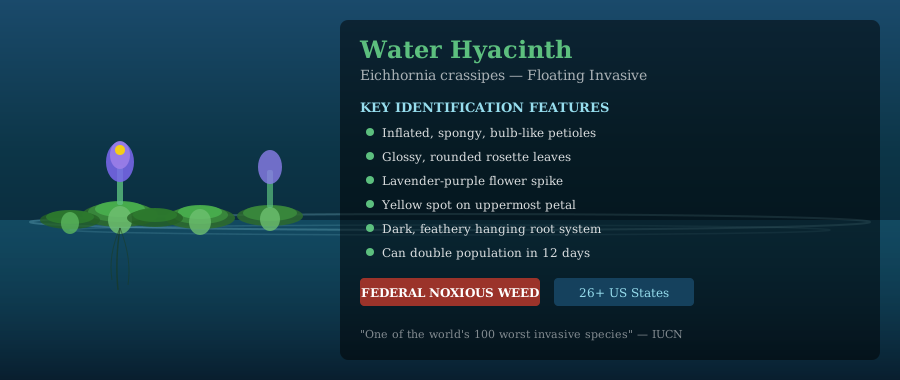
Eichhornia crassipes is one of the most distinctive floating plants in North America. The most immediately recognizable feature is the inflated, bulbous petiole — the leaf stalk is swollen with spongy aerenchyma tissue into a bulb-like bladder that provides the plant's buoyancy. This inflated petiole is diagnostic: no other common North American floating plant has this structure. Leaves are glossy, deep green, round to kidney-shaped, and stand 15–50 cm above the water surface on mature plants. Flowers are conspicuous: pale lavender to purple, orchid-like, arranged in a spike, with the uppermost petal marked with a yellow spot surrounded by a darker purple area. Root masses hang below in a feathery, dark purple-black curtain that can be 30–90 cm long.
The key diagnostic sequence: (1) floating plant with glossy, rounded leaves; (2) leaf stalk swollen into a balloon-like bulb; (3) purple flowers when in bloom; (4) dark hanging root mass. These four features together are unique to water hyacinth among common North American aquatic plants. See our leaf shapes guide for comparison with other floating plants.
| Feature | Description |
|---|---|
| Petiole | Bulbous, inflated with aerenchyma — diagnostic |
| Leaves | Round to kidney-shaped, glossy, deep green, 5–12 cm |
| Flowers | Pale lavender/purple spike, yellow spot on upper petal |
| Roots | Feathery, dark purple-black hanging mass |
| Growth form | Free-floating; not rooted in sediment |
Biology and Growth
Water hyacinth is one of the world's fastest-growing plants. Under ideal conditions — warm water (25–30°C), high nutrient levels, full sun — a single plant can produce a colony that covers a hectare within months. The documented maximum intrinsic rate of population increase is approximately 0.17 per day, giving a theoretical doubling time of 12 days. This exponential growth is driven entirely by vegetative reproduction: lateral stolons from the parent plant produce daughter plants that detach and become independent floating units. Sexual reproduction via seeds also occurs, producing seed banks that persist in sediment for 20+ years and can reestablish populations after control.
The inflated petiole is more than a flotation device — it is also a resource storage organ that allows the plant to survive temporary stresses (drought, shading, nutrient limitation). During nutrient-rich periods, the plant grows vigorously and the petiole deflates as growth resources are diverted to leaf and stolon production. When nutrients decline, petioles re-inflate and the plant shifts to a storage and survival mode.
Ecological Impacts
Dense water hyacinth mats reduce light penetration to the water below by 90–99%, eliminating submerged native vegetation and the spawning habitat, refuge, and food supply that native vegetation provides to fish. Nighttime dissolved oxygen levels beneath thick mats can drop to near-zero, causing fish kills. The still water beneath mats creates ideal mosquito breeding habitat. Decomposing water hyacinth biomass releases nutrients that fuel algal blooms, creating a positive feedback loop that sustains eutrophication even after plant removal. Full ecological impact overview →
Water hyacinth is a federally listed noxious weed. Interstate transport and sale is prohibited. State regulations vary — many states prohibit possession entirely. Florida alone spends $15–20 million annually managing water hyacinth in public water bodies.
Distribution and Habitat
Native to South America (tropical regions of Brazil), water hyacinth is now established across the southeastern United States — particularly Florida, Louisiana, Texas, and Georgia — and in California's Sacramento-San Joaquin Delta. It requires frost-free conditions or mild winters for year-round establishment; in colder climates it may overwinter from seeds or protected plants near shorelines. The species is most problematic in warm, nutrient-enriched (eutrophic) water bodies: shallow lakes, farm ponds, drainage canals, and river backwaters. It is generally absent from cool northern states except as a temporary introduction. Southeast distribution →
Control Methods
Water hyacinth is managed through mechanical removal, aquatic herbicide application, and USDA-approved biological control agents. An integrated program combining methods is most effective for sustained management:
- Mechanical: Harvesting machines provide immediate biomass reduction and access restoration. All collected material must be contained and removed from the water body — fragments regenerate. Effective for small to moderate infestations.
- Chemical: EPA-registered herbicides including 2,4-D (Aquamine, Navigate), diquat (Reward), glyphosate (Rodeo/AquaMaster), and flumioxazin (Clipper) are effective. State permits required. Water use restrictions (livestock watering, swimming, irrigation) apply after treatment. Professional application recommended.
- Biological: Two USDA-approved weevil species — Neochetina eichhorniae and N. bruchi — provide long-term suppression in warm-climate states. They do not provide rapid knockdown but reduce plant vigor and growth rate over 2–4 years of establishment. A stem-boring moth (Niphograpta albiguttalis) is also used. Biocontrol is most appropriate as a long-term suppression tool combined with initial chemical reduction.
Frequently Asked Questions
Is water hyacinth native to the United States?
No. Water hyacinth is native to tropical South America, specifically Brazil. It was introduced to the United States in the late 1800s — reportedly first displayed at the 1884 Cotton States Exposition in New Orleans and subsequently spread when visitors planted it in local waterways. It is now established across the southeastern U.S. and is a federally listed noxious weed prohibited from interstate transport or sale.
Can water hyacinth be used for anything beneficial?
Yes, water hyacinth has been studied and used for wastewater treatment (it absorbs heavy metals and excess nutrients from wastewater in constructed treatment systems), composting and biogas production, and as livestock fodder in some tropical countries. However, none of these uses justify allowing wild infestations to persist, and managed beneficial uses must be strictly controlled to prevent spread. Never introduce water hyacinth to natural water bodies for any purpose.
Why does water hyacinth keep coming back after I remove it?
Water hyacinth regrowth after removal is driven by several factors: seeds in the sediment that germinate after disturbance (seeds can persist 20+ years); small fragments that were missed or escaped containment during removal; re-introduction from upstream or connected water bodies; and persistent root crowns in protected shallow areas. Long-term management requires addressing all three persistence mechanisms — physical removal, herbicide treatment to kill roots and prevent seeding, and monitoring for re-introduction from external sources.
→ Full water hyacinth authority page | Aquatic herbicide guide | Biological control