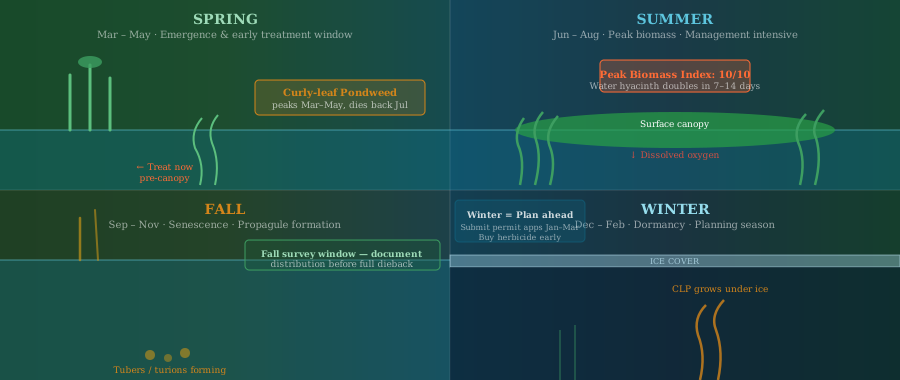
Fall: Transition and Management Opportunities
Fall is a transition season in aquatic weed biology — most warm-season species begin to decline as water temperatures drop and photoperiod shortens, while curly-leaf pondweed and other cool-season species begin their growth cycle. This seasonal transition creates specific management opportunities that, when correctly timed, can reduce the following season's management burden at significantly lower cost and effort than summer interventions. Understanding the biology of fall dieback — and the propagule production that accompanies it — is essential for planning management activities that reduce next year's infestation density.
Natural Senescence of Warm-Season Species
Most invasive warm-season aquatic weeds begin senescence in late summer and fall as water temperatures drop below their growth optimum:
- Eurasian watermilfoil: Stem tip die-off accelerates in August–September in the northern U.S. Fragmentation peaks as stems weaken and break in wind and current. The combination of natural fragmentation and late-season boating generates maximum fragment dispersal risk in August–September. Below-surface root crowns persist through winter and resume growth the following spring.
- Water hyacinth: Above-ground biomass is killed by frost. The timing of the first killing frost determines the end of the active management season. Seeds drop to the sediment before frost in years with sufficient seed production, creating a persistent seed bank.
- Duckweed: Produces dormant turion-like structures that sink to the sediment in fall. Some populations overwinter as resting buds in protected areas (leaf litter, sheltered bays). Growth ceases or dramatically slows as water temperatures drop below 10°C.
- Hydrilla: Above-ground stem growth slows dramatically in fall but does not completely cease until water temperatures drop below approximately 10–12°C. Tuber production in late summer (August–October) is completing as fall begins — this is the period when the tuber bank is being replenished for the following season.
Propagule Production in Late Summer–Fall
The period of plant senescence coincides with peak propagule production — the overwintering structures that ensure next year's population. Understanding this timing is critical for management planning:
- Hydrilla tubers: Produced August–October, peak September–October. Tubers drop to the sediment as plants senesce. By the time above-ground hydrilla biomass has largely disappeared in late October–November, the tuber bank for next year is fully replenished.
- Hydrilla turions: Produced in leaf axils August–September. Detach and sink to sediment as plants senesce.
- Curly-leaf pondweed turions: Produced April–June (spring, not fall). Fall-germinating seeds and sprouting turions begin new growth in fall.
- Eurasian watermilfoil overwintering root crowns: Persist through winter as metabolically active perennial tissue in the sediment, ready to produce new shoots in spring.
Fall Management Opportunities
Late-Season Herbicide Treatment for Curly-leaf Pondweed
Fall is a window for herbicide treatment specifically targeting curly-leaf pondweed. Because curly-leaf pondweed begins growing in late summer–fall from germinating turions, endothall or other registered herbicides applied in late September–October can target new seedlings before they overwinter and build large biomass for spring. This fall treatment window supplements (or in some cases replaces) the spring early-season treatment window. The advantage of fall treatment: plants are small, growth is active, and early kill of seedlings prevents biomass and spring turion production. The disadvantage: water is cooling and plant uptake may be slower than in warmer spring conditions. Not all states have permit windows that accommodate fall treatment — check with your state DNR.
Reducing Milfoil Fragment Dispersal
Fall is when Eurasian watermilfoil fragment dispersal is highest due to natural senescence fragmentation and continued boat traffic. End-of-season containment operations — harvesting milfoil from highest-use boat traffic areas to reduce fragment generation — can reduce within-lake spread at this critical time. More importantly, fall is when boat cleaning and decontamination for end-of-season storage must be enforced. Boats stored wet or with plant fragments attached after the last use of the season will carry viable fragments and propagules to new water bodies when they are launched next spring.
Fall Surveys and Documentation
Early fall (September–October) surveys capture the full season's population status before biomass dies back. This is the best time for annual documentation — taking GPS coordinates and photos of all infestation locations, estimating biomass, and documenting the effectiveness of that season's management programs. Autumn survey data informs next year's management plan and permit applications. Many state permit applications require the previous year's survey data as part of the application documentation.
Water Drawdown Initiation
For lakes where winter drawdown is a management option (regulated lakes and reservoirs with controllable water levels), fall is when drawdown should be initiated. Drawing down water levels in October or November exposes the shallow littoral zone to winter air temperatures, desiccating and freezing propagules in exposed sediment. Timing must account for the onset of ice formation, fish spawning timing, and wildlife habitat considerations. Contact your state DNR and Army Corps of Engineers (if a regulated impoundment) for permit requirements and timing guidance well in advance of the drawdown season. See winter dormancy for the next seasonal phase.
References
- Madsen, J.D. (1993). Aquatic weed management timing. Journal of Aquatic Plant Management 31:33–36.
- Bolduan, B.R. (1994). Curly-leaf pondweed fall management. Journal of the Minnesota Academy of Science 59:3–8.
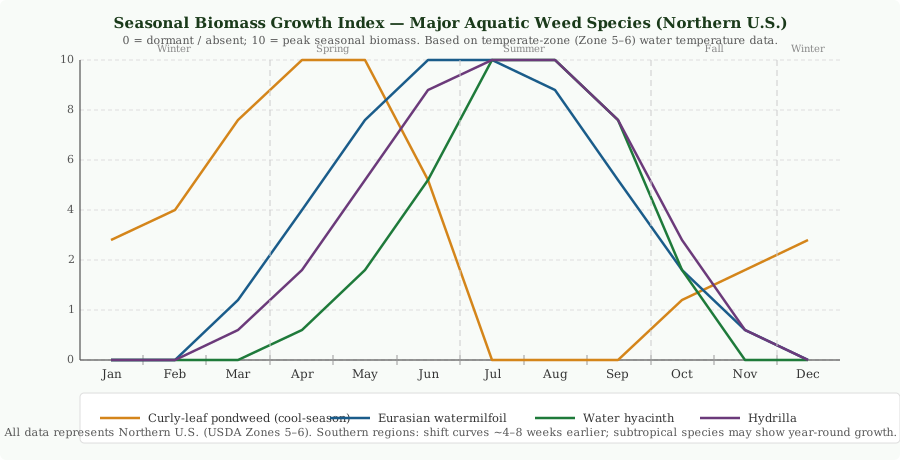
Regional Variation in Fall Dieback Timing
Fall dieback timing shifts dramatically with latitude and climate zone, and managers must adjust their fall treatment calendars accordingly:
- Zone 4–5 (Upper Midwest, northern New England): Natural senescence of warm-season species begins in late August–September. First frost kills above-ground floating plant biomass in September–October. Optimal fall herbicide window for curly-leaf pondweed: October–November, when new turions are germinating.
- Zone 6–7 (mid-Atlantic, southern Midwest, Pacific Northwest): Warm-season biomass decline October–November; significant management activities possible through October. CLP turion treatment window October–December.
- Zone 8–9 (Southeast, Gulf Coast, California): Warm-season species decline only with early winter temperature drops (November–December in most of this zone); water hyacinth and hydrilla may maintain reduced growth through "winter." No true fall dieback — management transitions from summer intensity to lower-level winter maintenance.
The sharp contrast between Zone 4 and Zone 9 management calendars illustrates why regional context is critical: a fall management technique proven effective in Minnesota may have no equivalent application in Louisiana. Regional distribution guides →
Fall Biomass Decline and Survey Opportunity
Fall's transition from peak biomass to dieback provides a particularly valuable opportunity for survey and assessment work that informs next year's management program:
- Post-treatment efficacy assessment: Fall surveys (conducted 6–10 weeks after last summer treatment) document what survived the season's management program — providing direct evidence of what worked, what failed, and where retreatment or method adjustments are needed.
- New infestation detection: In late September–October, before full dieback, GPS-based mapping of all infestation patches while vegetation is still visible creates the distribution baseline for the following year's management plan.
- CLP early detection: In October–November, newly germinated curly-leaf pondweed rosettes (small, 2–5 cm) are visible in the shallow littoral zone before snow cover makes monitoring impossible. This is the only window for detecting CLP presence before the spring management rush.
See the monitoring and survey methods guide for fall survey protocols and the mapping and documentation guide for recording fall distribution data. Winter management considerations →