Overview
Coontail (also called hornwort) is a rootless submerged aquatic plant native to North America. Unlike most aquatic plants, coontail floats freely in the water column or is anchored only loosely in sediment — it has no true roots. It plays important ecological roles as fish habitat, waterfowl food, and invertebrate cover, but can become dense and problematic in nutrient-rich waters where it may impede recreation and reduce water quality.
Identification Characteristics
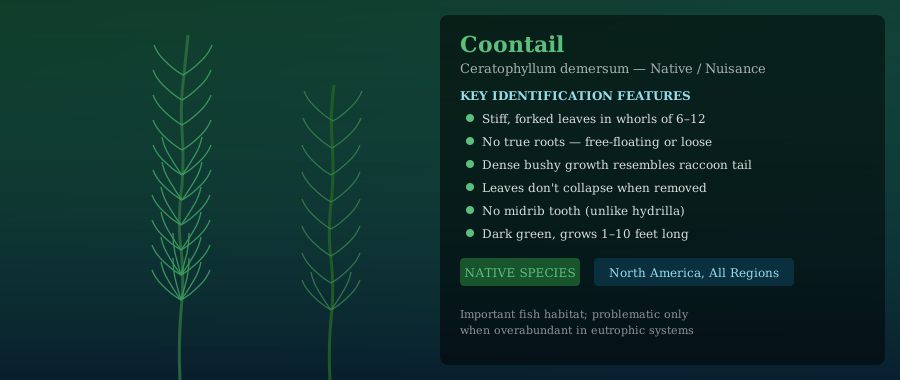
Coontail is one of the most distinctive native submerged plants, easily recognized by several unique features. Its rigid, dark green leaves are forked 2–4 times and arranged in dense whorls of 6–12 around the stem. This dense, bushy growth pattern, tapering toward the tips of branches, gives the plant the appearance of a raccoon's tail — the source of its common name. The leaves are stiff and hold their shape when removed from the water, unlike hydrilla and milfoil which tend to collapse.
The most diagnostic feature is the absence of true roots. While coontail may produce root-like structures (rhizoids) that anchor loosely in soft sediment, it has no functional root system and derives nutrients directly from the water column. This distinguishes it from virtually all other native submerged macrophytes.
Identification confusion most commonly occurs with hydrilla. Key distinctions: coontail leaves are much stiffer and fork multiple times, while hydrilla leaves are smaller and do not fork; coontail has no midrib tooth (hydrilla has a single diagnostic tooth on the leaf midrib underside); coontail has no roots whatsoever; and coontail leaves are not serrated along the sides in the way hydrilla leaves are.
Growth Habit & Ecology
Coontail is a native perennial that reproduces through vegetative fragmentation and seeds. Like many aquatic plants, even small stem fragments can root and establish new plants. It also produces turions — compact winter buds that sink to the sediment and remain dormant through winter, regrowing in spring.
Growth is typically most vigorous in warm (65–85°F), nutrient-rich water with moderate light. Coontail is tolerant of a wider range of light conditions than many native submerged plants, including turbid, eutrophic systems where other species struggle. This tolerance, combined with its lack of root competition for sediment nutrients, makes it competitive in degraded conditions.
Dense coontail beds can extend from shallow water to depths of 6–10 feet or more in clear conditions. The plant forms a characteristic gradation — denser growth in shallower water where light is ample, becoming sparser at depth as light diminishes. In very nutrient-rich ponds and lakes, coontail can form thick mats that reach the surface.
Habitat Preferences
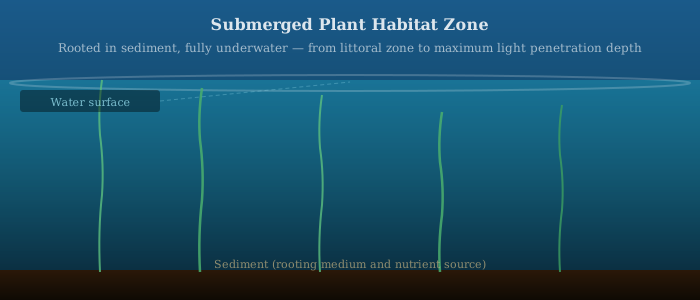
Coontail is one of the most ecologically flexible native submerged plants in North America, occupying a remarkably broad range of freshwater habitats. It grows in ponds, lakes, marshes, slow-moving rivers, backwater channels, drainage ditches, and created wetlands. Unlike many native submerged plants that require clear, well-oxygenated water, coontail is distinctly tolerant of eutrophic conditions — turbid water, reduced oxygen, and high nutrient levels that eliminate competing species.
Its most distinctive habitat adaptation is rootlessness: because coontail has no functional root system and absorbs nutrients directly from the water column, it is not limited by sediment quality or depth in the way rooted plants are. It can establish on hard substrates (gravel, clay, even bare rock), in very soft organic sediments where rooted plants would have difficulty anchoring, or literally floating free in the water column without any substrate attachment. This versatility expands its potential habitat to include environments inaccessible to most competitors.
Coontail is most problematic in nutrient-enriched water bodies — agricultural ponds, lakes in farming watersheds, suburban retention ponds receiving lawn and road runoff, and ponds with dense waterfowl populations that contribute direct nutrient loading. In clean, well-oxygenated, oligotrophic lakes, coontail is typically sparse and co-occurs with diverse native plant communities rather than forming monocultures.
Spread Mechanisms
Coontail spreads readily by vegetative fragmentation — stem pieces detach in response to physical disturbance (waves, animal activity, harvesting equipment, boats) and float freely in the water column until they become lodged in a new location and produce root-like rhizoids that anchor the fragment. Even very small fragments with a single node can establish new plants. Dense beds produce large quantities of fragments naturally through physical breakup.
Waterfowl are the primary natural long-distance vector. Diving ducks that feed heavily on coontail (canvasbacks, ringnecks, coots) carry stem fragments on their feet, bills, and feathers between water bodies throughout their ranges. Migratory waterfowl spread coontail along flyway corridors. Wading birds, herons, and shore birds that wade through coontail beds also contribute to local and short-distance spread.
Flooding is an important secondary vector, dispersing coontail fragments and turions through connected waterways during high-water events. Equipment — boats, fishing gear, waders — can also carry fragments between water bodies. Coontail is native and broadly distributed, so intentional introduction into isolated ponds for fish habitat is also a documented spread pathway. Once established, it is essentially impossible to eradicate and management focuses on controlling density rather than elimination.
Seasonal Growth Pattern
Coontail follows a relatively straightforward seasonal pattern tied closely to water temperature and light availability. In temperate regions, growth begins in spring as water temperatures warm above 50°F, typically in April in the northern U.S. Initial growth is slow, accelerating as water warms through May and June.
Peak biomass occurs in summer — July and August — when warm temperatures (65–85°F), long days, and abundant light drive maximum growth rates. Dense beds can form canopies that reach the water surface in shallow areas, and in highly eutrophic ponds, growth may be dense enough to cause management concerns during this peak period. Fish spawning associated with coontail beds typically occurs in spring and early summer.
Senescence begins in fall as temperatures drop and day length shortens. Stems begin to die back in September and October in northern states. Some populations produce turions — dense winter buds — that sink to the sediment and remain dormant through winter, re-sprouting in spring. Root-like rhizoids and dormant crowns also persist through freezing, providing a reliable source of spring regrowth. In mild winters or in the South, some coontail may remain green year-round. Early spring growth before the major waterfowl spring migration peaks (March–April) means that each year's cohort of migrating ducks encounters coontail-rich environments, reinforcing its presence in established habitats.
From a management perspective, coontail's seasonal pattern means that summer access complaints — when dense beds are most apparent to recreational users — correspond to peak ecological productivity and peak invertebrate community richness. Treatment applied at summer peak, while satisfying from a recreation standpoint, disrupts the same habitat value that makes coontail ecologically important. Lake managers working with coontail should develop seasonal density targets (maximum acceptable coverage during peak summer months) and focus mechanical management interventions to specific areas of highest impact (swimming areas, dock access, navigation channels) rather than whole-lake suppression. Native plant community monitoring in the same seasonal window — documenting which native species are co-occurring with coontail — provides essential context for deciding whether coontail density is truly problematic or reflects a healthy, if dense, native plant community. Consulting your state department of natural resources before initiating any management action on native coontail is both a regulatory best practice and an ecologically responsible first step. A targeted, conservative management approach preserves the ecological value coontail provides while addressing specific access and navigation concerns.
Ecological Impact
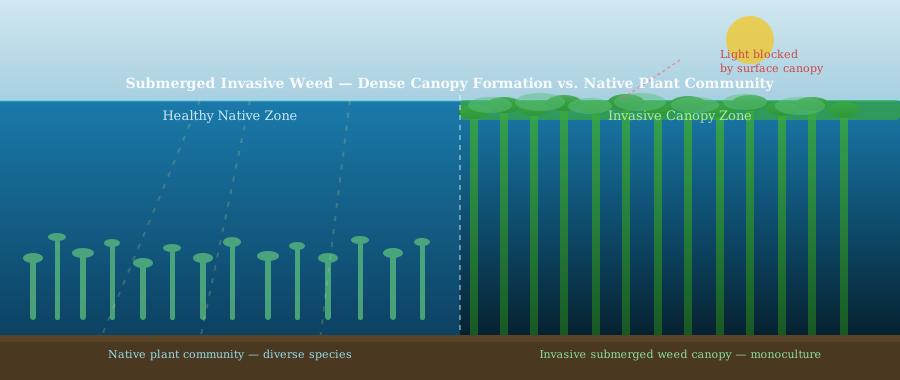
Coontail's ecological role is primarily positive in its native range. Dense coontail beds provide critical habitat functions: spawning substrate for bass, panfish, and other game fish; cover for juvenile fish and prey items; foraging areas for diving ducks (particularly canvasbacks, redheads, and ring-necked ducks, which consume coontail) and other waterfowl; and habitat for aquatic invertebrates that form the base of aquatic food webs.
However, in nutrient-enriched water bodies, coontail growth can become excessive. Very dense beds can impede recreational uses — swimming, boating, and fishing — and reduce oxygen through nighttime respiration and decomposition. Because coontail is a native species playing important ecological roles, management goals typically aim for reduction to acceptable levels rather than elimination.
An important distinction: when coontail becomes "weedy" or problematic, it is typically a symptom of underlying eutrophication rather than an inherently invasive behavior. Addressing the nutrient loading that fuels excess growth is generally more effective and ecologically sound than targeting the plants directly.
Control Methods
Because coontail is a native species with important ecological value, control decisions should carefully weigh benefits against costs. Complete removal of coontail from a water body is almost never appropriate and would harm the fish, waterfowl, and other organisms that depend on it.
Nutrient reduction is the most ecologically sound approach and the only one that addresses the underlying cause of excess growth. Implementing agricultural best management practices, repairing failing septic systems, establishing vegetated buffers, and reducing fertilizer inputs can gradually reduce the nutrient loading that drives excessive coontail growth.
Mechanical harvesting can reduce coontail biomass and improve recreational access in targeted areas. Repeated harvesting multiple times per growing season may be necessary. Harvested material should be composted away from the water body.
Aquatic herbicides (diquat, endothall, copper-based compounds) can control coontail in targeted areas but may also affect other native vegetation. Use should be limited to areas where coontail is clearly causing unacceptable impacts.
Triploid grass carp readily consume coontail and are used for management in some states. Caution is warranted because grass carp will also consume other beneficial native vegetation.
Important: Always obtain required permits before applying any aquatic herbicide or introducing biological control agents. Requirements vary by state. Contact your state department of natural resources or environmental protection agency for guidance.
Distribution in the United States
Coontail is native to North America and found throughout the continental United States, from southern Canada to the Gulf Coast. It is among the most widely distributed native submerged aquatic plants in the country, present in ponds, lakes, rivers, and wetlands in all regions.
Problem blooms — defined as growth dense enough to significantly impair recreational use or water quality — are most common in the agriculturally intensive Midwest and South, where nutrient loading from row crops and livestock operations enriches water bodies. The Mississippi River basin and its tributaries, the Chesapeake Bay watershed, and other areas with heavy agricultural nutrient inputs frequently experience excessive coontail growth. Urban and suburban ponds receiving stormwater nutrient loading are also commonly affected.
Frequently Asked Questions
Is coontail native or invasive?
Coontail (Ceratophyllum demersum) is native to North America. While it can become problematic in nutrient-rich water bodies, it is not classified as an invasive species and plays important ecological roles as fish habitat and waterfowl food. Management is warranted only when growth becomes dense enough to significantly impair water uses.
What is the difference between coontail and hydrilla?
Key differences: Coontail leaves are stiffer and fork multiple times, while hydrilla has smaller, un-forked leaves with visible serrations. Coontail has no true roots; hydrilla has root systems and produces underground tubers. Coontail leaves have no midrib tooth — hydrilla has a single diagnostic tooth on the midrib underside. Coontail is native to North America; hydrilla is an invasive non-native species.
Can coontail grow without roots?
Yes — coontail is one of very few aquatic plants that has no true root system. It absorbs water and nutrients directly through its leaves and stems. It may produce hair-like rhizoids that anchor loosely to the sediment, but these are not functional roots. This rootless characteristic makes coontail visually distinctive and is a reliable identification feature.
References & Further Reading
- Nichols, S.A. & Shaw, B.H. (1986). Ecological life histories of three aquatic nuisance plants: Myriophyllum spicatum, Potamogeton crispus, and Elodea canadensis. Hydrobiologia 131:3–21.
- Carpenter, S.R. & Lodge, D.M. (1986). Effects of submersed macrophytes on ecosystem processes. Aquatic Botany 26:341–370.
- Wetzel, R.G. (2001). Limnology: Lake and River Ecosystems (3rd ed.). Academic Press, San Diego.