Identification Features
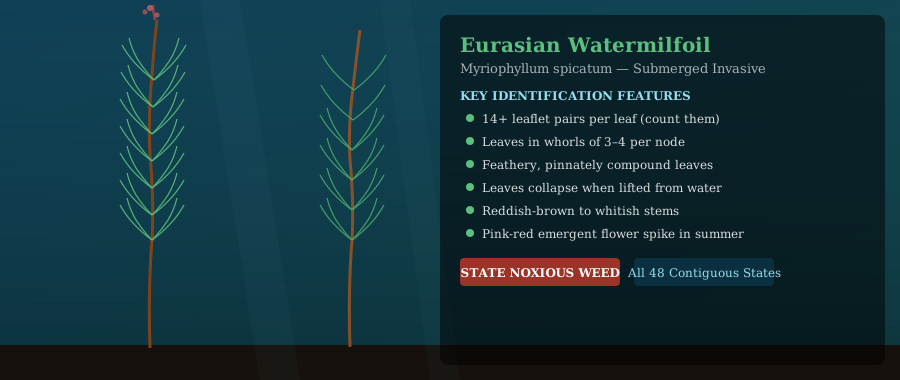
Eurasian watermilfoil (Myriophyllum spicatum) has the most distinctive leaf structure of any common submerged aquatic weed: leaves are pinnately divided (feather-like), with 12–21 pairs of thread-like segments arranged along a central axis — giving each leaf the appearance of a tiny green feather or comb. This pinnate leaf structure is immediately recognizable and distinguishes milfoil from all common submerged weeds except native milfoil species.
The critical identification challenge is distinguishing Eurasian milfoil from native milfoil species, particularly Northern watermilfoil (Myriophyllum sibiricum). The diagnostic character: count the pairs of leaflet segments on mature leaves. Eurasian milfoil has 12–21 pairs per leaf. Northern watermilfoil has 5–9 pairs per leaf. Collect several leaves from mid-stem (not tip growth, which can be atypically divided) and count consistently. Additional features: the leaves wilt and collapse when removed from water (distinctive "limp" character); emergent flower spikes have bracts shorter than the individual flowers. Detailed species comparison →
| Feature | Eurasian Milfoil | Northern Milfoil (Native) |
|---|---|---|
| Leaflet pairs | 12–21 ★ | 5–9 |
| Flower bracts | Shorter than flowers ★ | Longer than flowers |
| Origin | Eurasia (invasive) | Native to North America |
Biology and Spread
Eurasian watermilfoil's primary dispersal mechanism is vegetative fragmentation: stems break apart easily — especially when disturbed by boats, motors, or water currents — and every stem fragment with a node can root and become a new plant. Boating activity is the leading human-assisted dispersal vector. Milfoil fragments that adhere to boat hulls, trailers, and propellers are transported between water bodies. A fragment as small as a single node and pair of leaves can establish a new population.
Growth pattern: milfoil grows from the sediment in spring, forming long stems that reach the surface and then grow horizontally to form a surface canopy. Apical branching at the surface creates the characteristic dense mat appearance. At its peak in midsummer, a milfoil mat can reduce light penetration below it by 80–90%, eliminating all native submerged plant growth under the mat. Vegetative fragmentation biology →
Ecological Impacts
Dense milfoil canopies displace native submerged plant communities, degrade fish spawning and foraging habitat, entangle boat propellers, and impede swimming. Milfoil monocultures in the Midwest and Northeast have been documented to reduce fish species diversity, particularly cool-water species like walleye that require open water for feeding. The replacement of diverse native plant communities with milfoil monoculture represents a fundamental loss of ecosystem function. Fish and wildlife habitat effects →
Distribution
Established in all 48 contiguous U.S. states and most Canadian provinces. Most problematic in the northern Midwest (Wisconsin, Minnesota, Michigan), Northeast, Pacific Northwest, and mid-Atlantic. Midwest distribution | Northeast distribution
Control
Primary chemical tools: fluridone (whole-lake systemic control), triclopyr (selective for milfoil with reduced effect on native milfoils — the most selective option available), 2,4-D (effective, widely registered), endothall (spot treatment). Triploid grass carp (permit required) provide biological control. Harvesting provides temporary access restoration but promotes fragmentation spread if not carefully managed. A new pheromone-based deterrent is under research. Control methods hub →
Frequently Asked Questions
Can Eurasian watermilfoil hybridize with native milfoil?
Yes. Eurasian watermilfoil and Northern watermilfoil can hybridize, producing hybrid plants that may have characteristics intermediate between the two species or, in some cases, greater invasiveness than either parent. Hybrid milfoil has been documented in multiple U.S. and Canadian states, and in some cases hybrids have proven more resistant to herbicide treatment than the Eurasian parent. Hybrid identification requires genetic testing — morphological features are not reliable for distinguishing hybrids from pure species. Herbicide programs in areas with confirmed hybrid milfoil should be designed to account for potential reduced herbicide sensitivity.
Is milfoil getting worse in the Great Lakes region?
Milfoil remains a significant management challenge in the Great Lakes region, but sustained management efforts by state DNR programs, lake associations, and federal programs have achieved meaningful improvements in some water bodies. The key factors are early detection of new infestations and rapid response while populations are small, combined with boat inspection and decontamination to prevent new introductions. Milfoil management is considered a perpetual commitment for most affected lakes — it is suppressed, not eradicated, in most large water body situations.
Hybrid Milfoil and Herbicide Resistance
One of the most significant emerging management challenges in Eurasian watermilfoil management is the documented presence of hybrid milfoil — natural hybrids between Myriophyllum spicatum and native Northern watermilfoil (M. sibiricum). Hybrid milfoil populations have been confirmed in multiple states, particularly in the Great Lakes region and the Northeast. In several documented cases, hybrid milfoil has shown reduced sensitivity to fluridone — the most widely used systemic aquatic herbicide for milfoil control — compared to pure Eurasian milfoil. This reduced sensitivity means management programs designed around established fluridone dose-response curves may under-treat hybrid populations.
Triclopyr amine and triclopyr ester formulations have shown efficacy against both pure Eurasian milfoil and some hybrid populations and are now widely used as the preferred selective control option in states where the distinction between Eurasian milfoil and native milfoil is an active management concern. Genetic testing of milfoil populations prior to initiating a management program is recommended in water bodies where hybrid milfoil is suspected, to inform herbicide selection. For lakes with known hybrid milfoil, state DNR guidance and recent peer-reviewed management literature should be consulted before designing herbicide programs. Aquatic herbicide guide →
Full Species Profile: Visit the Eurasian Watermilfoil authority page →