Two Strategies, One Goal: Maximum Proliferation
Aquatic weeds are evolutionary specialists in proliferation. They exploit two fundamentally different reproductive strategies — sexual (seed-based) and vegetative (fragment-based) — and most invasive species have perfected both. Understanding which strategy dominates for a given species is essential for designing effective management programs, because the two strategies require entirely different management responses. A program that kills adult plants but leaves a dense seed bank or intact propagule reserve will see the population regenerate fully within one to three seasons.
Sexual Reproduction: Seeds and Seed Banks
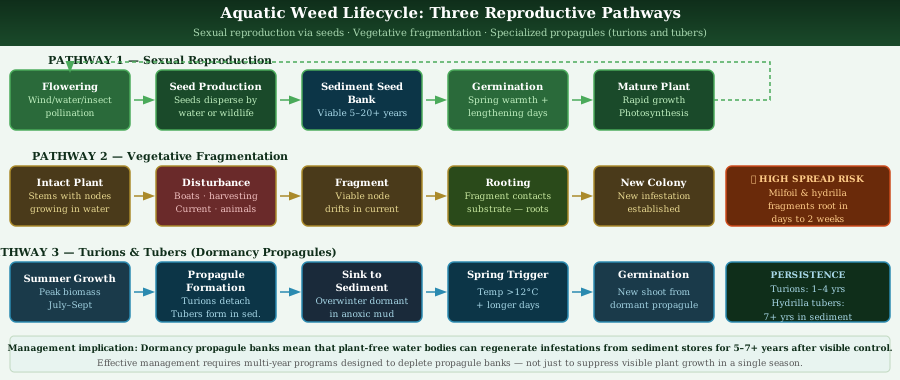
Sexual reproduction in aquatic plants requires flower pollination (by wind, water current, or insects), fertilization, and seed development. Seeds provide genetic diversity, enable long-distance dispersal to new water bodies, and — most importantly from a management perspective — produce a sediment seed bank: a reservoir of dormant seeds in the lake bottom that can persist for years or decades and regenerate the population long after all visible plants have been controlled.
Seed bank persistence varies dramatically by species. Water hyacinth seeds can remain viable in the sediment for 20 or more years. Curly-leaf pondweed turions (a modified vegetative propagule functionally analogous to seeds) persist for 3–5 years. Hydrilla seeds remain viable for up to 4 years in sediment. Purple loosestrife produces millions of seeds annually, creating an essentially inexhaustible seed bank in infested wetlands. These long-lived reserves mean that apparent above-ground eradication is frequently followed by full population regeneration from the seed bank — this is a primary reason why permanent elimination of established invasive aquatic plants from a water body is so difficult. Hydrilla reproductive biology →
Some aquatic weeds have evolved specializations for underwater or water-surface pollination. Hydrilla releases male flowers that detach and float to the surface, releasing pollen in a surface film captured by tethered female flowers. This reduces dependence on pollinators and allows successful sexual reproduction even when the plant is fully submerged in areas with limited insect populations — a significant adaptation for a plant that lives and grows primarily underwater. Milfoil reproductive strategies →
Vegetative Reproduction: Fragmentation
Vegetative fragmentation is the primary spread mechanism for most problematic invasive aquatic plants. The principle is straightforward: any plant fragment containing at least one viable node (the junction where leaves attach to the stem) can root and grow into a complete new plant when it contacts suitable substrate. No flowers, seeds, or genetic recombination are needed — the fragment is genetically identical to the parent plant.
The management implications are severe. Mechanical disturbance — harvesting, cutting, boating, propeller turbulence — that breaks plants into fragments without removing all fragment material from the water actively disperses the infestation. Eurasian watermilfoil infestations in northern lakes have been traced directly to harvesting operations that released untreated stem fragments. Boater traffic from infested to uninfested lakes transports fragments on hulls, trailers, and water-holding equipment. A single viable fragment is sufficient to establish a new colony. Detailed fragmentation guide →
Specialized Vegetative Propagules: Turions and Tubers
Beyond simple fragmentation, several species produce specialized dormancy structures designed for long-term survival and deferred germination:
- Turions: Dense, starch-filled dormancy buds formed in late summer and fall that detach from the parent plant, sink to the sediment, and survive winter in a metabolically suppressed state before germinating the following spring. Found in hydrilla (axillary turions along stem internodes), coontail (Ceratophyllum demersum), water violet, and several Potamogeton pondweed species. Turion viability in sediment typically ranges from 1–4 years — long enough to regenerate populations for multiple seasons after parent plants are suppressed. Turion and tuber biology →
- Tubers: Starchy underground storage organs produced in the sediment by hydrilla, particularly the dioecious biotype common in Florida and the Southeast. Hydrilla tubers are produced on stolon tips at depths up to 20 cm in the sediment, are highly resistant to desiccation and anoxia, and have documented viability of 7 or more years in anoxic sediment. The tuber bank is the primary reason hydrilla cannot be permanently eradicated from established populations with single-year treatment programs — viable tubers continue germinating for years after all above-ground and shallow below-ground management. Hydrilla management strategies →
- Stolons: Horizontal above-ground stems that grow across the water surface or sediment, producing new plants at nodes. The primary lateral spread mechanism for water hyacinth, European frogbit, and alligator weed. Stolon-based spread is extremely rapid — water hyacinth can double its surface coverage in as little as 14 days under ideal conditions. Water hyacinth biology →
Why Multiple Strategies Make Management So Difficult
The combination of sexual and vegetative reproduction — with multiple vegetative pathways operating simultaneously — means that every management approach faces at least one regeneration mechanism it cannot fully address. Herbicides that kill adult plants may leave seeds in the bank and fragments dispersed in the lake. Mechanical removal that eliminates fragmentation risk leaves root systems and turions intact. This is the fundamental biological reason why effective aquatic weed management requires multi-year integrated programs rather than single-season single-method treatments. Integrated management approaches →
Reproduction Rates: Why Species Become Invasive
Native aquatic plants typically have reproductive rates balanced by co-evolved herbivores, pathogens, and competitive pressures from their native habitat community. Invasive species introduced to new environments are released from these checks — the insects, fungi, and fish that suppressed their populations in their native range are absent. The result is that invasive species can express their full reproductive potential, which is often dramatically higher than native competitors: water hyacinth doubling in 14 days; hydrilla growing 2–3 cm per day under optimal conditions; Eurasian milfoil producing 250 million viable fragments per hectare per year in dense infestations. The absence of co-evolved biological controls is the biological explanation for why management of these species is so persistent and resource-intensive. Biological control strategies →
Frequently Asked Questions
What makes invasive aquatic plants reproduce faster than native species?
Invasive aquatic plants are not inherently faster reproducers than all natives — but in their introduced range, they encounter none of the co-evolved biological checks (specialist herbivores, pathogens, competitors) that regulate them in their native range. Their reproductive potential, which is held in check at home, is fully expressed in new environments. Additionally, many invasive species have been accidentally selected for high reproductive rates through the introduction process itself, since individuals that spread rapidly from a few founder propagules are disproportionately represented in founding populations.
If I remove all the plants from my lake, will they come back?
For established invasive species, yes — almost certainly. The seed bank, turion bank, or tuber bank in the sediment will continue germinating for years to decades after visible plants are removed. Additionally, re-introduction pressure from connected water bodies or from waterfowl transporting propagules is constant. Complete eradication of an established invasive aquatic plant from a lake or large water body has been achieved in only a handful of documented cases, usually early-stage introductions detected within the first 1–2 years before populations became established. Long-term management programs focus on reducing populations to ecologically tolerable levels and preventing further spread rather than on eradication.
How do aquatic plants spread from lake to lake?
The primary pathway for spread between water bodies is watercraft transport — fragments, turions, and seeds attached to boat hulls, trailers, propellers, live wells, bilge water, and fishing gear. Secondary pathways include waterfowl transport (seeds and fragments in feathers, feet, and digestive systems), intentional release of aquarium or water garden plants, and natural water connectivity via streams, rivers, and canals. Watercraft transport is the pathway most amenable to prevention through the Clean Drain Dry protocol and inspection programs. Waterfowl transport is uncontrollable but accounts for a smaller proportion of long-distance introductions than watercraft for most species.
References
- Les, D.H., and Mehrhoff, L.J. (1999). Introduction of nonindigenous aquatic vascular plants in southern New England: a historical perspective. Biological Invasions, 1(2-3), 281–300.
- Langeland, K.A. (1996). Hydrilla verticillata (L.F.) Royle: the perfect aquatic weed. Castanea, 61, 293–304.
- Gettys, L.A., et al. (2014). Biology and Control of Aquatic Plants: A Best Management Practices Handbook, 3rd ed. Aquatic Ecosystem Restoration Foundation.
- Muller, F.L.L. (2014). Aquatic plant reproduction. In: The Biology of Aquatic Vascular Plants. Springer.