The Core Trade-Off in Aquatic Weed Management
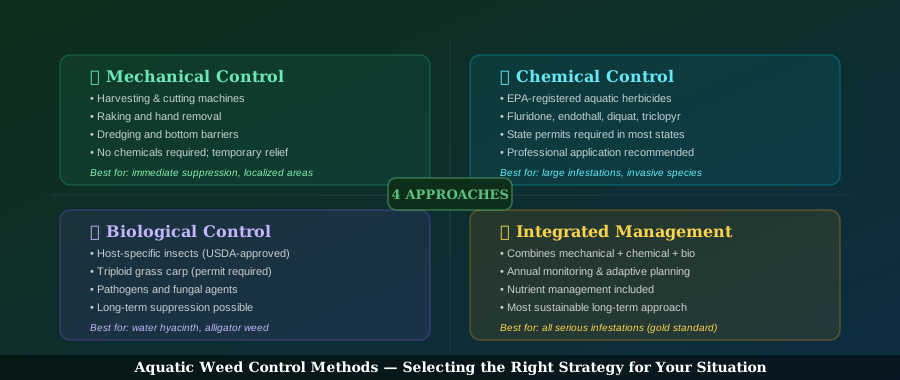
Mechanical harvesting and aquatic herbicide treatment are the two dominant operational tools in professional aquatic weed management. They are complementary rather than competing — most serious management programs use both — but understanding the specific advantages, limitations, and appropriate applications of each is essential to designing a cost-effective program. The right choice between leading with mechanical or chemical approaches (or combining both) depends on the species biology, infestation scale, water body characteristics, budget constraints, and management objectives.
This guide presents a direct comparison across seven key management dimensions to help managers, lake associations, and property owners make evidence-based decisions for their specific situation.
When to Lead with Mechanical Harvesting
Mechanical harvesting is the appropriate choice — or the required choice — under these conditions:
- Same-day access restoration is needed. If a boat launch, swimming area, or navigation channel must be usable this week, harvesting is the only option. Herbicides take 2–8 weeks; cutting provides immediate clearance. Mechanical control guide →
- The water body is chemical-free by policy or law. Water supply reservoirs, waters with herbicide restrictions, and waters near certified organic operations must be managed without chemical inputs. Mechanical approaches are the primary tool in these situations.
- Pre-herbicide biomass reduction is planned. Harvesting before herbicide application reduces the decomposing biomass load after treatment, lowering the dissolved oxygen crash risk in productive lakes. This is a common pre-treatment protocol in warm, eutrophic systems.
- Spot maintenance in a broader herbicide program. Even in lakes using lake-wide herbicide programs, mechanical harvesting is often used to maintain specific high-use access corridors between annual treatment windows.
- Early-stage infestations where complete removal may be achievable. For new small introductions, aggressive hand-pulling or targeted mechanical removal may eradicate the population before it establishes — an outcome no herbicide program can deliver once populations are large. Prevention and early response →
When to Lead with Herbicide Treatment
Aquatic herbicides are appropriate — and typically necessary — under these conditions:
- Large, established infestations. For infestations covering multiple acres, only herbicides can achieve lake-wide suppression in a single treatment season at practical cost. Mechanical coverage of the same area at sufficient treatment frequency is cost-prohibitive.
- Species with large propagule banks. Hydrilla (dense tuber beds), curly-leaf pondweed (turion banks), and Eurasian milfoil (extensive root crowns) cannot be durably controlled without root kill. Systemic herbicides translocate to underground structures; harvesting does not. Hydrilla tuber biology →
- Cost-constrained programs seeking maximum coverage. At $200–$600/acre, a single herbicide treatment covers more area for less money than mechanical harvesting, which costs $800–$3,000+ per acre and requires multiple passes per season for perennials.
- Long-term population reduction goals. Repeated applications of systemic herbicides deplete propagule banks over 3–7 years, trending toward sustainable maintenance levels. Harvesting alone cannot achieve this because it never reaches the underground structures fueling regrowth.
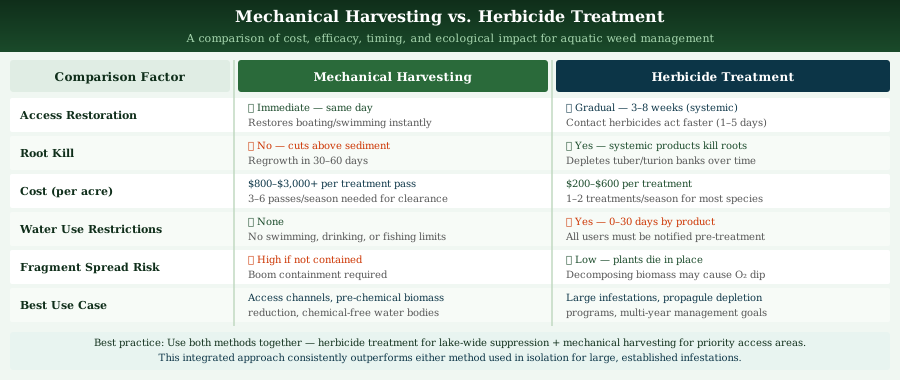
Side-by-Side Comparison
| Factor | Mechanical Harvesting | Herbicide Treatment |
|---|---|---|
| Speed of access restoration | Same day — immediate clearance of treated area | 2–8 weeks (systemic); 3–10 days (contact herbicides) |
| Root and propagule kill | No — cuts above sediment only; roots and tubers survive | Yes — systemic products translocate to roots, rhizomes, and tuber beds |
| Typical cost per acre | $800–$3,000+ per harvest pass; 3–6 passes/season typical for perennials | $200–$600 per treatment; 1–2 treatments/season typical for most species |
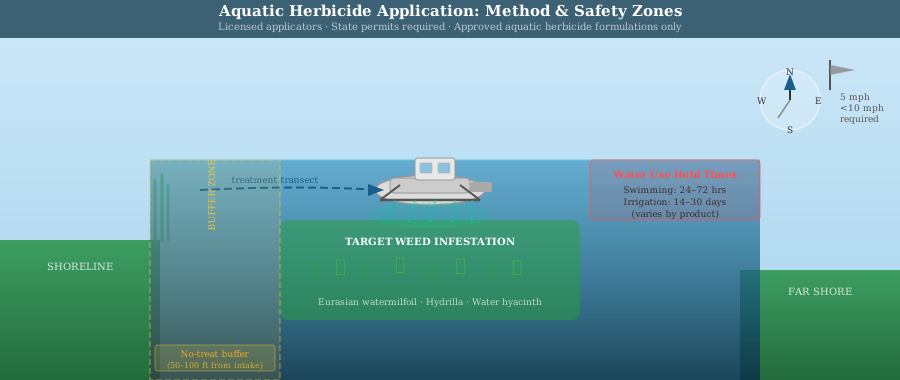
| Water use restrictions | None — no swimming, drinking, or irrigation limits | 0–30 days depending on product and use category; mandatory stakeholder notification required |
| Fragment spread risk | High if boom containment not properly implemented | Low — treated plants die in place without generating mobile fragments |
| Non-target plant impacts | Non-selective — all plants in cutting zone removed regardless of species | Variable — selective products spare non-target natives; broad-spectrum products less discriminating |
| Long-term population reduction | Limited without root kill; maintains access but does not reduce population trends | Yes — systematic retreatment programs deplete propagule banks over 3–7 year programs |
Advantages and Limitations Summary
| Advantages | Limitations | |
|---|---|---|
| Mechanical Harvesting | Immediate results; no water restrictions; no chemical inputs; removes nutrient-loaded biomass from lake system; usable in chemical-restricted waters | No root kill; rapid regrowth in 30–60 days; high per-acre cost for large areas; fragment dispersal risk requiring containment |
| Herbicide Treatment | Root and propagule kill capability; cost-effective at scale; enables multi-year population reduction; selective products available for native plant protection | 2–8 week action window; water use restrictions and mandatory notifications; permits required; dissolved oxygen risk from decomposing treated biomass |
Environmental Considerations
Both methods carry environmental considerations that inform appropriate use and program design:
- Mechanical harvesting environmental risks: Fragment dispersal (especially for Eurasian milfoil and hydrilla), incidental removal of macroinvertebrates and small fish from weed beds, and sediment disturbance in shallow areas. Fragment containment protocols are the primary mitigation measure. Fragmentation biology →
- Herbicide environmental risks: Dissolved oxygen depletion from decomposing plant biomass (managed by sectional treatment and post-treatment monitoring), non-target plant impacts (managed by product selection), and water use restrictions requiring stakeholder notification. Properly applied EPA-registered products have extensive safety records at label rates. Oxygen dynamics →
- Nutrient cycling differences: Herbicide treatment leaves plant biomass in the lake to decompose, recycling nutrients back into the water column. Mechanical harvesting physically removes that biomass and its nutrient content from the lake — a meaningful distinction for phosphorus management in nutrient-sensitive systems. Nutrient loading guide →
The Evidence-Based Recommendation: Use Both
For established large infestations in water bodies without chemical restrictions, the evidence-based recommendation is an integrated approach using both methods for their respective strengths. Herbicide treatment handles lake-wide population suppression and root kill (the chemical component does the heavy lifting on long-term population reduction). Mechanical harvesting delivers immediate access restoration in priority areas and manages the oxygen depletion risk by removing dead biomass after treatment. This combination consistently outperforms either method used in isolation: better access restoration outcomes, faster progress toward management targets, and lower total program cost over a multi-year horizon. Complete integrated management guide →
Frequently Asked Questions
If herbicides are cheaper per acre, why does anyone use mechanical harvesting?
Three main reasons: First, herbicides require 2–8 weeks to act, and many situations require immediate access — you cannot wait 6 weeks to open a swim beach or boat launch corridor. Second, some water bodies cannot legally receive herbicide applications — water supply reservoirs, waters near organic operations, water bodies with herbicide moratoriums, and private ponds where owners prefer chemical-free management. Third, even in lakes running active herbicide programs, the period between annual treatments often requires mechanical harvesting to maintain key access areas. Most professional programs use both tools for these reasons.
What happens to dead plant biomass after herbicide treatment?
After systemic herbicide treatment, treated plants die gradually over 2–8 weeks and decompose in place in the water. This decomposition process is managed through sectional treatment — treating no more than one-third of the littoral zone at a time, with waiting intervals between sections — to prevent the simultaneous decomposition of the entire plant biomass. In very productive lakes, post-treatment dissolved oxygen monitoring is standard practice, and emergency aeration may be deployed if DO levels drop to thresholds threatening fish populations. Mechanical harvesting of dead biomass after treatment is sometimes used but is less common in practice because plants die gradually over an extended period rather than simultaneously.
Is either method better for native aquatic plant recovery?
For native plant community recovery goals, well-timed selective herbicide treatment typically outperforms mechanical harvesting. Selective herbicides (fluridone for milfoil/hydrilla; triclopyr for broadleaf species) can suppress invasive targets while sparing native species — allowing the native community to recover into the cleared area. Mechanical harvesting is non-selective in the cutting zone, removing native and invasive plants alike. For programs with explicit native plant restoration goals, selective herbicide treatment is the preferred primary tool, with mechanical harvesting limited to areas where native plant recovery is not an objective.
References
- Madsen, J.D. (2000). Advantages and disadvantages of aquatic plant management techniques. Lakeline, 20(3), 22–34.
- Gettys, L.A., et al. (2014). Biology and Control of Aquatic Plants: A Best Management Practices Handbook, 3rd ed. Aquatic Ecosystem Restoration Foundation.
- Netherland, M.D., et al. (2005). Aquatic Plant Management in Lakes and Reservoirs. North American Lake Management Society and Aquatic Ecosystem Restoration Foundation.
- Smith, C.S., and Barko, J.W. (1990). Ecology of Eurasian watermilfoil. Journal of Aquatic Plant Management, 28, 55–64.
Relevant Species
This control approach is applied to the following aquatic weed species. See each species profile for species-specific guidance, herbicide rates, and optimal treatment timing:
Regulatory Notice: Most aquatic weed control activities require permits from your state's department of natural resources or environmental protection agency. Always verify permit requirements before taking any management action.