Year-Round Weed Pressure Along the Gulf
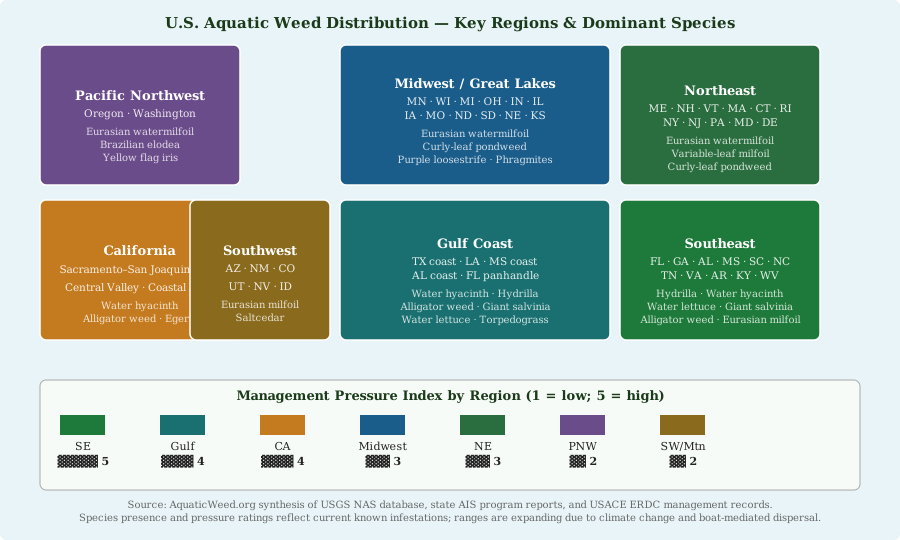
The Gulf Coast region — coastal Texas, Louisiana, Mississippi, Alabama, and the Florida panhandle — faces essentially year-round aquatic weed pressure. Subtropical climate conditions with minimal frost frequency allow continuous plant growth throughout the year, and the region's extensive interconnected waterways (bayous, river deltas, coastal bays, irrigation canals) facilitate rapid spread of established infestations.
Water Hyacinth Dominance
Water hyacinth (Eichhornia crassipes) is the dominant floating weed problem throughout the Gulf Coast. Louisiana's waterways — the Atchafalaya Basin, the Bayou Teche system, coastal marshes — have been managed for water hyacinth for over a century. The Texas Parks and Wildlife Department maintains active management programs on the Sabine River, Lake Houston, and multiple East Texas river systems. The combination of high rainfall, nutrient-enriched agricultural runoff, and frost-free climate enables water hyacinth to grow essentially without natural constraint on many Gulf Coast waterways.
Alligator Weed
Alligator weed (Alternanthera philoxeroides) is ubiquitous along Gulf Coast waterways in both aquatic and terrestrial forms. It colonizes levee slopes, road shoulders, and agricultural fields adjacent to the water, creating management challenges that span the aquatic-terrestrial boundary. USDA-approved biological control agents (stem-boring moth, flea beetle) are established in the region and provide ongoing suppression in some locations, but management remains necessary in heavily infested drainage systems. Alligator weed profile →
Giant Salvinia in Louisiana and Texas
Giant salvinia infestations in Louisiana's Toledo Bend Reservoir, Sam Rayburn Reservoir in Texas, and multiple other Gulf Coast water bodies have been among the most severe documented infestations in North America. Early infestations at Toledo Bend in 2001 were treated aggressively with both herbicide and biocontrol weevil establishment — a program that achieved substantial suppression over several years and became a model for integrated giant salvinia management. Salvinia profile →
Management Resources
The Gulf Coast states maintain some of the most active aquatic plant management programs in the nation. Key resources: Texas Parks and Wildlife Department Aquatic Invasive Species program; Louisiana Department of Wildlife and Fisheries coastal restoration programs; Army Corps of Engineers operations and maintenance programs for Gulf Coast navigation channels; USDA ARS Aquatic Weed Research Unit in Fort Lauderdale, FL (biological control research).
Louisiana and Texas: The Bayou and Coastal Prairie Challenge
Louisiana's coastal marsh and bayou system represents one of the most ecologically sensitive and management-challenging aquatic weed environments in North America. Dense water hyacinth mats on the Atchafalaya River and its distributaries, Bayou Teche, and the coastal marsh complex block navigation in the nation's most productive commercial and recreational fishery. The Louisiana Department of Wildlife and Fisheries Aquatic Invasive Species Program coordinates management across a complex of private and public water bodies involving thousands of square miles of waterway. Texas similarly manages water hyacinth on the Sabine, Trinity, and San Jacinto river systems and in coastal marshes near Galveston and Corpus Christi. Water hyacinth management →
Coastal Versus Interior Water Bodies
Gulf Coast management challenges differ between coastal brackish-water environments and inland freshwater bodies. Most aquatic herbicides registered for freshwater use are not labeled for estuarine or brackish water applications, limiting management options in coastal environments. Mechanical removal and biological control (biocontrol insects for water hyacinth) are proportionally more important management tools in coastal and brackish habitats. Alligator weed infestations in rice-growing regions of coastal Louisiana and Texas are particularly damaging because they cannot be effectively managed with selective aquatic herbicides without impacting rice production — mechanical and cultural control are the primary management tools in these contexts. Biological control methods →
Frequently Asked Questions
Is water hyacinth getting better or worse in Louisiana?
The picture is mixed. Active management programs have maintained navigational access in priority waterways, and biological control weevil populations provide baseline suppression. However, the underlying nutrient loading from agricultural runoff in the Louisiana coastal plain continues to fuel weed growth, and climate change projections suggest continued or expanded favorable conditions for warm-season weeds. The Gulf Coast states' aquatic weed problems are managed rather than solved — continued investment in active management and in source nutrient reduction is required to prevent deterioration.
Climate Influence on Gulf Coast Aquatic Weed Growth
The Gulf Coast's subtropical climate creates an exceptionally challenging aquatic weed management environment. Coastal Texas, Louisiana, Mississippi, and Alabama experience frost events that rarely kill aquatic plant root systems even when they damage above-ground biomass. Water temperatures in Louisiana bayous and coastal marshes rarely drop below 8–10°C even in January, and by March, warm-season species are already showing vigorous growth. The result is a management year that begins in February–March and continues through November–December, with no true dormant season providing a natural management break.
Water hyacinth in the Atchafalaya Basin of Louisiana is active year-round in the warmest years, retreating only during the occasional hard freeze that kills above-ground biomass — but the stolons and root mass survive to regenerate the following month. Giant salvinia in east Texas and Louisiana bayous similarly maintains activity through mild winters, with populations re-expanding from surviving tissue within 4–6 weeks of a frost event.
Climate projections for the Gulf Coast anticipate increased hurricane frequency and intensity, which periodically redistributes aquatic weed fragments across wide areas; increased winter minimum temperatures (reducing the frequency of freeze-kill events); and more intense summer heat increasing evapotranspiration and salinity variability in coastal estuaries. These changes collectively favor invasive species over native aquatic vegetation.
Management Timing for Gulf Coast Species
| Species | Peak Growth Period | Optimal Treatment |
|---|---|---|
| Water hyacinth | Year-round; peak Apr–Oct | Feb–Apr (low biomass pre-season treatment) |
| Giant salvinia | Apr–Nov; rapid summer doubling | Mar–May before mat formation; biocontrol for large areas |
| Alligator weed | Mar–Nov in aquatic form | May–Jul foliar treatment; biocontrol flea beetle well-established |
| Hydrilla | Year-round growth; peak May–Oct | Jan–Mar fluridone application for season-long control |
State-Level Variation on the Gulf Coast
Louisiana hosts some of the largest water hyacinth and giant salvinia infestations in North America. The Atchafalaya Basin — the largest river swamp in the U.S. at 884,000 acres — has battled water hyacinth for over a century. The Louisiana Department of Wildlife and Fisheries operates a year-round aquatic plant management program with emergency response capability for new giant salvinia invasions.
Texas faces significant aquatic weed pressure in east Texas lakes, rivers, and bayous (water hyacinth, giant salvinia, alligator weed) and in west Texas irrigation infrastructure. The Texas Parks and Wildlife Department and the Texas Commission on Environmental Quality jointly regulate aquatic plant management.
Mississippi and Alabama have coastal river systems with water hyacinth and alligator weed, and inland reservoirs with Eurasian milfoil and hydrilla. These states have smaller management program budgets than Louisiana and Texas, and many private water bodies in these states are managed through individual landowner permits.