State-by-State Invasive Aquatic Plant Reference
The following state-by-state reference summarizes the primary invasive aquatic plant concerns for each U.S. state or region, along with the key state management program. For current infestation maps, permit requirements, and species-specific management guidance, contact your state's department of natural resources, fish and wildlife agency, or environmental protection department directly.
| State/Region | Primary Invasive Aquatic Plants |
|---|---|
| Florida | Hydrilla, water hyacinth, water lettuce, giant salvinia, torpedo grass |
| Texas | Giant salvinia, water hyacinth, alligator weed, hydrilla, hydrilla |
| Louisiana | Water hyacinth, alligator weed, giant salvinia, water lettuce |
| California | Water hyacinth, alligator weed, Eurasian milfoil, water primrose (Ludwigia), hydrilla (eradication targets) |
| Wisconsin | Eurasian watermilfoil, curly-leaf pondweed, invasive Phragmites, purple loosestrife |
| Minnesota | Eurasian watermilfoil, curly-leaf pondweed, flowering rush, water lettuce (new reports) |
| Michigan | Eurasian milfoil, curly-leaf pondweed, invasive Phragmites, European frogbit |
| New York | Eurasian milfoil, hydrilla (expanding), variable-leaf milfoil, water chestnut, European frogbit |
| Massachusetts / New England | Eurasian milfoil, variable-leaf milfoil, fanwort (Cabomba), water chestnut |
| Washington | Eurasian milfoil, Brazilian elodea, yellow flag iris, fragrant water lily (in some contexts) |
| Oregon | Eurasian milfoil, yellow flag iris, purple loosestrife |
| Georgia / S. Carolina | Hydrilla, water hyacinth, Eurasian milfoil, alligator weed, spiny najas |
| N. Carolina / Virginia | Hydrilla (expanding), Eurasian milfoil, alligator weed, water chestnut (northern VA/MD) |
| Ohio / Indiana / Illinois | Curly-leaf pondweed, Eurasian milfoil, invasive Phragmites, purple loosestrife |
| Great Plains states | Eurasian milfoil, curly-leaf pondweed, common reed |
How to Find Your State's Management Resources
Every U.S. state has an aquatic invasive species program. Search "[your state] aquatic invasive species" to find: current infestation maps; prohibited and regulated species lists; permit applications for management activities; lake monitoring volunteer programs; and cost-sharing programs for management. University cooperative extension programs also provide state-specific management guidance — search "[your state] aquatic plants cooperative extension."
Federal Resources
Several federal agencies maintain national resources for aquatic invasive species management:
- USGS Nonindigenous Aquatic Species Database (nas.er.usgs.gov): The authoritative national database for non-native aquatic species distribution, with interactive maps showing documented occurrences for each species by state and watershed.
- USDA APHIS Plant Protection and Quarantine: Manages federal noxious weed designations and interstate commerce restrictions for listed aquatic plants.
- U.S. Army Corps of Engineers Aquatic Plant Control Research Program: Conducts and funds research on aquatic plant management, including herbicide evaluation, biological control, and integrated management strategies.
- EDDMaps (eddmaps.org): Early Detection and Distribution Mapping System — a national platform for reporting and tracking invasive species occurrences. Used by state programs, volunteer monitors, and professional managers.
Prevention Is a Shared Responsibility
The state-by-state pattern of aquatic weed distribution is not static — species are constantly expanding into new states and new water bodies, primarily via contaminated boats and equipment. The most cost-effective prevention investment available to every boater and lake user is the habitual practice of Clean, Drain, Dry protocol every time equipment moves between water bodies. Early reporting of suspicious species to state programs enables rapid response while eradication is still possible. These are individual actions with collective national consequences.
State Management Agency Quick Reference
Every U.S. state has an aquatic invasive species management program. Most are housed within the state Department of Natural Resources (DNR), Department of Environmental Quality (DEQ), or Fish and Wildlife agency. State programs maintain current infestation maps, lists of regulated species, permit applications, and contact information for licensed aquatic plant management contractors. To find your state program, search "[state name] aquatic invasive species" or "[state name] aquatic plant management."
Several national resources supplement state programs: the USGS Nonindigenous Aquatic Species (NAS) database (nas.er.usgs.gov) maintains the most comprehensive national distribution database with interactive mapping; EDDMaps (eddmaps.org) provides a citizen science reporting platform for invasive species sightings; and the National Invasive Species Council coordinates federal agency programs and policy. For reporting new invasive species sightings, your state program is the primary contact — early detection reports that reach state biologists while an infestation is still small and potentially eradicable have documented conservation value and are among the most high-impact individual actions available to lake users. Clean Drain Dry protocols →
Frequently Asked Questions
Where can I report a new aquatic weed sighting?
Report new aquatic invasive species sightings through your state's aquatic invasive species program — most states have online reporting forms, dedicated reporting apps (EDDMaps is widely used), or phone hotlines. For federally listed noxious weeds (hydrilla, water hyacinth, giant salvinia, hydrilla), new sightings should be reported to both your state program and to the USDA APHIS Plant Protection and Quarantine program. Early reporting of new infestations is the most cost-effective intervention available — early detection enables eradication before large propagule banks establish.
→ Distribution hub | Identification guides
Climate Zones and Invasive Species Risk
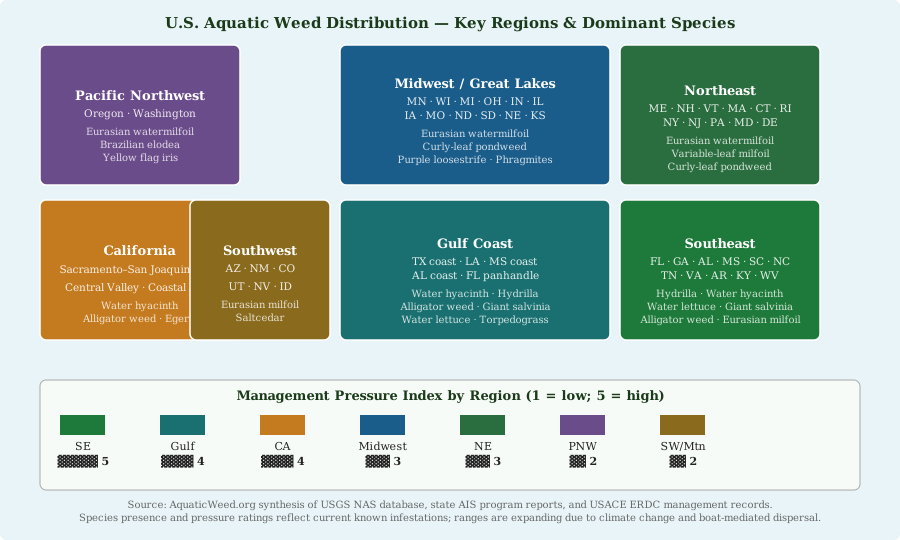
The pattern of invasive aquatic plant distribution across U.S. states is not random — it closely follows climate zones, historical introduction pathways, and the intensity of recreational boating activity. Understanding these drivers helps predict which species pose the highest risk in any given location and allows prevention programs to focus resources on the most likely introduction pathways.
Water temperature is the primary determinant of which species can establish: subtropical species (water hyacinth, water lettuce, giant salvinia, hydrilla in its most aggressive biotype) require average summer water temperatures above 25°C and minimal frost to maintain persistent populations. Temperate-adapted species (Eurasian watermilfoil, curly-leaf pondweed, purple loosestrife, common reed) can establish across a much broader geographic range, including the northern tier states.
Climate Change and Shifting Range Boundaries
Historical range boundaries are increasingly unreliable for predicting future invasive plant risk. Multiple factors are driving range expansions northward:
- Warming summer water temperatures: Average summer water temperatures in northern lakes have increased 0.5–1.5°C since 1980, expanding the climatically suitable range for warm-season species by 100–300 km northward.
- Shorter ice cover seasons: Lakes in the Upper Midwest and Northeast are losing 1–2 weeks of ice cover per decade, extending the growing season for aquatic weeds and enabling established populations to build larger propagule banks before winter.
- Milder winters: Reduced frequency of extreme cold events reduces mortality of propagules and root systems in previously limiting northern areas, allowing species survival at the northern range edge.
Hydrilla — historically confined to the Southeast — now has established populations in Connecticut, Maryland, New York, and Washington. Water hyacinth is occasionally establishing in protected California water bodies that previously experienced killing frosts. These are bellwether indicators of the range expansion trajectory for the coming decades. See the distribution hub for regional detail and the biology hub for temperature-growth relationships.
Management Timing Varies with Climate Zone
The optimal management calendar shifts predictably with latitude and climate zone:
- USDA Zone 9–10 (Gulf Coast, South Florida): Year-round management required; no true dormant season; treatment window limited by water use restrictions, not plant biology.
- Zone 7–8 (Southeast, Mid-Atlantic, Pacific Coast): 8–10 month growing season; spring treatment window February–April; fall follow-up treatment beneficial.
- Zone 5–6 (Midwest, Northeast): 5–6 month growing season; spring critical window May–June; permit applications should be submitted February–March.
- Zone 3–4 (Upper Midwest, northern New England): 3–4 month growing season; short spring window June–early July; single-treatment programs may achieve adequate seasonal control.
For management planning specific to your region, see the management planning hub and the setting management goals guide.
Key State Program and Species Links
- Northeast regional guide — milfoil and CLP management
- Southeast regional guide — hydrilla and water hyacinth
- Midwest regional guide — Great Lakes and milfoil
- Gulf Coast regional guide — year-round management
- California regional guide — Delta and Tahoe management
- Pacific Northwest regional guide — milfoil and elodea
- Prevention — stopping new introductions at the state border