Milfoil, Elodea, and Emerging Threats
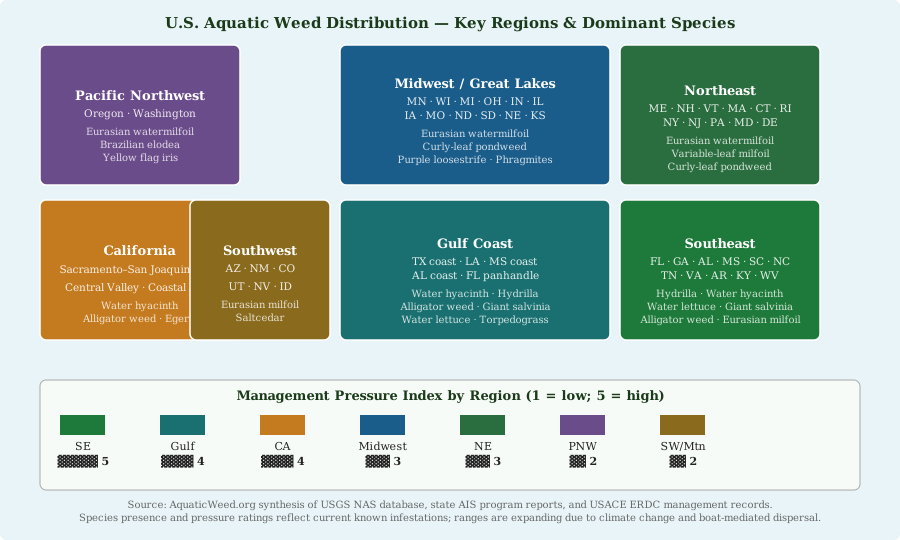
The Pacific Northwest — Oregon and Washington — faces significant aquatic weed challenges driven primarily by Eurasian watermilfoil in recreational lakes and Brazilian elodea in fish-bearing river systems, with emerging concerns about invasive species from the Eastern U.S. (including hydrilla) that have been detected in isolated locations.
Eurasian Watermilfoil in Washington and Oregon
Eurasian watermilfoil is the most widely distributed and management-significant invasive aquatic plant in Washington state, present in hundreds of lakes across the state. The Washington Department of Ecology oversees a robust lake management program, and many of the state's lake associations have multi-year milfoil management contracts. Oregon also manages milfoil in multiple Willamette Valley and Coast Range lakes.
The Pacific Northwest's boating culture (heavy recreational boating, with boats moving frequently between water bodies) is a primary milfoil dispersal mechanism. The Washington State Department of Ecology, in partnership with lake associations, operates one of the most comprehensive watercraft inspection and decontamination programs in the nation — a direct response to documented milfoil dispersal by contaminated boat trailers.
Brazilian Elodea in Alaska
An unusual challenge in the Pacific Northwest and Alaska is the invasive Brazilian elodea (Egeria densa), introduced to Chignik Lake system in Alaska where it threatens native salmon habitat. Alaska has invested heavily in eradication efforts, combining fluridone treatment and mechanical removal in one of the highest-latitude invasive aquatic plant management programs in North America. The potential spread of Brazilian elodea through Alaska's salmon-bearing river systems is a serious conservation concern.
Yellow Flag Iris
Yellow flag iris (Iris pseudacorus), a European native sold as an ornamental, is a significant emergent invasive in Pacific Coast wetlands and streams. It forms dense stands that displace native vegetation and is extremely difficult to control due to its rhizome network and seed bank. Washington and Oregon list it as a noxious weed. Management uses imazapyr (fall application) with follow-up monitoring and replanting.
Water Infrastructure and Agricultural Systems
The Columbia River Basin's extensive irrigation infrastructure — canals, diversions, and reservoirs serving agriculture in eastern Washington, Oregon, and Idaho — provides an interconnected pathway for aquatic invasive plant spread within the watershed. Brazilian elodea (Egeria densa) has spread through irrigation canal systems in the Columbia Basin and now requires active management in Columbia River tributaries and several Columbia Basin reservoirs. Yellow flag iris (Iris pseudacorus), introduced as a garden ornamental, has naturalized throughout Pacific Northwest riparian zones and wetlands, threatening native plant communities in wetlands that are otherwise relatively free of invasive aquatic plants. Brazilian waterweed profile →
State Programs and Aquatic Invasive Species Enforcement
Washington State's Aquatic Invasive Species Prevention Program is one of the most comprehensive in the Pacific Northwest, operating mandatory watercraft inspection stations at major border crossing points and high-use boat launches during peak recreation season. Washington's NPDES General Permit for aquatic plant management provides a streamlined permit pathway for professional management programs in certified water bodies. Oregon's Aquatic Invasive Species Management Plan coordinates prevention, early detection, and rapid response across state agencies and tribal governments. Idaho Fish and Game operates a mandatory watercraft inspection program at its borders that has intercepted multiple high-risk watercraft carrying invasive mussel and aquatic plant propagules annually. Permit requirements →
Frequently Asked Questions
What aquatic weeds should Pacific Northwest boaters be most concerned about?
Pacific Northwest boaters should primarily watch for and prevent spread of Eurasian watermilfoil (already present in many lakes), Brazilian elodea (present in some sites), and exotic milfoil hybrids. Practicing Clean, Drain, Dry every time you move your boat between water bodies is essential. Washington, Oregon, and Idaho all have mandatory watercraft inspection requirements or strongly encourage self-inspection at all boat launch facilities. Reporting any suspected new infestations to your state fish and wildlife agency immediately enables early response while eradication is still possible.
Climate Influence on Pacific Northwest Aquatic Weed Growth
The Pacific Northwest encompasses two climatically distinct zones: the maritime climate west of the Cascade Mountains, and the drier continental climate of eastern Oregon and Washington. These climate zones create very different aquatic weed challenges. West of the Cascades, mild year-round temperatures (rarely below -5°C), abundant winter rainfall, and moderate summers (20–24°C) support year-round aquatic plant growth with a compressed management season. East of the Cascades, hotter summers (30–38°C), cold winters, and irrigation-dependent agriculture create a distinct management environment in which canal systems and irrigation reservoirs are primary management targets.
Eurasian watermilfoil is the dominant invasive plant across both zones, but its growth timing differs: in western Oregon and Washington, milfoil begins active growth in March–April and maintains growth through October; in eastern Washington and Oregon, the summer peak (July–August) is more intense but the growing season is similarly longer than in the northern Midwest due to the warm summers. Brazilian elodea — less common in most U.S. regions — is a particular Pacific Northwest concern because of its cold-water tolerance and establishment in fish-bearing rivers in the Willamette Valley and in Alaska.
Management Timing in the Pacific Northwest
| Species | Optimal Treatment | Notes |
|---|---|---|
| Eurasian watermilfoil | Apr–Jun (W of Cascades); May–Jul (E) | Triclopyr standard; fragment containment critical in rivers |
| Brazilian elodea | Year-round (cold-tolerant) | Special concern in salmon-bearing rivers; herbicide use restricted |
| Yellow flag iris | May–Jul | Widespread in wetlands and water margins; imazapyr effective |
State-Level Variation: Oregon vs. Washington
Washington has the more severe overall aquatic weed problem, with Eurasian watermilfoil documented in hundreds of lakes across the state, from the San Juan Islands to the Columbia Basin. The Washington Department of Ecology operates the Aquatic Plant Management program and requires permits for all chemical and physical control in state waters. Washington has dedicated resources to intensive early detection in eastern Washington lakes, where annual surveys have detected new milfoil infestations early enough for eradication in several cases.
Oregon focuses significant management attention on its irrigation canal systems in eastern Oregon, where Eurasian milfoil and other aquatic plants obstruct water delivery to agricultural operations. The Oregon Department of Agriculture and the irrigation districts collaborate on canal management programs that combine mechanical harvesting and herbicide treatment.
Both states face an emerging concern: Hydrilla has been detected in several Pacific Northwest water bodies in recent years. The cool-water adaptation of certain hydrilla strains (the monoecious biotype shows broader temperature tolerance) means hydrilla could potentially establish in Pacific Northwest lakes, creating a management challenge of significantly greater severity than current milfoil problems.