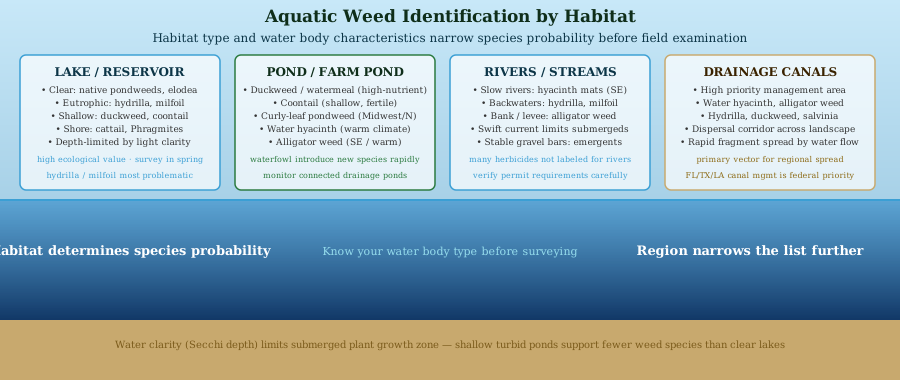
How Habitat Shapes Species Probability
Aquatic plant species are not randomly distributed across all water bodies. Each species has ecological requirements — water depth, flow velocity, light penetration, sediment type, nutrient level, water temperature, and climate — that determine where it can establish and thrive. Understanding these requirements allows you to construct a species probability list for any given habitat before conducting a field survey, dramatically increasing identification efficiency.
For example: if you are surveying a slow, eutrophic drainage canal in Florida, the most probable species are water hyacinth, duckweed, hydrilla, alligator weed, and water lettuce. If you are surveying a clear, cold, oligotrophic mountain lake in Colorado, the most probable species are native pondweeds, elodea, and coontail — and several of the Florida species would not be expected. Regional climate also imposes major constraints: giant salvinia is limited to frost-free regions; curly-leaf pondweed requires cold water for germination and is absent from the deep South. Knowing your region and habitat type before field surveys is not a shortcut — it is standard protocol for professional aquatic plant management surveys.
Lakes and Reservoirs
Lakes and reservoirs represent the largest and most ecologically complex habitat type for aquatic weeds. The key variables within lake systems that determine species distribution are: water depth, water clarity (Secchi depth), nutrient status (oligotrophic / mesotrophic / eutrophic), shoreline substrate, and connection to other water bodies or drainages.
Shallow, nutrient-rich (eutrophic) lakes: The highest-probability species include hydrilla, Eurasian watermilfoil, water hyacinth (warm-climate lakes), duckweed, and emergent cattails. These species thrive under high-nutrient conditions and tolerate the reduced water clarity common in eutrophic systems.
Clear, low-nutrient (oligotrophic) lakes: Submerged native plants tend to dominate — elodea, native pondweeds, wild celery, and chara. Invasive submerged weeds can still establish if introduced, but tend to achieve lower densities in low-nutrient conditions. Hydrilla and milfoil can become established in oligotrophic lakes when introduced but grow more slowly than in eutrophic systems.
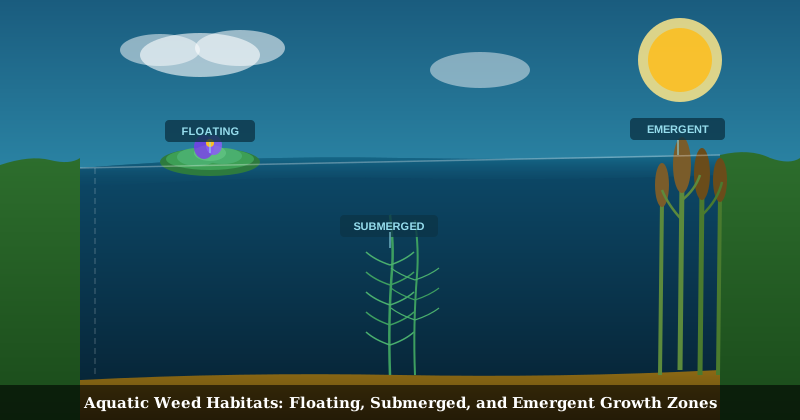
Deep lakes: Submerged vegetation is constrained by light penetration to the photic zone (the depth to which sufficient light for photosynthesis penetrates). In clear lakes, this may extend to 6–8 meters. In turbid lakes, photosynthetically active depth may be less than 1–2 meters. Floating plants are not depth-limited — water hyacinth can cover deep-water lakes as easily as shallow ones.
Ponds and Farm Ponds
Farm ponds, retention ponds, and decorative ponds differ from natural lakes in several management-relevant ways: they are often shallower, have higher nutrient loading from agricultural or urban runoff, are more frequently connected to drainage networks that facilitate species dispersal, and are often actively managed for fish production or aesthetics.
The most commonly encountered nuisance species in pond systems include: duckweed and watermeal (especially in high-nutrient ponds with limited wind exposure); coontail (thrives in shallow, fertile ponds); curly-leaf pondweed (especially farm ponds in the Midwest and North); and cattails along the pond margin. In warm-climate states (Florida, Texas, Louisiana), water hyacinth and alligator weed are frequent pond invaders.
Ponds connected to larger drainage systems often introduce new species rapidly — a single waterfowl landing can introduce duckweed, salvinia, or water hyacinth from a nearby infested water body. Monitoring ponds connected to drainage canals or rivers for new introductions is standard practice in aquatic invasive species management programs.
Rivers and Streams
Flowing water presents a fundamentally different environment from still water. Species that succeed in rivers must withstand current forces, tolerate periodic high-energy flood events, and anchor effectively in shifting gravel, sand, or silt substrates. This environmental filter limits the suite of aquatic weeds that can establish and persist in rivers compared to lakes.
In slow-flowing rivers and backwater areas: water hyacinth forms the most problematic floating infestations in southeastern U.S. rivers (St. Johns River, Florida; Sacramento River delta, California). Large river backwaters and slow-moving side channels support hydrilla, coontail, and milfoil in their respective ranges. Alligator weed is a frequent emergent colonizer of river banks and levee slopes.
In fast-flowing rivers and streams: rooted submerged vegetation is generally confined to protected backwaters and shallow areas with stable substrates. Emergent vegetation like bulrush, bur-reed, and cattail can colonize stable gravel bars and low-energy bank environments. Very few free-floating species can maintain position in swift current — water hyacinth rafts break up in high-velocity flow and disperse downstream.
Drainage Canals and Irrigation Ditches
Drainage canals and irrigation ditches are among the most frequently infested habitat types in the southern United States, California's Central Valley, and other heavily managed agricultural landscapes. They combine high nutrient loading (from agricultural runoff), warm water temperatures, slow flow, and connectivity across large landscapes — ideal conditions for invasive aquatic weed establishment and spread.
Canals are primary conduits for weed dispersal. Boats, water transfer operations, and irrigation equipment move plant fragments from infested to uninfested areas. Water hyacinth, alligator weed, hydrilla, and duckweed are all first-rate canal invaders in warm-climate states. The Florida Department of Environmental Protection's aquatic plant management program focuses significant resources on canal weed management because of the rapid dispersal these corridors enable.
Wetlands and Marshes
Natural wetlands and managed marshes support some of the most complex aquatic plant communities and are simultaneously some of the most vulnerable to invasive species impacts. Wetland-specific invasive species include invasive Phragmites (reed), purple loosestrife (Lythrum salicaria), water primrose (Ludwigia spp.), and in warm climates, giant salvinia and water hyacinth.
The most important diagnostic challenge in wetland identification is distinguishing invasive Phragmites from native Phragmites. Both are the same species — but the invasive European subspecies (Phragmites australis subsp. australis) forms dense monocultures that exclude native wetland plant communities, while the native North American lineage is ecologically integrated. Genetic testing is often required for definitive subspecies identification.
Water Depth and Light Penetration: The Submerged Plant Constraint
Water depth, combined with water clarity, is the primary physical constraint on submerged aquatic plant distribution within any water body. Submerged plants can only grow where sufficient light reaches the sediment to support photosynthesis — a zone called the photic zone. The depth of the photic zone is controlled by Secchi depth (water clarity): in very clear water (Secchi depth 4–6 m), submerged plants may colonize depths of 5–8 m. In turbid water (Secchi depth < 0.5 m), no submerged plants can survive below 0.5–1 m.
This constraint creates predictable species distribution patterns: in clear, deep lakes, hydrilla and milfoil can colonize large areas of the lake bottom at depths of 3–6 m. In turbid ponds and canals, submerged vegetation is restricted to the shallow margins, while floating weeds (which are not depth-limited) can cover the entire surface. Knowing water clarity before a field survey tells you which water body zones to prioritize for submerged plant surveys.
Species Hub Quick Reference by Habitat
Habitat-to-Species Probability Table
| Species | Lakes | Ponds | Rivers | Canals | Wetlands |
|---|---|---|---|---|---|
| Hydrilla | ●●● | ●●● | ●● | ●●● | ● |
| Water Hyacinth | ●● | ●●● | ●● | ●●● | ●● |
| Eurasian Watermilfoil | ●●● | ●● | ●● | ●● | ● |
| Duckweed | ●● | ●●● | ● | ●●● | ●●● |
| Coontail | ●●● | ●●● | ● | ●● | ●● |
| Alligator Weed | ● | ●● | ●●● | ●●● | ●● |
| Curly-leaf Pondweed | ●●● | ●● | ● | ●● | ● |
●●● = high probability; ●● = moderate; ● = low or habitat-dependent. Based on typical North American distributions — varies by region and local water quality.
Frequently Asked Questions
Does water body type affect which control methods are available?
Yes significantly. Many aquatic herbicides are labeled for use only in 'non-flowing' water bodies (lakes and ponds) and cannot legally be applied in rivers, streams, or irrigation ditches due to the risk of drift to non-target areas or contamination of water supplies. Some herbicides have irrigation use restrictions that prohibit treated water from being used for crop irrigation for days to weeks after application. Always check state registration labels and consult your state environmental agency before applying any aquatic herbicide.
Why are drainage canals particularly prone to aquatic weed infestations?
Drainage canals combine multiple factors that favor weed establishment: high nutrient loading from agricultural runoff, warm water temperatures from shallow, exposed water, slow flow that allows plants to anchor and grow, and extensive connectivity that rapidly distributes plant fragments across large landscapes. They often link infested water bodies to previously uninfested ones, providing a dispersal corridor. Many state aquatic invasive species management programs identify canal systems as priority management areas because the cost of controlling a species once established in a canal network increases exponentially with time.
Are wetland invasive plants managed differently from lake weeds?
Yes. Wetland invasive plant management faces additional regulatory complexity: wetlands are jurisdictional waters under federal law, and any management activity (mechanical removal, herbicide application, physical alteration of the wetland) may require permits under Section 404 of the Clean Water Act, in addition to state-level water quality and aquatic herbicide application permits. The ecological sensitivity of wetlands also means that management programs must carefully avoid non-target impacts to native wetland plant communities. Biological control agents are more commonly used in wetland management programs because of the reduced risk of non-target impacts compared to herbicides in complex wetland plant communities.
How does water clarity affect which species I might find?
Water clarity (measured as Secchi depth) directly determines how deep submerged aquatic plants can grow by controlling the depth of the photic zone — the layer of water receiving sufficient light for photosynthesis. In very clear lakes (Secchi depth 4–8 meters), submerged plants may grow at depths up to 6–8 meters. In turbid lakes (Secchi depth less than 1 meter), submerged plant growth may be limited to depths of 0.5–1.5 meters. This means that high-turbidity water bodies have a smaller potential habitat for submerged weeds, but those that do establish are concentrated in very shallow water where they can be more intensive management problems.