Why Misidentification Matters
The decision to treat a plant as a weed — whether through herbicide, mechanical removal, or biological control — carries significant ecological consequences if the plant is misidentified. Native aquatic plants provide essential services that are rarely appreciated until they are gone: they oxygenate the water column, stabilize sediment, provide spawning habitat for fish, shelter invertebrates that form the base of the aquatic food web, and supply food for waterfowl. A dense bed of native elodea or coontail supports more fish biomass per acre than the same water body without it.
At the same time, invasive weeds like hydrilla, Eurasian watermilfoil, and water hyacinth cause cascading ecological damage that can persist for years. The challenge is that several key invasive species look remarkably similar to their native ecological counterparts — to the point where even experienced observers make errors on visual inspection alone.
The principle is simple: Always confirm the species before taking any management action. If you cannot confirm identification yourself, collect a sample and contact your state cooperative extension service or department of natural resources before applying any herbicide or conducting mechanical removal. This is not merely conservation ethics — in most states, the misapplication of aquatic herbicides is a regulatory violation.
The Most Important Look-Alike Pairs
1. Hydrilla vs. Elodea
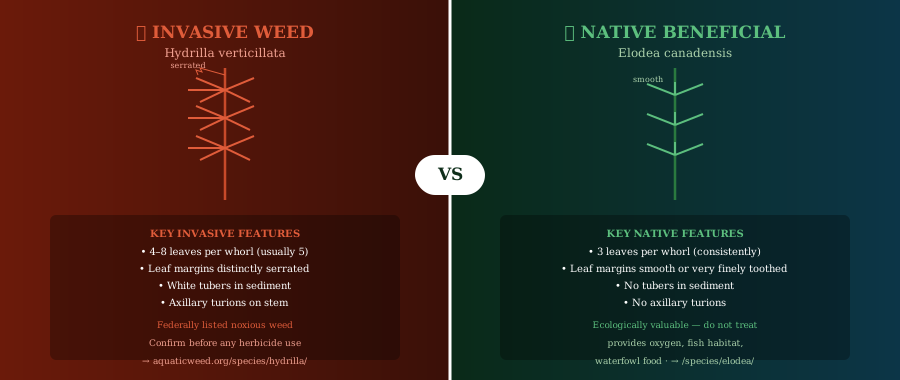
This is the most frequently confused pair in submerged aquatic plant identification in North America. Both are submerged, rooted species with whorled, narrow leaves. The key differences are reliable and observable in the field:
| Feature | Hydrilla (Invasive) | Elodea (Native) |
|---|---|---|
| Leaves per whorl | 4–8 (usually 5) | Usually 3 |
| Leaf margin | Distinctly serrated (visible with naked eye) | Smooth or very finely toothed (needs lens) |
| Tubers in sediment | Yes — small white potato-like tubers | No |
| Axillary turions | Present (small bead-like buds) | Absent |
| Origin / Status | Asian origin; federally listed noxious weed | Native to North America; ecologically valuable |
Field test: Count the leaves at three different nodes along the same stem. If the consistent count is 3, you have elodea. If the consistent count is 4 or more, investigate further — hydrilla with 4-leaf whorls is possible. Check the leaf margin with a hand lens. Serrations visible under 10× magnification confirm hydrilla. Also check for small white tubers by pulling a sediment sample from the plant's root zone.
→ Hydrilla species profile | Elodea species profile
2. Eurasian Watermilfoil vs. Northern Watermilfoil
Eurasian watermilfoil (Myriophyllum spicatum) is a highly invasive species from Europe and Asia that has colonized thousands of water bodies across North America. It closely resembles several native milfoil species, particularly Northern watermilfoil (Myriophyllum sibiricum). The critical distinguishing feature is the number of pairs of leaflet segments on each pinnate leaf:
- Eurasian watermilfoil: 12–21 pairs of leaflet segments per leaf (highly subdivided; feathery appearance)
- Northern watermilfoil: 5–9 pairs of leaflet segments per leaf (less subdivided; less feathery)
Count the leaflet pairs carefully on several leaves from different nodes. This count is consistently different between the two species and is the standard field diagnostic used by aquatic biologists. A hand lens makes counting easier. Also note that Eurasian watermilfoil's emergent flower spikes have leaves (bracts) that are shorter than the flowers, while native milfoils often have bracts longer than the flowers. → Eurasian Watermilfoil species profile
3. Coontail vs. Non-Native Cabomba
Coontail (Ceratophyllum demersum) is a native, often ecologically beneficial submerged plant that is sometimes confused with Cabomba (Cabomba caroliniana) — a non-native invasive plant in many northern states. Both have finely divided leaves and grow as submerged, bushy masses. The distinction is straightforward:
- Coontail has stiff, forked (dichotomously branched) leaves that feel rough when rubbed; it has no true roots.
- Cabomba has fan-shaped, pinnately divided leaves (more like a spread hand than a fork); it is rooted in sediment; it produces distinctive floating leaves (oval, notched at the base) near flowering stems; and it has conspicuous white or yellow flowers.
4. Curly-Leaf Pondweed vs. Native Pondweeds
The Potamogeton genus (pondweeds) includes dozens of native North American species alongside the invasive curly-leaf pondweed. The invasive curly-leaf pondweed is distinguished from most native pondweeds by its distinctively wavy, crinkled leaf margins — which give the plant its common name and are visible to the naked eye. It also lacks the floating broad leaves present on many native pondweed species during the growing season, and it has a unique cool-season phenology (peak growth in late fall through spring, dying back in summer) that distinguishes it from warm-season native pondweeds. → Curly-leaf Pondweed species profile
5. Chara vs. True Aquatic Weeds
Chara is frequently misidentified as a submerged aquatic weed by lakefront property owners and even some management professionals. In fact, Chara is not a true plant at all — it is a charophytic alga that resembles a small vascular plant. More importantly, Chara is generally ecologically beneficial in most water bodies: it grows in clear, well-oxygenated water, indicates good water quality, provides low-growing habitat for invertebrates and fish fry, and is typically not tall enough to impede navigation. In most water bodies, Chara should not be managed unless it is causing a specific, documented problem. The diagnostic feature is the distinctive garlic or skunk-like odor when crushed — no true aquatic plant has this odor. → Chara species profile
Principles for Distinguishing Weeds from Natives
Three principles guide the native-vs.-invasive assessment beyond species-level identification:
- Regional origin: Is this species native to North America or introduced from Europe, Asia, or South America? Federally listed noxious weeds (hydrilla, Eurasian watermilfoil, water hyacinth) are non-native invasives. Native species have co-evolved with North American fish and wildlife and occupy their historical ecological niche.
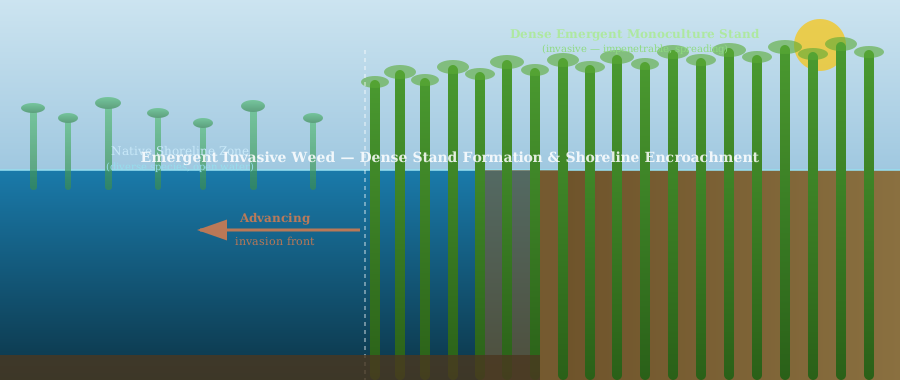
- Abundance and monoculture formation: Even native species can become nuisance species when they form dense monocultures that exclude other native plant diversity. Native duckweed in clear-water ponds is ecologically normal; duckweed forming a closed mat in a eutrophic pond indicates a water quality problem that should be addressed at its source (nutrient input reduction) rather than through plant removal.
- Management purpose: What is the management goal? Improving navigation? Protecting native biodiversity? Controlling an invasive before it spreads to new water bodies? The appropriate management response differs significantly depending on the goal. Removing native plants to improve a fishing spot may harm the very fish habitat you are trying to protect.
Frequently Asked Questions
Is it legal to remove native aquatic plants without a permit?
In most states, any removal or treatment of aquatic vegetation — native or non-native — requires either a permit or must be performed by or under the supervision of a licensed aquatic pesticide applicator. Physical removal of small quantities of vegetation for dock access may be allowed under general permits in some states, but check your state's regulations before any removal activity. Federal permits under Section 404 of the Clean Water Act may also apply to large-scale vegetation removal in navigable waters.
What should I do if I suspect I have found hydrilla but am not 100% certain?
Collect a complete sample including stem, leaves, and a sediment sample from the root zone (looking for white tubers). Photograph the sample clearly — especially close-ups of leaf whorls showing the number of leaves per node, and the leaf margin texture under a hand lens. Contact your state's cooperative extension aquatic plant specialist or department of natural resources for free verification. If hydrilla is confirmed, most states require notification of the state invasive species coordinator and will often provide management assistance. Do not apply herbicides before receiving expert confirmation and guidance.
Why is Chara usually considered beneficial rather than a weed?
Chara typically grows in clear, well-oxygenated, low-nutrient water — it is an indicator of good water quality rather than a symptom of a water quality problem. It grows low to the bottom and rarely impedes navigation or recreation. It provides important habitat for macroinvertebrates and shelter for small fish and fish fry. Most aquatic biologists consider Chara beneficial, and most state agencies discourage management of Chara unless it is documented to be causing a specific, significant problem. Its presence often indicates a healthy lake ecosystem.
How can I tell if a native plant has become a nuisance species?
The threshold for 'nuisance' status of a native plant depends on the management context. Regulatory guidelines and ecological thresholds vary by state. Generally, a native plant may be considered a nuisance when it covers more than 25–50% of a water body's littoral zone at densities that impede recreation, navigation, or access; when it has formed a monoculture that has excluded most other native aquatic plant species; or when its decomposing biomass is causing documented water quality problems (oxygen depletion, fish kills). Contact your state aquatic plant regulatory authority for specific guidance.
Does the presence of waterfowl or fish indicate a healthy native plant community?
Waterfowl use and fish density are imperfect but useful indicators of aquatic plant community health. Dense submerged aquatic plant beds — whether native or invasive — attract waterfowl that feed on plant material and the invertebrates associated with it. However, dense monocultures of invasive species (hydrilla, Eurasian watermilfoil) ultimately reduce native aquatic plant diversity and may degrade habitat quality for species that depend on structurally diverse plant communities. The presence of multiple native plant species, healthy macroinvertebrate populations, and diverse fish assemblages are more reliable indicators of a healthy aquatic ecosystem than waterfowl counts alone.