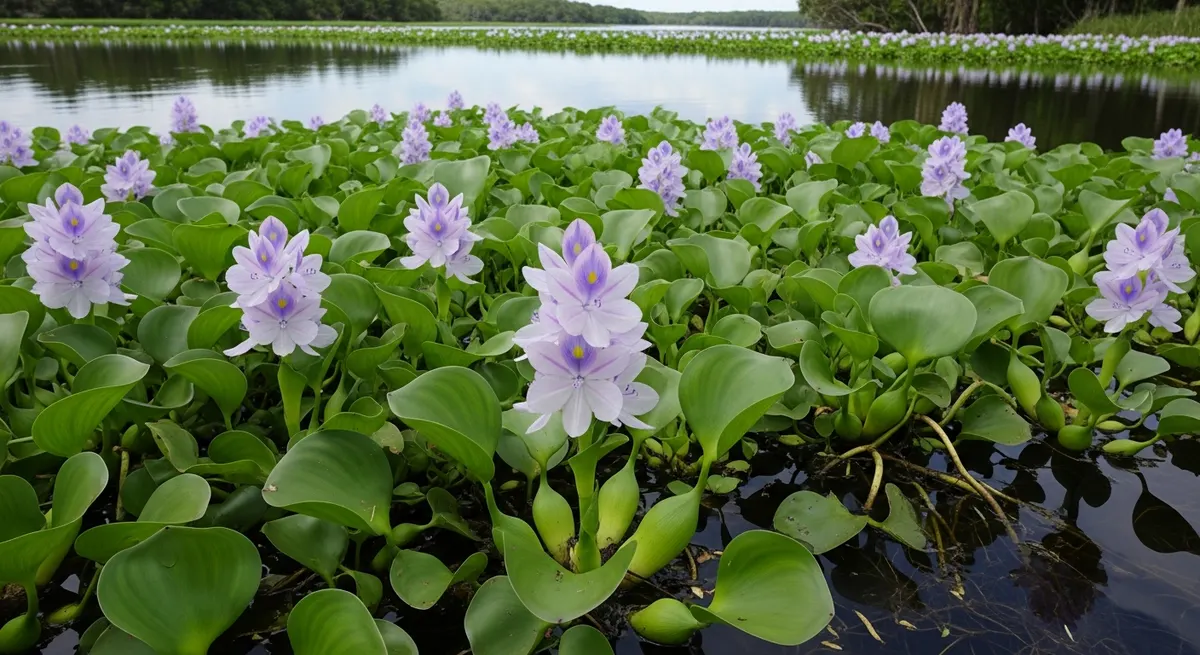
Identifying Water Hyacinth
Water hyacinth is one of the easiest aquatic plants to identify once you have seen it. The combination of its distinctive inflated petioles, glossy rounded leaves, feathery purple roots, and showy flower spikes creates an appearance unlike any other plant in U.S. waterways. Confusion with other species is rare for mature plants, though early growth stages and less common Eichhornia relatives can occasionally cause uncertainty. This guide covers all key features for definitive identification at every life stage.
Key Identification Features
1. Inflated Petioles (Bulbous Leaf Stalks)
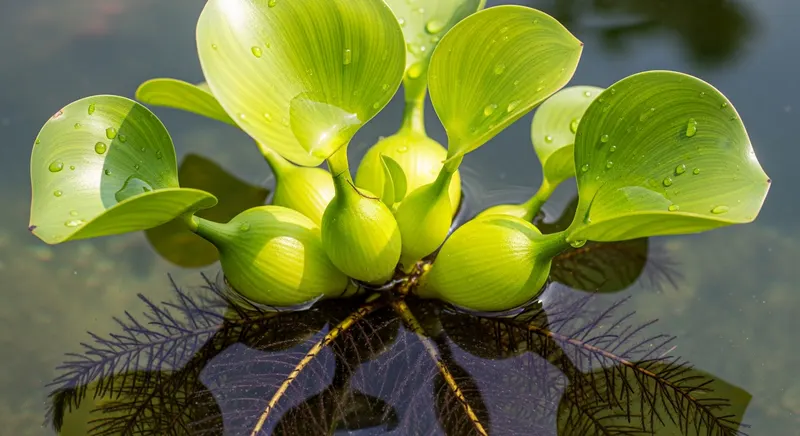
The most distinctive feature of water hyacinth is its petioles — the stalks connecting the leaf blades to the central stem. In established, free-floating plants growing in open water, these petioles are dramatically inflated and spongy, ranging from 3–15 cm in diameter. They are filled with aerenchyma tissue (air-filled cells) that provide buoyancy. The degree of inflation varies: plants in nutrient-rich open water tend to have large, bulbous petioles; plants growing in dense mats or along shorelines may have elongated, less inflated petioles as they compete for space. The inflated petiole is diagnostic — no other U.S. aquatic weed has this feature.
2. Leaf Shape and Texture
Leaf blades are rounded to kidney-shaped (ovate to reniform), typically 4–20 cm across. The surface is glossy and smooth, dark green on the upper surface, slightly paler below. Leaf margins are smooth (entire) with no teeth. The surface has a waxy sheen that causes water to bead. Leaves emerge in a rosette pattern from the central meristem, with the youngest leaves at the center and largest outer leaves fully expanded. Leaf size varies significantly with nutrient availability and plant density — plants in high-density mats have smaller leaves with elongated petioles.
3. Roots
The roots of water hyacinth are among its most recognizable features. They hang freely in the water below the floating rosette, forming a dense, fibrous mat of dark purple to black or brownish root hairs. Root length ranges from a few centimeters (young plants) to 1+ meter (mature plants in deep, nutrient-rich water). The feathery root mat is distinctively purple-black — this coloration, combined with the fine texture, makes it immediately identifiable when collected or seen underwater. Roots are highly efficient nutrient absorbers; their purple color is due to anthocyanin pigments.
4. Flower Spike
Water hyacinth flowers are among the most beautiful of any aquatic weed. The flower spike (raceme) rises 10–30 cm above the leaves and bears 8–15 individual flowers. Each flower is 3–4 cm across, with 6 petals (technically tepals) in shades of lavender to blue-violet, with the uppermost petal bearing a distinctive yellow spot with a violet-blue margin. The overall effect is resembling an orchid or hyacinth bloom. Flowers are produced primarily from spring through fall and open sequentially along the spike over several days. After pollination, seed capsules containing 10–450 seeds per capsule develop below the water surface, attached to the stalk that pulls the developing fruit underwater.
5. Stolon Production
Water hyacinth reproduces vegetatively by producing stolons (runners) that extend horizontally from the parent plant and terminate in a bud that develops into a daughter plant. Stolon-produced daughter plants initially remain attached, creating chains of rosettes, then detach and become independent floating plants. This vegetative reproduction is the primary mechanism of rapid spread within a water body and enables the exponential population growth that characterizes blooms.
Life Stage Variation
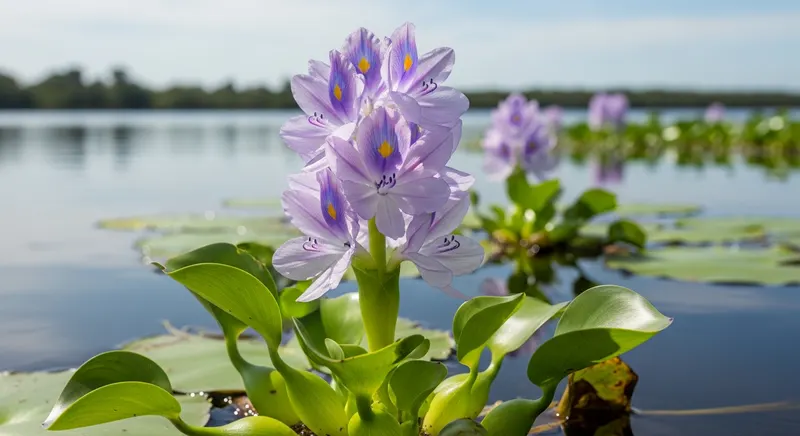
Young water hyacinth plants (germinated from seed or newly produced vegetative propagules) lack the inflated petioles of mature plants and may superficially resemble other small floating plants. Young seedlings have round, small leaves (1–3 cm) with only slightly inflated petioles. At this stage, the glossy leaf surface and purple roots still provide identification clues. The flower spike is produced only on mature, established plants — typically after the plant has developed at least 4–6 mature leaves and grown for several weeks.
Comparison to Similar Species
Pickerelweed (Pontederia cordata)
Pickerelweed is in the same family (Pontederiaceae) and has similar blue-purple flowers, but it is a rooted emergent plant — it grows from sediment, not floating — with lance-shaped to heart-shaped leaves very different from water hyacinth's rounded rosette. Pickerelweed is native and valuable; it should not be confused with or treated as water hyacinth.
Frog's Bit (Limnobium spongia)
American frog's bit is a small native floating plant with rounded leaves that can superficially resemble young water hyacinth. Frog's bit lacks inflated petioles (leaves float flat), produces much smaller flowers, and stays small (leaves typically 1–4 cm diameter vs. 4–20 cm in water hyacinth). It is native and should not be confused with or treated as an invasive.
Reporting Confirmed Water Hyacinth
Confirmed water hyacinth identification in a state or water body where it has not been reported should be immediately reported to your state department of natural resources or through EDDMapS (eddmaps.org). Early detection enables rapid response before large populations with extensive seed banks establish. For management options, see water hyacinth control methods.
References
- Godfrey, R.K. & Wooten, J.W. (1981). Aquatic and Wetland Plants of Southeastern United States. University of Georgia Press.
- UF/IFAS Center for Aquatic and Invasive Plants. plants.ifas.ufl.edu
Whole-Lake Hydrilla Management: Lake Tohopekaliga, FL
Lake Tohopekaliga ("Lake Toho"), a 22,700-acre Central Florida lake, has sustained one of the most intensively managed hydrilla programs in the U.S. since the 1990s. Annual fluridone treatments combined with targeted mechanical harvesting in high-use recreational areas have maintained hydrilla coverage below nuisance thresholds while preserving native submersed vegetation communities in designated littoral zones.
Key outcome: Multi-decade integrated program demonstrates that hydrilla can be managed at acceptable levels in large water bodies, but requires sustained annual investment and coordinated agency cooperation across FDEP, SFWMD, and local fisheries managers.
As a lakefront property owner I was completely lost until I found AquaticWeed.org. The permit guidance alone saved me from making costly, potentially illegal treatment mistakes.
Gerald Renfrew Lakefront Landowner, WI · Vilas CountyI've managed aquatic vegetation on Texas reservoirs for 15 years. The water hyacinth control content here is the most up-to-date, practical guidance I've found anywhere online.
Travis McKinley Commercial Fishing Guide, TX · Lake Travis / Lake Austin