Developing a Lake Aquatic Weed Management Plan
Lakes present the most complex aquatic weed management challenges. Large water areas, variable depth profiles, diverse uses (fishing, boating, swimming, drinking water), multiple property owners, and complex regulatory requirements all make lake management planning substantially more involved than small pond management. A well-structured lake management plan provides the framework for making consistent, evidence-based decisions over a multi-year management program.
Step 1: Baseline Survey and Species Inventory
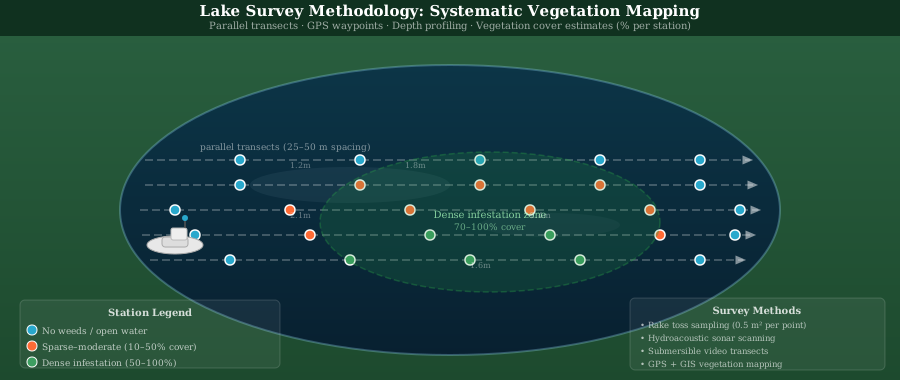
A baseline survey conducted before any management action is the foundation of the plan. For lakes, the baseline survey should include: systematic aquatic plant mapping (transect or point-intercept methodology) documenting species identity, distribution, and relative abundance throughout the lake; water quality baseline measurements (dissolved oxygen, temperature, transparency, nutrients) at multiple stations; existing native plant community documentation; and identification of sensitive areas (water intakes, native plant beds, fish spawning areas, adjacent wetlands) that require protection during management.
For lakes larger than 50 acres, professional survey methods (boat-based survey with GPS plant mapping, underwater video, or hydro-acoustic mapping) are recommended. Contact your state department of natural resources or university cooperative extension program for survey methodology guidance and potential technical assistance. Survey methods →
Step 2: Stakeholder Engagement and Goal Setting
Lakes with multiple adjacent property owners, public access, or shared use require stakeholder engagement before finalizing management goals and approach. Lake associations are the most effective vehicle for coordinating lakeside owners in shared management programs — collective programs are consistently more effective and cost-efficient than fragmented individual management. If no lake association exists for your lake, establishing one is a high-priority pre-planning step.
Goals should reflect the specific use priorities of the water body. A reservoir managed for drinking water has different goals (water quality, taste and odor prevention) than a bass fishing lake (open water zones, adequate dissolved oxygen, spawning habitat) or a recreational boating lake (navigation channel clearance, swimming access). Be explicit about which goals have priority when tradeoffs are necessary. Goal setting guide →
Step 3: Regulatory Coordination
Lake management in most states requires coordination with multiple regulatory agencies: the state department of natural resources (aquatic plant management permits, protected species), the state environmental quality department (water quality standards, herbicide permits), and potentially the U.S. Army Corps of Engineers (jurisdictional wetland impacts) and U.S. Fish and Wildlife Service (protected species). Begin permit applications 6–8 weeks before the planned treatment window. For complex, multi-treatment programs, pre-application meetings with agency staff can streamline permit processing significantly.
Step 4: Treatment Program Design
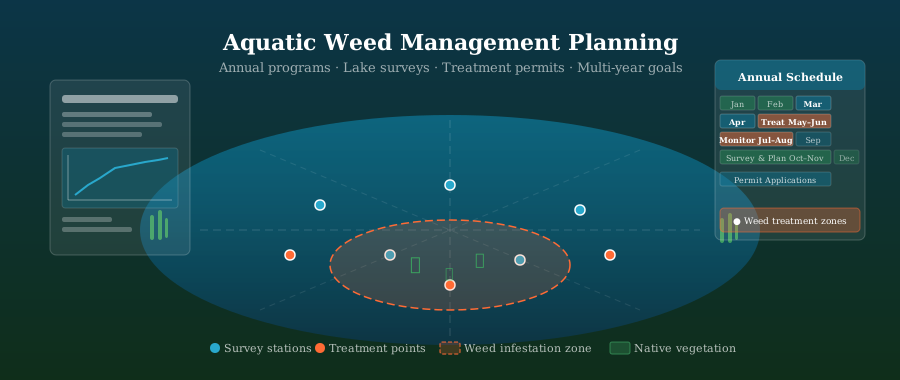
The treatment program for a lake should include: the specific control methods and products to be used; application timing and sequence; sectional treatment design for large lakes (to prevent mass oxygen depletion from simultaneous treatment); contingency plans for post-treatment oxygen monitoring and emergency aeration if needed; and a 3–5 year projected program that acknowledges multi-year depletion requirements for species with persistent propagule banks.
Step 5: Annual Monitoring and Adaptive Management
Annual surveys (ideally at the same time of year, using the same methodology as the baseline survey) document progress toward goals and identify treatment program adjustments needed. Monitoring results drive adaptive management decisions: increase treatment intensity where progress is below target; reduce or discontinue treatment in areas where goals are achieved; expand surveyed areas as new infestation zones are identified. Maintain a complete management record that will support future regulatory applications and inform long-term program decision-making. Documentation guidance →
Frequently Asked Questions
How do I organize other lake property owners for a shared management program?
Start by contacting your state department of natural resources, which typically has resources and contacts for lake association formation. Reach out to neighboring property owners individually or through any existing communication channels (neighborhood email list, local Facebook group). Call a meeting at a central location. Present the baseline data on the weed problem and the economic and ecological case for collective action. Shared management programs typically work through a lake association that collects dues, hires a professional management company, obtains permits, and manages the program — each property owner pays a share proportional to their lakefront footage or a flat per-lot assessment.