What Are Emergent Aquatic Weeds?
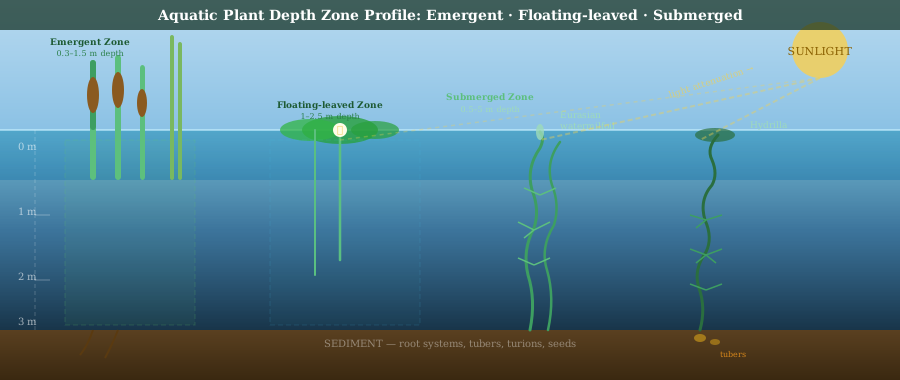
Emergent aquatic plants are rooted in saturated soil or shallow water but extend their leaves, stems, and reproductive structures above the water surface. They occupy the biologically rich transition zone between open water and upland habitats — the wetland margin, shallow shoreline, and riparian zone that supports disproportionately high biodiversity compared to either the open water or upland habitat alone.
This biological richness makes emergent weed problems particularly significant: invasive emergent species don't just replace open water habitat — they replace one of the most ecologically productive zones in the landscape. When invasive Phragmites establishes on a Great Lakes shoreline or a Delaware Bay wetland, it replaces a diverse community of native sedges, rushes, wildflowers, and aquatic plants that supports breeding populations of marsh birds, amphibians, waterfowl, fish, and hundreds of invertebrate species.
Emergent weeds include both invasive non-native species and native species that have expanded into nuisance densities under disturbed or nutrient-enriched conditions. This distinction is critical for management strategy: invasive emergent species require aggressive, targeted control; native emergent species that have become dense under eutrophic conditions may require nutrient management as the primary intervention, with plant control as a secondary measure.
Emergent plant communities are also uniquely persistent. Unlike floating or submerged plants that may die back seasonally and resprout from seeds or propagules, many emergent weeds spread primarily through underground rhizomes — dense mats of horizontal roots that can persist in the soil for years and regenerate vigorously from even small fragments after disturbance. This rhizome network makes emergent weed management one of the most challenging categories of aquatic plant control.
Biology and Establishment Mechanisms
Rhizome-Based Spread
The dominant reproductive strategy of most emergent weeds is lateral spread through underground rhizomes — horizontal stems that grow through the soil just below the surface. Cattails can extend rhizomes at 4 meters per year in favorable conditions. Invasive Phragmites rhizomes can penetrate 1–2 meters deep into soil and extend 10 or more meters laterally per year. Alligator weed spread through both rhizome growth and vegetative stem fragmentation that floats and roots at new sites.
This rhizome network has several management implications: cutting or mowing above-ground stems is almost never sufficient for long-term control because the rhizome network remains intact and vigorously resprouts. Effective control typically requires either systemic herbicide application (absorbed by leaves, transported to kill the rhizome system) or comprehensive mechanical removal including excavation of the rhizome mat. How aquatic weeds reproduce →
Competitive Exclusion
Dense emergent monocultures exclude other plant species through several mechanisms: direct resource competition (light, space, water, nutrients), physical inhibition by dense litter accumulation that prevents other species from establishing, allelopathy (chemical suppression of competing plants), and altered hydrology (emergent mats trap sediment and can raise ground levels, changing water depth and drying out shallow areas over time). Invasive Phragmites is particularly aggressive — established stands can grow to 4 meters (13+ feet) in height, completely shading out lower-growing native species.
Ecological Impacts
Dense emergent weed monocultures reduce habitat quality in multiple ways:
- Structural simplification: Diverse native emergent communities support birds, frogs, turtles, invertebrates, and fish at every vertical layer. Phragmites and cattail monocultures have dramatically lower vertebrate species diversity than native-dominated wetlands — research in the Great Lakes region found 37% fewer bird species in Phragmites-dominated marshes compared to native-dominated marshes.
- Aquatic access obstruction: Dense emergent growth blocks access to the water's edge for swimming, fishing, launching boats, and other recreation. This eliminates the shoreline use that most waterfront property owners purchased their land for.
- Water flow restriction: Emergent vegetation in drainage channels, culverts, and stormwater basins dramatically reduces hydraulic capacity, increasing flood risk during storm events. Management of emergent weeds in stormwater infrastructure is an ongoing municipal maintenance challenge.
- Waterfowl habitat degradation: Ducks and shorebirds depend on diverse, structurally complex emergent vegetation interspersed with open water. Dense monocultures lack the habitat complexity these species require. Research has documented significant waterfowl population declines in Phragmites-dominated Great Lakes coastal wetlands.
- Sediment trapping and wetland conversion: Over decades, emergent plant litter and trapped sediment can progressively raise wetland surface elevations, converting shallow open water to dense emergent marsh and eventually to terrestrial habitat — a process called terrestrialization. Aggressive emergent invaders dramatically accelerate this natural succession.
Complete ecological impact hub → | Shoreline encroachment →
Species Profiles
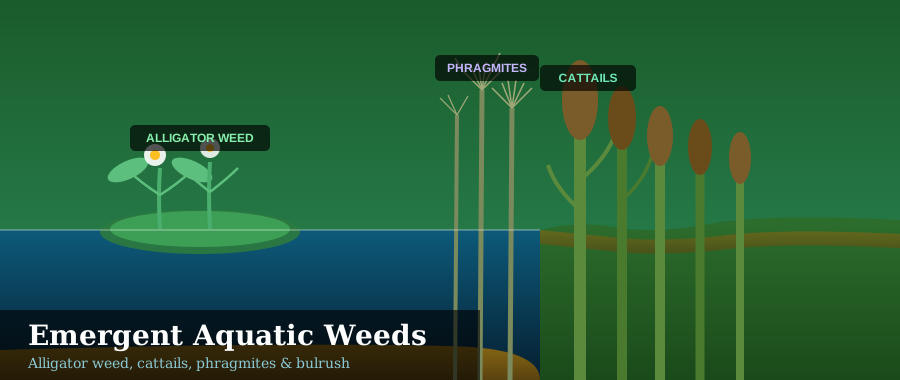
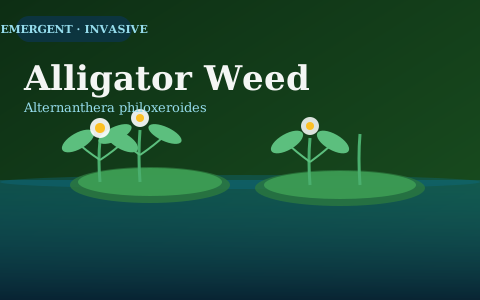
- → Alligator Weed Alternanthera philoxeroides — Federally listed noxious weed from South America; hollow stems; white clover-like flowers; grows aquatically, emergently, and terrestrially. Full profile →
- → Phragmites / Common Reed Phragmites australis — Invasive non-native subspecies is among North America's most aggressive wetland invaders; reaches 4m tall; feathery tan plumes; forms dense impenetrable monocultures.
- → Cattails Typha spp. — Native but nuisance in disturbed/eutrophic wetlands; colonial spread via rhizomes; distinctive cylindrical brown seed heads; both broad-leaf and narrow-leaf species occur.
- → Bulrush Schoenoplectus spp. — Native emergent sedge; triangular stem cross-section; important wildlife habitat but can dominate in nutrient-enriched shallow water.
- → Primrose Willow Ludwigia spp. — Bright yellow flowers; several invasive species established in California and the Southeast; colonizes shallow water margins aggressively.
The Invasive Phragmites Challenge
Invasive non-native Phragmites (Phragmites australis subsp. australis) deserves particular attention as one of the most difficult and ecologically damaging emergent weed problems in North America. It is now established across virtually every U.S. state except Hawaii and several Canadian provinces. It dominates coastal wetlands along the entire Atlantic coast, has massively colonized Great Lakes coastal wetlands, and continues expanding inland through virtually every state.
The management challenge with invasive Phragmites is compounded by the existence of a native North American subspecies (Phragmites australis subsp. americanus) that is morphologically very similar and ecologically valuable. Distinguishing between the invasive and native forms requires careful observation of stem color, leaf sheath attachment, stem surface texture, and ideally genetic testing. Treating native Phragmites as a weed is an error that has occurred in management programs lacking this identification expertise.
Effective Phragmites management requires multi-year commitment, typically combining fall herbicide application (systemic imazapyr or glyphosate after peak growth, when the plant is translocating nutrients to its rhizomes) followed by prescribed fire or mechanical removal of the dead above-ground biomass, then monitoring and repeated treatment for several years. Common reed management strategies →
Control Strategies
Emergent weed control is complicated by rhizome persistence and the need to balance control with native plant protection:
- Systemic herbicides: Imazapyr and glyphosate (aquatic formulations only) applied in late summer/fall provide effective kill of above-ground biomass and significant damage to rhizomes when the plant is actively translocating photosynthate downward. Multiple treatment years are typically required. State permits required; buffer zones and water use restrictions apply. Herbicide guide →
- Prescribed fire: Burning dead Phragmites and cattail stems after fall herbicide treatment removes the standing dead biomass, creates favorable conditions for native plant establishment, and can stimulate some rhizome kill when combined with herbicide. Requires regulatory approval and trained personnel.
- Mechanical removal: Cutting, mowing, and excavation provide temporary suppression and can be useful in small infestations or sensitive areas where herbicides cannot be used. Excavation of rhizome mats is effective when complete but extremely labor-intensive. All cut material must be disposed of in a way that prevents reestablishment.
- Biological control: USDA-approved insects for alligator weed (Agasicles hygrophila, the alligator weed flea beetle, and Vogtia malloi, the alligator weed stem borer) have provided excellent long-term suppression across the Gulf South. No approved biocontrol agents exist for invasive Phragmites or cattails as of 2024.
Complete control methods guide →
Frequently Asked Questions
How do I tell invasive Phragmites from native Phragmites?
Invasive Phragmites (P. australis subsp. australis) and native Phragmites (P. australis subsp. americanus) look nearly identical. Key field differences of the invasive form: (1) stems are typically darker tan to gray-green and persist very stiffly through winter; (2) leaf sheaths do not fall away from the stem as easily; (3) stems are usually smoother; (4) stands are typically denser and taller; (5) native Phragmites usually has reddish lower stem nodes and a purplish leaf sheath. Definitive identification may require genetic analysis. Contact your state extension service or DNR for assistance before treating what might be native Phragmites.
Are cattails bad for lakes and ponds?
Not inherently — cattails are native North American plants that provide important habitat for nesting red-winged blackbirds, marsh wrens, muskrats, and many other species, and offer stormwater filtration benefits. The problem emerges when cattails form dense monocultures in nutrient-enriched water bodies, crowding out diverse native plant communities and eliminating open water areas in shallow marshes. Managing cattails involves both direct plant control (herbicide, cutting) and addressing the underlying eutrophication that allows nuisance densities to develop. Native cattails should not be eliminated — the goal is maintaining appropriate densities interspersed with other native plants, not eradication.
What makes alligator weed so difficult to control?
Alligator weed presents multiple management challenges: it grows in three distinct habitats (aquatic floating mats, emergent shoreline stands, and terrestrial upland areas), requiring different control strategies for each; its hollow jointed stems allow it to resprout from small fragments; its rhizome system makes complete mechanical removal very difficult; and in many warm-climate states it grows year-round. Biological control agents (particularly the alligator weed flea beetle) have been most successful in warm Gulf Coast states, but cold-climate states must rely more heavily on herbicide treatments, which require repeat application. In frost-free areas, biocontrol has essentially eliminated alligator weed as a major management problem in many water bodies.
Can I cut Phragmites or cattails to control them?
Cutting alone is generally not effective for long-term control of either Phragmites or cattails because the rhizome network remains intact and resprouts vigorously from the remaining roots. Repeated cutting (mowing) over multiple years can gradually stress and weaken the plants if done consistently and at the right timing (cutting when the plant has committed its energy reserves to above-ground growth), but this is labor-intensive and rarely eliminates the infestation. Cutting is most useful as a preparation for subsequent herbicide treatment or as an ongoing suppression strategy in areas where herbicides cannot be used. Cutting in winter on frozen ground prevents spring growth but must be repeated annually.
How fast does invasive Phragmites spread?
Invasive Phragmites spreads via rhizomes and seeds. Rhizome growth of 4–5 meters per year laterally is typical, meaning an established stand can expand its perimeter by several feet in all directions each growing season. Seed production is prolific — each plant can produce thousands of seeds annually — and while many germinate poorly, establishment from seeds does occur particularly in disturbed or bare soil areas. A new Phragmites stand that goes unmanaged for 5 years can easily grow from a few square meters to an area many times larger. Early detection and rapid management response before stands become established is far more effective and less expensive than managing large mature stands.
References and Further Reading
- Mal, T.K., and L. Narine. (2004). "The biology of Canadian weeds: 129. Phragmites australis (Cav.) Trin. ex Steud." Canadian Journal of Plant Science, 84(1), 365–396.
- Marks, M., B. Lapin, and J. Randall. (1994). "Phragmites australis (P. communis): Threats, Management, and Monitoring." Natural Areas Journal, 14, 285–294.
- Center, T.D., et al. (1982). "Biological control of alligator weed in Florida waterways." Proceedings of the Florida Weed Control Conference.
- Wilcox, K.L., et al. (2003). "Waterfowl use of Great Lakes coastal wetlands during the fall migration." Wilson Bulletin, 115(2), 192–200.
- Tulbure, M.G., et al. (2007). "Comparison of Phragmites australis and Typha spp. stand structure, composition and biomass in Ohio, USA wetlands." Annals of Botany, 99, 1231–1240.
- USDA NRCS. (2023). Plant Guide: Common Reed (Phragmites australis). National Plant Data Team, Greensboro, NC.