Identification and the Native vs. Invasive Problem
Phragmites (Phragmites australis), the common reed, presents one of the most challenging identification problems in North American aquatic plant management: two distinct genetic lineages of the same species are present — one native to North America, ecologically integrated and valuable; one non-native from Europe, highly invasive and destructive. The challenge is that they are the same species (Phragmites australis) and look very similar without careful examination.
Key features that may help distinguish the non-native (invasive) from native lineages:
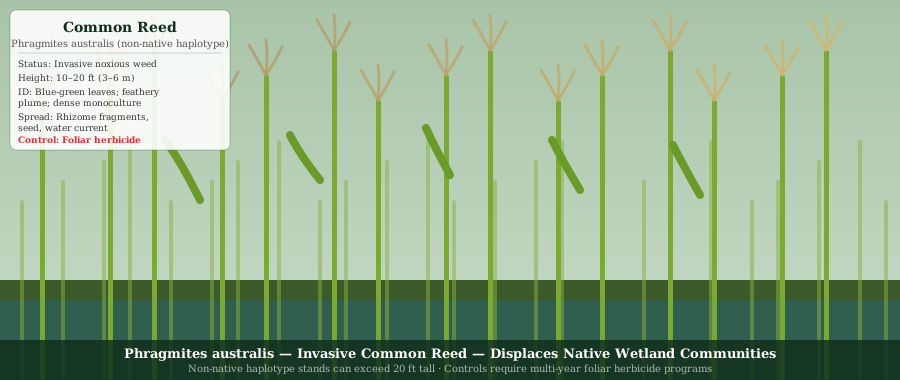
- Non-native invasive: Tan to gray-colored dead stems that persist standing through winter (native stems tend to be more red-brown and to break down faster); dense, single-species monocultures with few or no other plant species; smooth, glaucous (blue-green) leaf sheaths; stems often reach 4–5 meters or more; ligule (the membrane where leaf meets stem) is a very short fringe of hairs.
- Native: Generally coexists with other native plant species rather than forming pure monocultures; red-brown dead stems; tends to be less tall in most habitats; ligule characteristics differ subtly.
Important caveat: these morphological features overlap between lineages and reliable identification often requires genetic testing (genetic markers from leaf tissue, conducted by university labs or state agencies). Do not take management action on suspected invasive Phragmites without either expert confirmation or genetic testing — treating native Phragmites would be ecologically harmful.
Biology and Invasiveness
Invasive Phragmites spreads primarily through underground rhizomes, extending 10–20 meters per year into adjacent habitats. Rhizomes can penetrate 2 meters deep, making mechanical removal without herbicide pretreatment ineffective. Stems can grow to 5 meters (16 feet) in height, completely shading out all shorter native vegetation beneath. Stump resprout after cutting is vigorous unless a systemic herbicide has killed the rhizome network. Dense litter accumulation from dead stems creates a deep thatch layer (20–50 cm) that prevents native seed germination even after Phragmites is controlled.
The invasive lineage arrived in eastern North America in the 1800s (possibly via ballast water) and has dramatically expanded since the 1950s–1970s, likely aided by hydrological modifications and increased nitrogen deposition from atmospheric pollution. Reproduction biology →
Ecological Impacts
Invasive Phragmites monocultures are among the most ecologically damaging invasive plants in North American coastal and freshwater wetlands. A Phragmites monoculture replaces a diverse native wetland plant community (with dozens of species and associated wildlife) with a structurally simplified habitat that supports few native animals. Nesting habitat for rare marsh birds is eliminated. Open water areas important for waterfowl feeding and invertebrate production are filled in. Shoreline access for recreational fishing is blocked. The economic and ecological costs of large-scale Phragmites invasions are documented in the billions of dollars across the Great Lakes and Atlantic Coast. Fish and wildlife habitat impacts →
Distribution
Invasive Phragmites is most severe in the Great Lakes region and Atlantic Coast from Maine to Florida, with significant infestations throughout the Midwest and increasingly the Gulf Coast. Northeast distribution | Midwest distribution
Control
Effective large-scale Phragmites management requires systemic herbicide application (imazapyr, glyphosate — aquatic registered formulations) to kill the rhizome network, followed by mechanical removal of dead stems and litter, and replanting with native species. Fall application (when plants are translocating photosynthate to rhizomes) is most effective. Multi-year follow-up treatment for resprouting plants and seed germination is essential. Programs managing large Phragmites stands require 3–5+ years of sustained effort. Control methods →
Frequently Asked Questions
Why is it important to distinguish native from invasive Phragmites?
Native North American Phragmites plays an ecologically integrated role in wetland communities where it occurs naturally — it coexists with dozens of other native plant and animal species and provides habitat functions without displacing the surrounding community. The non-native (European) lineage forms dense, single-species monocultures that eliminate all native plant diversity. Treating native Phragmites with herbicides would destroy valuable native wetland habitat, which is both ecologically harmful and potentially illegal under wetland protection regulations. State-level programs require confirmation of the invasive lineage before authorizing management actions.