Identification Features
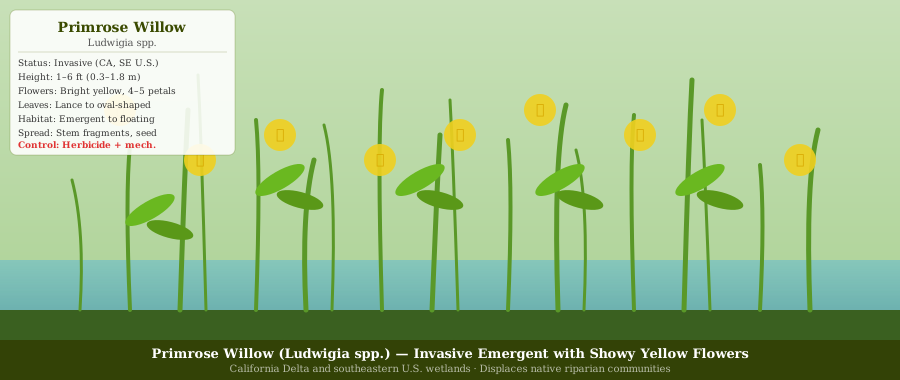
Primrose willow (water primrose, Ludwigia spp.) is a group of emergent to floating-leaved aquatic plants distinguished by their conspicuous bright yellow, four- or five-petaled flowers. The flowers (2–5 cm across) are the most immediately recognizable feature — large, showy, and produced in abundance. Leaves are simple, alternate, lance-shaped to oval, and vary in texture from glossy to slightly hairy depending on species. Stems are often reddish and may float horizontally on the water surface or stand erect at the shoreline.
The most invasive species in the U.S. are Ludwigia hexapetala (Uruguay water primrose — 6 petals) and L. grandiflora (Uruguay water primrose — 5 petals, variable), both introduced from South America. Native Ludwigia species (several) also occur in the U.S. and are generally not considered invasive. The non-native invasive species are distinguished from native ludwigias by their aggressive growth, dense mat formation, and typically larger size. Accurate species identification usually requires examination of leaf, stem, and fruit characteristics — consult your state DNR if uncertain. Identification guide →
Biology and Growth
Invasive Ludwigia species grow by spreading horizontal floating stems (stolons) from established plants across the water surface and into adjacent shoreline areas. New rooting occurs at nodes wherever the stem contacts soil or sediment. Growth is rapid in warm, nutrient-rich conditions — colonies can expand several meters per growing season. Plants can also spread into terrestrial habitats beyond the water's edge, colonizing moist soils along banks and levees.
In warm-climate states (California, Louisiana, Florida), invasive Ludwigia produces large quantities of seed in addition to vegetative spread. Seeds are small and dispersed by water, birds, and human transport. The combination of vegetative spread and prolific seeding makes population control challenging once an infestation is established.
Distribution and Invasiveness in California
Invasive Ludwigia species are most problematic in California (Sacramento-San Joaquin Delta and coastal wetlands), the Gulf South, and the Pacific Northwest. In California, water primrose is considered a primary invasive species threatening wetland and riparian habitats — infestations in the Delta have covered thousands of acres and required multi-million-dollar management programs. France and other European countries have also struggled with large-scale Ludwigia invasions, where the species was introduced as an ornamental aquatic plant. California distribution →
Control
Early detection and rapid response are essential — large established infestations are significantly more difficult and costly to manage than new, small populations. Effective chemical control uses imazapyr (Habitat, Arsenal) or glyphosate (Rodeo, AquaMaster) applied in summer during active growth. Physical removal is feasible for small populations but requires complete removal of all fragments (which root readily). All treatment requires state permits. California has implemented an aggressive early detection and rapid response program for new Ludwigia introductions. Control methods →
Management Approaches and Control
Water primrose management is complicated by its rapid regrowth from root fragments and stems and by the species' high ecological value in some contexts — it provides excellent waterfowl food and cover in managed wetlands, and some primrose species are native to portions of the U.S. range. Before treating any primrose population, confirm species identity (invasive Ludwigia hexapetala or Ludwigia grandiflora vs. native Ludwigia palustris or other native species) — non-native species warrant aggressive management while native species may warrant protection.
For confirmed invasive primrose populations, foliar applications of systemic herbicides (imazapyr, glyphosate, triclopyr) to actively growing emergent and terrestrial stems achieve good control. Aquatic formulations must be used for treatments in or immediately adjacent to water. Mechanical removal without herbicide is generally insufficient for established populations because root fragments readily regenerate. Post-treatment monitoring for regrowth from seed bank and root fragments is essential, as retreatment in the following one to two seasons is typically necessary to deplete residual regeneration. Chemical control for emergent species →
Frequently Asked Questions
Is all Ludwigia invasive?
No. There are many native Ludwigia species in the United States — including L. palustris (water purslane), L. alternifolia, and L. sphaerocarpa — that are native, ecologically integrated components of eastern U.S. wetlands. These native species are not considered invasive. The primary invasive concern is with South American species, particularly L. hexapetala and L. grandiflora, which have been introduced and are spreading aggressively in California, the Gulf South, and the Pacific Northwest. Correct species identification before management is essential.