Identification Features
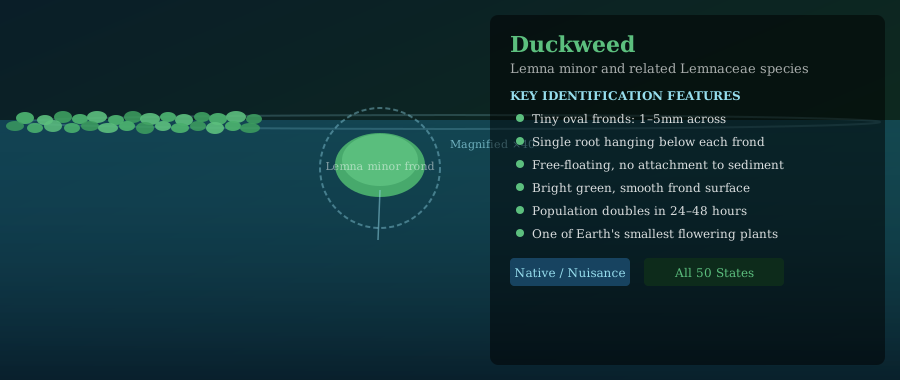
Common duckweed (Lemna minor) is the simplest vascular plant in appearance: small, flat, oval green fronds floating individually or in loosely connected groups of 2–4. Each frond is 1.5–5 mm long, elliptic to oval, with a single root hanging below into the water. The upper surface is bright green and smooth; the underside is slightly paler. The critical identification features that distinguish duckweed from look-alike species: (1) individual frond size 1.5–5 mm — larger than watermeal, smaller than dotted duckweed; (2) one root per frond; (3) smooth, flat frond surface without obvious veins.
The most commonly confused species are watermeal (Wolffia spp.) — smaller, rootless, more spherical fronds — and giant duckweed (Spirodela polyrhiza) — larger (4–10 mm), with multiple roots and reddish underside. When in doubt, the root count is the most reliable feature: Lemna has exactly 1 root per frond; Spirodela has 7–21; Wolffia has none. See identification guide →
| Feature | Lemna minor | Wolffia spp. | Spirodela polyrhiza |
|---|---|---|---|
| Frond size | 1.5–5 mm | 0.3–1.5 mm | 4–10 mm |
| Roots | 1 per frond | None | 7–21 per frond |
| Underside | Pale green, flat | Pale green | Purple-red |
Biology and Growth
Despite being a native plant, duckweed earns nuisance status in eutrophic water bodies through its extraordinary growth capacity. Under warm temperatures (20–30°C), high phosphorus and nitrogen levels, and calm water conditions, duckweed populations can double every 24–48 hours. Population growth is entirely vegetative — each frond simply divides into two daughter fronds that remain briefly connected before separating. Sexual reproduction and seed production are rare, but dormant overwintering turions (small, dense fronds that sink and rest on the sediment through winter) allow populations to persist through cold seasons in northern water bodies.
Duckweed is native throughout North America and plays a legitimate ecological role in healthy aquatic ecosystems — providing cover for invertebrates, food for waterfowl and fish, and some light regulation in pond margins. The problem arises when nutrient loading drives population densities to the point where a thick, continuous mat covers the entire water surface, excluding light, depleting oxygen, and driving out all other species.
Ecological Impacts and Management Context
Dense duckweed coverage reduces photosynthesis and gas exchange in the water below, leading to oxygen depletion that can cause fish kills in severe, prolonged infestations. However, because duckweed is a native species, management philosophy differs from invasive weed management: the primary intervention for nuisance duckweed is nutrient reduction — addressing the phosphorus and nitrogen loading that fuels the bloom — rather than direct plant removal alone.
Direct removal without addressing the underlying nutrient problem typically results in rapid regrowth. Effective long-term control requires watershed-level nutrient management: reducing fertilizer runoff, addressing stormwater inputs, improving septic systems, and managing waterfowl activity (a significant source of nutrient loading in small ponds).
Distribution and Habitat
Duckweed is found in every U.S. state and on every continent except Antarctica. It is most abundant in nutrient-rich, still or slow-moving water bodies: farm ponds, retention ponds, sheltered lake bays, drainage ditches, and backwaters. It cannot establish in fast-flowing water. Distribution overview →
Management
Manage duckweed through an integrated approach: nutrient management first, then physical/chemical reduction as needed. Duckweed-eating fish (koi, grass carp with a permit, fathead minnows) can provide ongoing biological control. Wind and aeration disturb still-water conditions that favor duckweed. If chemical treatment is needed, fluridone, diquat, and certain peroxide-based products are labeled for duckweed in certain water body types — always check state permit requirements and water use restrictions. See control methods hub →
Frequently Asked Questions
Is duckweed harmful to fish?
In small to moderate amounts, duckweed is not harmful to fish and is in fact eaten by many species. Dense mats become harmful when they reduce dissolved oxygen to critically low levels, especially during hot weather when oxygen solubility is already reduced. Thick mats can also make surface-feeding fish more vulnerable by obscuring them from aerial predators. Ponds with moderate duckweed coverage typically have healthy fish populations; problems arise when coverage approaches 60–100% of the surface.
Can I manually remove duckweed with a net?
Yes, and manual removal with a fine-mesh net is effective as a short-term measure for small ponds. The key is to remove as much biomass as possible and dispose of it on land, away from any water. Manual removal does not address the underlying nutrient problem and will need to be repeated frequently if nutrient loading remains high. For larger ponds or persistent infestations, addressing nutrient inputs is essential for lasting results.
What is the difference between duckweed and algae blooms?
Both can cover pond surfaces with a green coating, but they are very different. Duckweed consists of individual small plants with visible structure — you can see individual fronds when you scoop a handful. Algal blooms are composed of microscopic cells that form a uniform, paint-like coating, often with a slimy texture and musty or sulfurous odor. Algal blooms may also discolor the water itself (blue-green). Duckweed does not discolor the water column. Management approaches differ: duckweed responds to nutrient management and physical removal; algal blooms may require algaecide and aeration in addition to nutrient management.