Identification Features
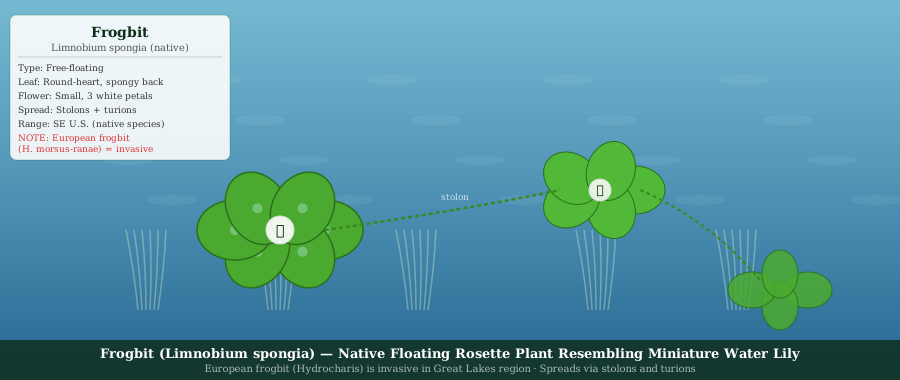
American frogbit (Limnobium spongia) is a native floating plant found primarily in eastern North America. It has a distinctive appearance: rounded, heart-shaped to oval leaves arranged in floating rosettes, 2–6 cm across, that float at the surface. The underside of the leaf is notably spongy due to aerenchyma (air-filled tissue) that provides buoyancy — this soft, spongy texture on the underside is a key identification character. Upper surface is bright to deep green, smooth, and shiny with visible palmate veins.
The species most commonly confused with American frogbit is European frogbit (Hydrocharis morsus-ranae), an invasive species established in the Great Lakes region (Ontario, Quebec, parts of New York and Michigan). European frogbit has similar rounded leaves but is typically smaller (1–3 cm), has a kidney-shaped leaf base with a more pronounced sinus (notch), and is found primarily in sheltered Great Lakes coastal wetlands and rivers rather than the southeastern U.S. habitat of American frogbit. If you are in the Great Lakes region, confirm which species you are dealing with before taking management action — American frogbit is native and protected in some areas.
| Feature | American Frogbit (L. spongia) | European Frogbit (H. morsus-ranae) — Invasive |
|---|---|---|
| Leaf size | 2–6 cm | 1–3 cm |
| Range (US) | Eastern/Southeastern US (native) | Great Lakes region (invasive) |
| Leaf underside | Prominently spongy, raised aerenchyma | Spongy but less pronounced |
| Flowers | 3 white petals, yellow center | 3 white petals, yellow center, similar |
Biology and Growth
Frogbit reproduces through both vegetative and sexual means. Vegetatively, it produces stolons (horizontal runners) that bear daughter rosettes at intervals — allowing a single plant to colonize a significant area over a growing season. Sexual reproduction via seeds occurs in late summer; seeds are small and dispersed in water and by waterfowl. In autumn, the plant produces turions (dense, leaf-like dormancy buds) that sink to the sediment and overwinter before germinating in spring.
American frogbit grows in still to very slow-moving water: lake bays, backwater ponds, swamps, and sheltered river margins. It prefers shaded to partially shaded conditions (unlike water hyacinth, which requires full sun) and is often found growing beneath tree canopy or in the shelter of emergent vegetation. European frogbit, the invasive species, has similar habitat preferences but has proven more adaptable and is establishing in Great Lakes coastal wetlands and slow-moving rivers where American frogbit does not naturally occur.
Ecological Significance
American frogbit is a native species that plays a legitimate ecological role in southeastern aquatic plant communities. Dense floating rosettes provide shelter for invertebrates, tadpoles, and juvenile fish. However, at very high densities (which may occur in disturbed or nutrient-enriched water bodies) it can reduce light penetration and oxygen levels below the mat. European frogbit, by contrast, forms dense monoculture mats in Great Lakes coastal wetlands that displace native plant communities — its management is treated as an invasive species control problem.
Distribution
American frogbit is found throughout the southeastern United States — Florida, Georgia, the Carolinas, and northward along the Atlantic coast. European frogbit is primarily a concern in the Great Lakes region — it was first detected in Ontario in the 1930s, was introduced in the 1980s in New York, and has subsequently spread to multiple Great Lakes coastal wetlands. If you are in the northeastern U.S. or Great Lakes region, contact your state department of natural resources for identification assistance before management.
Management
American frogbit: management is generally not necessary unless the species reaches nuisance densities in a specific area, in which case physical removal or shading (in small areas) is appropriate. Chemical treatment of a native plant requires careful consideration and usually state permits. European frogbit: treat as an invasive species requiring active management. Physical removal, targeted herbicide application (fluridone, diquat), and monitoring are the primary approaches. Permit requirements apply in all states. Control methods →
Frequently Asked Questions
Is frogbit invasive in the United States?
American frogbit (Limnobium spongia) is native to the eastern United States and is not considered invasive. European frogbit (Hydrocharis morsus-ranae) IS invasive in the Great Lakes region of the United States and Canada, where it is established in coastal wetlands and slow-moving rivers. If you find frogbit in the Great Lakes region, identifying which species it is matters significantly for management response. Your state DNR or university cooperative extension can assist with identification.
Can frogbit grow in moving water?
Neither American nor European frogbit can establish in swift-moving water. Both are restricted to still or very slow-moving water bodies — sheltered lake bays, pond margins, backwaters, ditches, and slow streams. This current limitation means frogbit cannot spread through river corridors the way water hyacinth can in slow-flowing southern rivers. Dispersal is primarily via waterfowl, seed transport, or human introduction.