What Is Nutrient Loading?
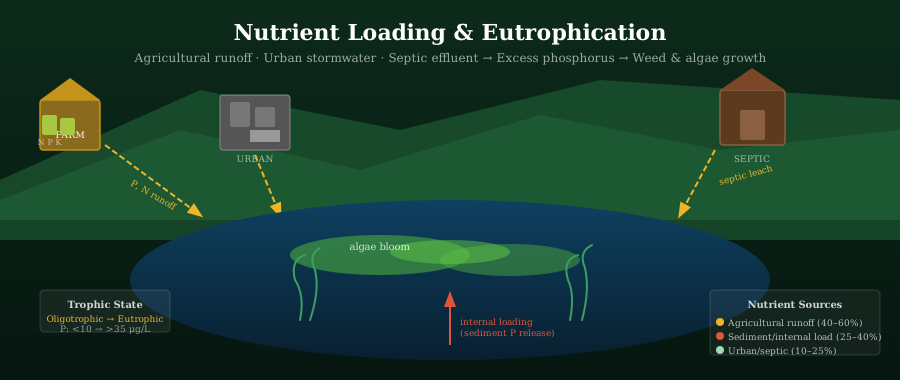
Nutrient loading refers to the input of plant-essential nutrients — primarily phosphorus (P) and nitrogen (N) — into a water body beyond its natural capacity to process them. These nutrients enter water bodies through agricultural runoff, lawn fertilizer, septic system effluent, urban stormwater, atmospheric deposition, and the decomposition of organic matter. In a natural, undisturbed watershed, nutrient inputs and outputs are approximately balanced, and aquatic plant growth is limited to levels the system can sustain. When human activity increases nutrient inputs above this threshold, the balance tips toward eutrophication.
Eutrophication: From Oligotrophic to Hypereutrophic
Eutrophication is the process by which a water body becomes enriched in dissolved nutrients, leading to excessive growth of algae and aquatic plants, and the associated cascade of ecological changes. Water bodies are often classified along a trophic spectrum:
| Trophic State | Total Phosphorus (μg/L) | Typical Aquatic Plant Condition |
|---|---|---|
| Oligotrophic (low nutrients) | <10 | Sparse native vegetation; clear water; few invasive problems |
| Mesotrophic (moderate) | 10–35 | Moderate native vegetation; some invasive risk |
| Eutrophic (high nutrients) | 35–100 | Dense aquatic weed and algae growth; significant management problems |
| Hypereutrophic (excessive) | >100 | Severe weed and algae dominance; oxygen depletion; fish kills common |
Phosphorus: The Primary Limiting Nutrient
Phosphorus is the primary limiting nutrient in most freshwater systems — meaning that growth rate is primarily controlled by phosphorus availability once light and temperature are adequate. Even small increases in phosphorus concentration can dramatically increase aquatic plant biomass. The reason phosphorus is particularly problematic: it is efficiently retained in watersheds and water bodies, accumulating in sediments over years to decades. Unlike nitrogen, which can be partially removed from lakes through denitrification (bacterial conversion to atmospheric N₂), phosphorus has no comparable removal pathway — once it enters a lake, it cycles between water column, plant biomass, and sediment indefinitely unless physically removed. How nutrients drive weed growth →
Sources of Nutrient Loading
Understanding which sources are significant in your watershed is the starting point for effective nutrient management:
- Agricultural row crops: Tile drainage from corn and soybean fields exports large quantities of dissolved phosphorus and nitrate. Agricultural landscapes in the Midwest are the largest collective source of nutrient loading to freshwater in the U.S.
- Lawn fertilizer: Lawn fertilizer applied near water bodies or on impervious surfaces can wash directly into waterways. High-phosphorus lawn fertilizers are particularly impactful. Many states now restrict phosphorus in turf fertilizer for this reason.
- Septic systems: Aging or undersized septic systems can discharge partially treated effluent into groundwater that drains to lakes and streams. In lake-rich regions with dense shoreline development, failing septic systems are a major phosphorus source.
- Waterfowl waste: Canada goose and domestic duck populations in urban and suburban ponds and lakes can be significant local nutrient sources. A large goose population at a small urban lake can contribute nutrient loads comparable to multiple lawn fertilizer applications per season.
- Internal loading: Phosphorus accumulated in lake sediments from years of external loading can be re-released under anoxic conditions, sustaining eutrophic conditions even after external nutrient inputs are reduced.
Managing Nutrient Loading
Effective nutrient management for long-term aquatic weed control requires addressing sources at the watershed level:
- Vegetated buffer strips (minimum 10 meters, ideally 30+ meters) between agricultural fields and water bodies intercept and filter runoff
- Reduced-rate, precision agriculture nutrient management reduces total fertilizer applied per unit area
- Septic system inspection and upgrade programs in sensitive lake watersheds
- Stormwater retention and filtering infrastructure in urban watersheds
- In-lake alum treatment to precipitate dissolved phosphorus and bind it to sediment under aerobic conditions
- Sediment dredging to physically remove phosphorus-loaded sediment from severely impacted water bodies
Phosphorus Cycling: The External-Internal Loading Feedback
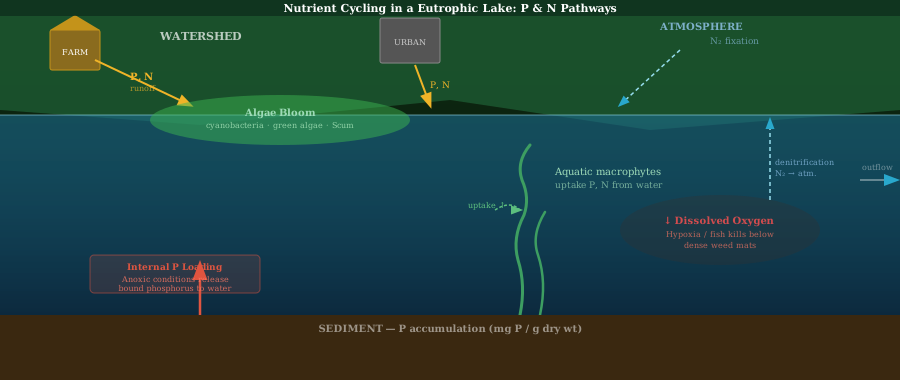
One of the most important and least intuitive aspects of lake eutrophication is the distinction between external loading (nutrients coming in from the watershed) and internal loading (nutrients released from sediment that has accumulated in the lake over prior years). In lakes that have been receiving elevated nutrient inputs for decades, the sediment contains a large reservoir of accumulated phosphorus — this sediment P can be released back into the water column through internal loading, sustaining eutrophic conditions even after external inputs are dramatically reduced.
The mechanism of internal loading: under aerobic (oxygen-present) conditions at the sediment surface, phosphorus is bound tightly to iron in iron-phosphate complexes. When the sediment surface becomes anoxic — which happens in the bottom waters of stratified, productive lakes during summer thermal stratification — iron is reduced to its soluble ferrous form, releasing the bound phosphorus into the overlying water. This internally loaded phosphorus is immediately bioavailable to algae and aquatic plants. In mature eutrophic lakes, internal loading can deliver 2–10 times more phosphorus annually than all external watershed inputs combined, explaining why lake water quality may not improve for years to decades after external nutrient reduction measures are implemented. Oxygen dynamics driving internal loading →
Nitrogen Dynamics in Eutrophic Systems
While phosphorus is the primary limiting nutrient in most freshwater systems, nitrogen plays an important secondary role in aquatic weed productivity and deserves attention in management programs:
- Nitrogen forms and availability: Aquatic plants use ammonium (NH₄⁺) and nitrate (NO₃⁻) as nitrogen sources. Ammonium, which accumulates in anoxic bottom waters, is directly available to rooted aquatic plants accessing deep sediment pore water. Nitrate, delivered primarily through agricultural drainage, is the dominant nitrogen form in most surface waters receiving cropland runoff.
- Cyanobacteria and nitrogen fixation: Some cyanobacteria species (Anabaena, Aphanizomenon) can fix atmospheric nitrogen — converting N₂ gas to biologically available forms. In phosphorus-enriched systems that become nitrogen-limited, these nitrogen-fixing species have a competitive advantage over other algae and can dominate bloom communities. This is a key reason why phosphorus control, even without nitrogen control, is effective at managing cyanobacteria blooms — it prevents conditions that favor nitrogen fixers.
- Denitrification in weed beds: The sediment-water interface of aquatic weed beds supports active microbial denitrification — the conversion of nitrate to nitrogen gas (lost to the atmosphere), permanently removing nitrogen from the system. Dense aquatic plant beds may actually provide a modest nitrogen removal service in nutrient-enriched systems. However, this benefit does not offset the ecological damage of dense invasive plant growth.
Nutrient Management Strategies That Support Weed Control
Long-term aquatic weed management in nutrient-enriched water bodies must include nutrient management components alongside direct plant control. The most effective integrated strategies:
- Watershed best management practices: Riparian buffer strips (10–30 m of native vegetation along water edges) intercept nutrient-laden runoff before it reaches the water. Cover crops and reduced tillage in adjacent agricultural fields reduce sediment and nutrient loss. Constructed wetlands in agricultural drainage pathways can remove 50–80% of incoming phosphorus loads. These measures require watershed-scale coordination among landowners but address the fundamental nutrient driver of weed problems. Management planning integration →
- In-lake phosphorus inactivation (alum treatment): Aluminum sulfate (alum) applied to lake water reacts with dissolved phosphorus to form insoluble aluminum phosphate that settles to the sediment and remains bound even under anoxic conditions (unlike iron-bound P). Alum treatment addresses internal loading directly, suppressing the sediment P release that maintains eutrophic conditions after external load reduction. Alum effects typically persist for 5–15 years, after which retreatment may be needed.
- Hypolimnetic aeration and destratification: Mechanical aeration of the bottom water in stratified lakes maintains aerobic conditions at the sediment-water interface, suppressing the anoxic trigger of internal P loading without chemical treatment. Destratification aeration (mixing the water column with diffuser systems) prevents thermal stratification entirely, distributing dissolved oxygen throughout the water column and eliminating the seasonal anoxic conditions driving internal loading.
Eutrophication's Irreversibility and Long Recovery Timelines
Lake recovery from eutrophication — even after aggressive external nutrient load reduction — is slow. The accumulated sediment P reservoir sustains internal loading for years to decades, and the shift from a turbid, phytoplankton-dominated state to a clear-water, macrophyte-balanced state involves complex ecological transitions with two alternative stable states (the turbid state and the clear state) that can resist conversion in either direction. This ecological concept of alternative stable states explains why lakes can resist improvement despite apparently adequate nutrient reduction, and then abruptly switch to clear-water conditions when a tipping point is reached.
Setting realistic expectations for eutrophication recovery timelines is important for program planning and stakeholder communication. Significant water quality improvement after nutrient load reduction typically requires 5–20 years, depending on lake depth, flushing rate, sediment P accumulation, and whether in-lake treatment addresses internal loading. Setting realistic management goals →
Frequently Asked Questions
If I reduce nutrient inputs to my lake, how long until water quality improves?
The recovery timeline after nutrient input reduction depends primarily on the magnitude of internal loading (phosphorus stored in the sediment). In lakes with high internal loading, water quality improvement can take 10–20 years even after complete external nutrient input elimination — because the sediment continues releasing stored phosphorus for years. In lakes with low internal loading and a discrete, correctable external source (a nearby failing septic system, for example), improvement can be seen within 2–5 years. In-lake phosphorus management (alum treatment) can accelerate the recovery timeline by inactivating sediment phosphorus, providing 5–10 years of internal loading suppression per treatment.
What is the single most important thing I can do to reduce aquatic weed growth in my pond?
For most ponds with nutrient-driven weed problems, eliminating or minimizing fertilizer application within 50–100 feet of the waterline provides the most immediate, cost-effective improvement. Lawn fertilizer applied near pond edges is highly mobile in rainfall events and directly delivers the phosphorus that drives weed growth. Establishing a vegetated buffer strip (native grasses, sedges, and wildflowers rather than mowed turf) along the shoreline intercepts nutrients before they reach the water and provides additional habitat value. If livestock have access to the pond, exclusion fencing — even for just 70% of the shoreline — can dramatically reduce nutrient inputs from direct waste deposition and bank erosion.
Does dredging a eutrophic lake solve the nutrient problem?
Dredging removes accumulated nutrient-rich sediment and increases water depth, which can meaningfully reduce internal phosphorus loading and provide 10–20 years of improved water quality. However, dredging is expensive ($50,000–$500,000 or more for a typical lake depending on volume and disposal logistics), and it does not address the external nutrient loading that caused the eutrophication originally. A dredged lake will re-accumulate nutrient-laden sediment at the same rate as the original lake unless external nutrient sources are reduced. Dredging is most cost-effective when combined with watershed nutrient reduction to slow the re-eutrophication rate and extend the benefits of the dredging investment.
Can aquatic weeds themselves make eutrophication worse?
Yes, in a significant feedback loop. Dense aquatic plant growth temporarily incorporates nutrients from the water column into plant tissue, but when those plants die and decompose in fall, all stored nutrients are released back into the water — often generating a concentrated pulse of nutrients that fuels algae blooms in late summer and fall. Decomposing plant matter also depletes dissolved oxygen, creating the anoxic sediment conditions that trigger internal phosphorus release. This means that a heavy aquatic weed biomass is itself an internal nutrient source cycling every year, and programs that remove harvested plant material from the water body provide a net nutrient export that can measurably reduce the internal loading cycle over time.