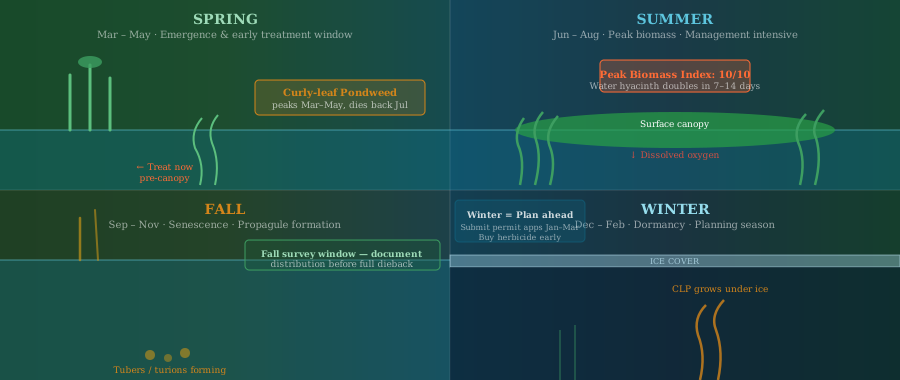
Spring: The Critical Window for Aquatic Weed Management
Spring is the most consequential season in aquatic weed management. It is when invasive plants establish their competitive advantage over native vegetation, when management interventions have the highest cost-effectiveness, and when the decisions made — or not made — in March through May determine ecological and recreational outcomes for the entire growing season. Understanding the biological processes driving spring aquatic weed growth is the foundation of well-timed, effective management programs.
Emergence from Winter Dormancy
Most submerged and floating aquatic weeds emerge from winter dormancy in spring, triggered by increasing water temperatures, longer photoperiod, and increasing light intensity. Each species has a different thermal threshold for growth resumption:
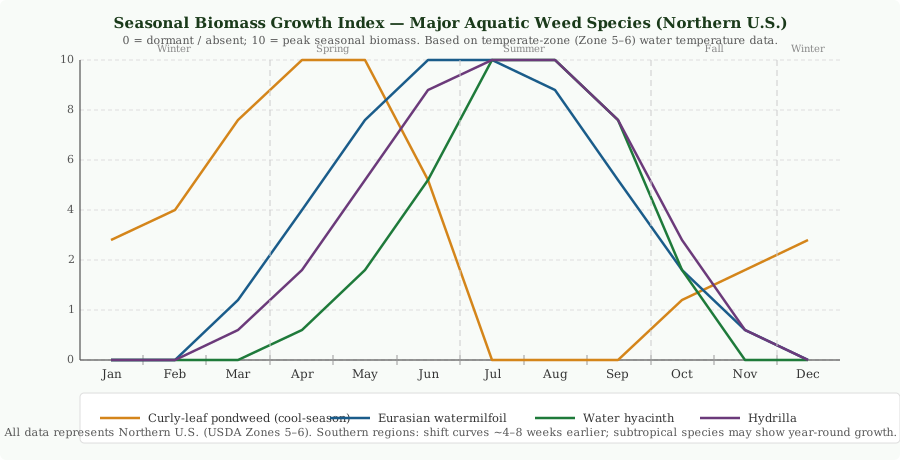
- Curly-leaf pondweed (Potamogeton crispus): Already growing through winter; reaches peak biomass in April–May, before any other species becomes active. This cool-season head start is its primary competitive advantage.
- Eurasian watermilfoil (Myriophyllum spicatum): Begins growth as early as March–April from overwintering root crowns when water temperature exceeds 5–10°C. Reaches surface canopy by late May in northern states — earlier than most native submersed plants.
- Hydrilla (Hydrilla verticillata): Tubers and turions begin germinating when water temperatures reach approximately 15°C (59°F), typically mid-April to May in southern states. Growth accelerates rapidly in warm conditions.
- Duckweed (Lemnaceae): Begins growing when water temperatures exceed 7–10°C. Small floating populations appear on sheltered pond surfaces as early as March. Growth is slow initially and accelerates dramatically as temperatures warm.
- Water hyacinth (Eichhornia crassipes): In frost-free regions, maintains some growth year-round; in colder-winter areas, begins active growth when water temperatures consistently exceed 15°C, typically April–May.
The Competitive Race in Spring
Spring is an ecological race between invasive species that resume growth early (or never stopped) and native aquatic plants that are adapted to warmer growing conditions. Invasive species like Eurasian watermilfoil and curly-leaf pondweed have an enormous advantage: they are photosynthesizing and building biomass while native plants are still dormant or just beginning to emerge. By the time native pondweeds, wild celery (Vallisneria americana), coontail, and other native submersed plants reach significant biomass in June, invasive plants have already established a surface canopy that blocks the light native plants need to grow.
This early-season light monopoly — enabled by the invasive plants' greater cold-water tolerance — is the primary ecological mechanism by which invasive submersed plants displace native communities over multiple years. Even if the invasive plant is partially controlled later in summer, the spring competitive advantage has already suppressed native plant emergence for that season.
Management Timing Principles in Spring
Early-Season Herbicide Application
Spring is the optimal herbicide application window for many species. Treating actively growing plants before they reach full canopy size — typically when plants are 30–60 cm tall in submerged species, or when floating species have not yet reached 20–30% surface coverage — achieves several advantages:
- Smaller biomass requires less herbicide to achieve effective concentration
- Actively metabolizing plants take up herbicide more efficiently than dormant plants
- Early treatment prevents propagule production (turions, seed) that would replenish next year's population
- Early treatment prevents the spring canopy from suppressing native plant emergence
- Earlier intervention means faster clearing and earlier seasonal improvement in water quality and recreation
The Treatment Window for Curly-leaf Pondweed
Curly-leaf pondweed's management window is especially time-sensitive because it begins its natural die-off in June. To prevent turion production, endothall treatment should typically be applied in April or early May — before turions are fully developed. Treatment after late May may kill above-ground biomass but the turion bank is already replenished. Monitoring should begin in March (or even late February in southern portions of curly-leaf pondweed's range) to identify treatment timing.
Survey and Monitoring
Spring surveys are the most important monitoring events of the year for establishing baseline conditions, identifying new infestations while they are small, and calibrating treatment timing. For invasive submerged species, diver surveys, underwater video transects, or hydro-acoustic mapping in April–May provide the data needed to plan the season's management actions. Early detection of new infestations — found before large biomass or propagule bank establishment — is the only scenario where eradication may be achievable. See monitoring and survey methods for complete survey guidance.
Early-Season Prevention
Spring is also when prevention is most critical. Boats that spent the winter stored in garages or on trailers need to be inspected and decontaminated before the first use of the season — plant fragments and propagules can survive winter storage on wet equipment. The first boat launches of the season at high-use boat ramps carry the highest risk of introducing new aquatic invasive plants to previously uninfested lakes, because boaters may not have performed end-of-season decontamination the previous fall. Spring boater education campaigns at high-use launch sites — reminder of Clean-Drain-Dry protocols as the season opens — are a cost-effective prevention investment. See prevention and early detection for complete guidance.
Connecting Spring to the Full Season
Management decisions made in spring determine the difficulty and cost of management for the rest of the growing season. Effective spring treatment reduces biomass heading into summer, gives native plants a chance to establish before the invasive canopy develops, reduces propagule production that would generate next year's population, and dramatically lowers the management burden in summer and fall. Conversely, missed spring treatment windows mean management programs must chase larger biomass at higher cost through summer, with less ecological benefit. Investing in spring management — early surveys, timely permit applications, spring herbicide programs — consistently produces better outcomes than reactive summer treatment. See the summer peak biomass guide for the next seasonal phase.
References
- Madsen, J.D. (2000). Aquatic weed management in practice. Journal of Aquatic Plant Management 38:75–82.
- Getsinger, K.D., et al. (1997). Spring timing of herbicide treatment. Journal of Aquatic Plant Management 35:13–17.
- Minnesota DNR. Aquatic Plant Management Program Guidelines. dnr.mn.us
Regional Variation in Spring Timing
Spring management timing varies dramatically across U.S. climate zones, requiring managers to adjust their treatment calendars to their specific geography. A management calendar developed for a Minnesota lake cannot be applied unchanged to a Virginia reservoir or a Florida canal:
- Zone 5–6 (Upper Midwest, northern New England, USDA): Ice-out April–May; milfoil treatment window May–mid-June; CLP treatment window March–April (under ice or just after ice-out).
- Zone 7 (mid-Atlantic, Tennessee, southern Midwest): Growing season begins March; milfoil treatment April–May; first monitoring survey March.
- Zone 8–9 (Southeast, Pacific Coast): Growing season begins February; hydrilla and milfoil treatment February–April; hyacinth pre-season treatment January–March.
- Zone 10 (South Florida, Gulf Coast): No true spring transition; management is year-round, but February–March is the most favorable low-biomass treatment period for water hyacinth and hydrilla.
Climate change is shifting these windows northward by approximately 3–5 days per decade, meaning management programs should review and update their historical treatment calendars every 5–10 years to account for the changing phenology of both invasive species and native vegetation.
Spring Biomass Accumulation Rates
Understanding the rate of spring biomass accumulation helps managers set monitoring frequency and trigger points for treatment decisions. Under typical spring conditions (progressively warming water from 8°C to 18°C over 4–6 weeks), the following approximate growth rates apply in northern-tier U.S. lakes:
- Eurasian watermilfoil: From overwintering root crowns, shoots elongate at approximately 1–3 cm per day in early spring, accelerating to 3–7 cm per day as temperatures warm. Plants can reach 1 meter in 3–4 weeks under favorable conditions. At 30 cm depth, plants are still below the optimal treatment target; at 1 meter in a 2-meter-deep lake, plants have reached or nearly reached the surface — the critical "time to treat" threshold.
- Curly-leaf pondweed: Already 15–30 cm tall at ice-out after winter growth. Rapid biomass accumulation in April from existing rosettes reaching surface canopy by mid-April in Minnesota lakes in most years. This is the narrowest treatment window of any common invasive species — often only 2–4 weeks between ice-out and full surface canopy development.
- Hydrilla (southern lakes): From overwintering tubers, shoot emergence occurs when sediment temperatures reach 15°C, typically 2–3 weeks after air temperature warming is detectable. Growth accelerates rapidly in warm spring conditions, with southern Florida populations reaching 5–10 cm growth per day in March–April.
See the monitoring and survey methods guide for spring survey protocols that track biomass accumulation and trigger management decisions.
References
- Madsen, J.D. (1993). Biomass techniques for monitoring aquatic plants. Lake and Reservoir Management 7(2):141–154.
- Smith, C.S. & Barko, J.W. (1990). Ecology of Eurasian watermilfoil. Journal of Aquatic Plant Management 28:55–64.