What Are Submerged Aquatic Weeds?
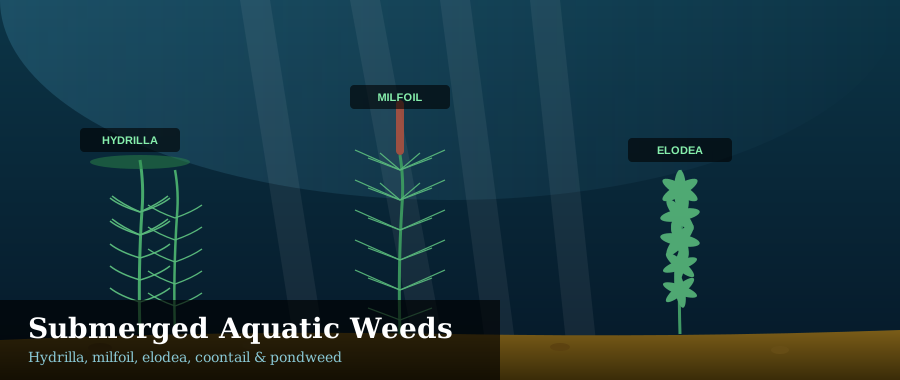
Submerged aquatic plants grow entirely below the water surface. Most are rooted in the bottom sediment, with stems extending upward through the water column and leaves distributed along the entire stem length. A few notable exceptions — coontail (Ceratophyllum demersum) and some pondweed forms — are rootless or near-rootless, floating freely in the water column anchored only by bottom contact.
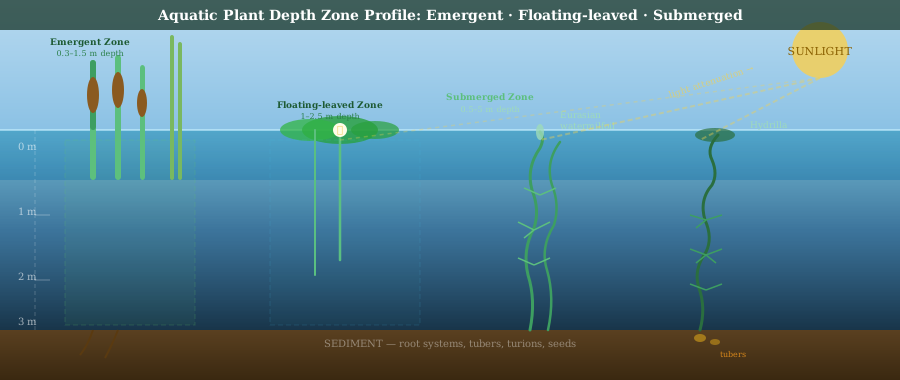
Submerged plants photosynthesize using dissolved carbon dioxide in the water, which imposes a growth limitation compared to atmospheric CO₂. They also experience light attenuation through the water column — photosynthetically active radiation decreases with depth. As a result, submerged plant communities are sharply depth-limited in turbid water but can colonize surprisingly deep water in clear lakes. Hydrilla, notably, can photosynthesize in extraordinarily low light — as little as 1% of surface light — giving it a competitive advantage even in turbid water bodies where other submerged species cannot survive.
This category contains many of the most ecologically damaging aquatic invasive plants in North America. Hydrilla has been documented in over 30 U.S. states and territories. Eurasian watermilfoil is established in all contiguous states. Curly-leaf pondweed reaches peak nuisance growth in spring, ahead of native submerged plants, giving it a competitive advantage that can allow it to dominate entire water bodies before warmer-water species compete. Together, these three species alone account for hundreds of millions of dollars in annual management costs and incalculable ecological damage.
Biology and Competitive Adaptations
Submerged aquatic weeds have evolved remarkable adaptations that explain their management difficulty:
Vegetative Reproduction and Fragmentation
Most problematic submerged weeds reproduce primarily through vegetative fragmentation — detached stem segments that can root and establish new populations. A single fragment of Eurasian watermilfoil attached to a boat propeller or fishing line is sufficient to introduce an invasive population to a new water body. Hydrilla produces both axillary turions (dormant stem buds that detach and overwinter, germinating the following spring) and tubers (underground storage organs) that can persist viable in the sediment for years — making eradication extremely difficult.
This fragmentation biology has a direct management implication: mechanical cutting or harvesting of submerged weeds without complete containment and removal of all fragments can paradoxically increase population spread, distributing propagules throughout the treatment area and beyond. Modern mechanical harvester designs include fragment containment systems, but the risk is never fully eliminated. Understanding vegetative fragmentation →
Low-Light Tolerance
Hydrilla's ability to photosynthesize efficiently at light levels as low as 1% of surface irradiance is extraordinary among aquatic plants. This allows hydrilla to colonize water bodies that are too turbid for most native submerged species, invade deeper water than native competitors, and establish beneath floating weed mats. Once established in a low-light environment, hydrilla forms a dense canopy near the surface that further reduces light penetration and eliminates competing species below. Light and temperature effects on aquatic plant growth →
Canopy Formation
Many submerged invasive weeds exhibit dramatic apical branching near the water surface, forming dense horizontal canopies. Eurasian watermilfoil's stem tips spread laterally at the surface, creating a mat that intercepts the majority of available light before it can reach lower levels of the water column. This canopy-forming strategy excludes native submerged species that cannot compete for the remaining light — dramatically reducing native plant diversity within a single growing season of invasion.
Ecological Impacts
Dense submerged weed beds create extensive ecological disruption:
- Native plant displacement: Invasive submerged weeds outcompete and displace the diverse communities of native aquatic plants that provide fish habitat, waterfowl food, and ecosystem function. A hydrilla-dominated lake bottom may support one species where dozens grew before.
- Dissolved oxygen swings: Dense submerged plant beds produce large amounts of oxygen during daylight through photosynthesis, then consume oxygen at night through respiration. This creates wide daily swings in dissolved oxygen — daytime supersaturation followed by nighttime depletion. After summer die-offs of dense beds, decomposition consumes oxygen and fish kills can result.
- Navigation impairment: Dense canopy-forming species like hydrilla and milfoil at the surface entangle boat propellers, cause motor stalls, and make water bodies effectively impassable. Even small water bodies can become unusable for boating within a single season of heavy infestation.
- Altered food webs: While some submerged weeds do provide habitat used by certain fish species (particularly largemouth bass in light infestations), heavy infestations reduce habitat diversity and can significantly alter fish community composition over time — typically favoring rough fish and reducing sport fish populations.
- Sediment and nutrient cycling: Submerged plant beds trap fine sediment, alter nutrient cycling between the sediment and water column, and can increase the release of phosphorus from sediments into the water — contributing to eutrophication in a positive feedback cycle.
Complete ecological impact hub → | How submerged weeds affect waterways →
Species Profiles
- → Hydrilla Hydrilla verticillata — Most problematic submerged invasive in the U.S.; 30+ states; 1"/day growth; tubers persist for years. Full profile →
- → Eurasian Watermilfoil Myriophyllum spicatum — All contiguous U.S. states; feathery leaves; spreads by fragmentation on boats. Full profile →
- → Curly-leaf Pondweed Potamogeton crispus — Cool-season invasive; peak growth in spring; distinctively crinkled leaves. Full profile →
- → Coontail Ceratophyllum demersum — Native; rootless; fan-shaped branched tips; nuisance at high density. Full profile →
- → Elodea (Common Waterweed) Elodea canadensis — Native; oxygen-producing; nuisance only in eutrophic conditions. Full profile →
- → Chara (Muskgrass) Chara vulgaris — Native alga; garlicky odor; gritty calcium-encrusted texture; beneficial in many contexts. Full profile →
- → Najas (Water Nymph) Najas spp. — Slender-stemmed; some native, some invasive (N. minor); common in warm water.
- → Cabomba (Fanwort) Cabomba caroliniana — Fan-shaped divided leaves; invasive outside SE U.S.; spread via aquarium trade.
Identification and the Hydrilla–Elodea Confusion
Hydrilla and elodea are the most commonly confused species pair among submerged aquatic weeds — an identification error with serious management consequences since they require different control approaches and hydrilla is a regulated noxious weed in many states. Key differences:
- Leaf whorls: Hydrilla typically has 4–8 leaves per whorl; elodea typically has 2–3 per node.
- Leaf margin: Hydrilla has distinctly serrated (toothed) margins visible to the naked eye; elodea has smooth margins.
- Underside of leaf: Hydrilla has a single sharp tooth on the midrib of the underside — a definitive diagnostic feature requiring a hand lens.
- Tubers: Hydrilla produces small white tubers in the sediment; elodea does not.
If in doubt about whether you have hydrilla, contact your state DNR immediately. Hydrilla is a regulated noxious weed in many states and reporting is required. Complete identification hub →
Control Strategies
Submerged weeds are managed using mechanical, chemical, biological, and integrated approaches. A key management consideration is that fragmentation control (mechanical cutting) must be carefully managed to avoid spreading the infestation:
- Herbicide treatment: EPA-registered aquatic herbicides including fluridone (applied as a season-long low-dose treatment for hydrilla), endothall, diquat, triclopyr, and penoxsulam are effective against specific submerged species. Species identification is critical — hydrilla and Eurasian milfoil respond to different compounds and application strategies. State permits required. Herbicide guide →
- Mechanical harvesting: Harvesting machines collect cut plant material and remove it from the water body. Appropriate for localized infestations and provides immediate navigation relief but does not prevent regrowth. Fragment containment is critical. Mechanical control guide →
- Grass carp: Triploid grass carp are approved in many states for submerged weed control. They are effective on many species (particularly hydrilla, elodea, and coontail) but selective stocking rates are required and state permits are mandatory. Over-stocking can result in elimination of all aquatic vegetation. Biological control →
- Winter drawdown: Lowering water levels in fall/winter exposes hydrilla tubers and milfoil rhizomes to freezing temperatures, reducing their viability. Effective in northern states where hard freezes occur but limited in warmer climates.
Complete control methods guide →
Frequently Asked Questions
How do submerged aquatic weeds spread between lakes?
The primary mechanism is human-assisted transport of plant fragments on boats, trailers, propellers, bilge water, live wells, and fishing equipment. A single fragment — even a small stem piece invisible to casual inspection — can establish a new hydrilla or milfoil population. Clean, Drain, Dry protocols (cleaning all plant material from equipment, draining all water, allowing complete drying before moving to another water body) are the most effective prevention strategy. Natural spread via watercurrents, flooding, and waterfowl also occurs but is generally slower and more limited.
What depth do submerged aquatic weeds grow to?
Growth depth depends on water clarity and available light. In turbid water, most submerged species are limited to the top 1–2 meters (3–6 feet). In clearer water, native species like pondweeds may grow to 3–4 meters (10–13 feet). Hydrilla, with its exceptional low-light tolerance, can grow significantly deeper than most species — documented at depths up to 7 meters (23 feet) in clear water. This deep-water colonization capability is one of the reasons hydrilla is so difficult to manage in clear lakes.
Can submerged aquatic weeds be beneficial?
Yes, at appropriate densities. Submerged aquatic vegetation (SAV) at moderate densities provides critical habitat structure for fish (nesting areas, juvenile cover, ambush points), invertebrate food sources, waterfowl food (particularly ducks that graze on pondweeds, coontail, and elodea), and water quality benefits (sediment stabilization, nutrient uptake, oxygen production). Management goals typically aim to maintain moderate densities of diverse native submerged vegetation while preventing invasive species from forming monocultures. "Complete eradication" of all submerged vegetation is rarely the appropriate goal and often causes significant collateral damage.
Why is hydrilla considered the worst submerged aquatic weed in the U.S.?
Hydrilla's management difficulty stems from a combination of factors that make it uniquely challenging: it can grow up to 1 inch per day; it reproduces via three separate mechanisms (vegetative fragmentation, axillary turions that overwinter, and bottom tubers that remain viable in sediment for multiple years); it can photosynthesize in extremely low light, giving it a competitive advantage in turbid water; it forms very dense surface canopies that exclude all other species; it tolerates a wide range of water quality conditions; and its tubers make eradication virtually impossible — management is typically long-term suppression rather than elimination. Hydrilla is established in over 30 U.S. states and has been estimated to double the management costs of affected water bodies.
What is the difference between hydrilla and elodea?
Both are submerged plants with whorled leaves, but they differ in critical ways: hydrilla has distinctly serrated leaf margins (toothed edges visible to the naked eye) while elodea has smooth margins; hydrilla has a single tooth on the underside of the midrib (requires hand lens); hydrilla typically has 4–8 leaves per whorl while elodea has 2–3; hydrilla produces small white tubers in the sediment while elodea does not. These distinctions matter greatly because hydrilla is an invasive noxious weed requiring reporting and management, while elodea is a native species that should generally be protected. When in doubt, contact your state DNR for assistance.
References and Further Reading
- Langeland, K.A. (1996). "Hydrilla verticillata (L.F.) Royle (Hydrocharitaceae), 'The Perfect Aquatic Weed.'" Castanea, 61(3), 293–304.
- Smith, C.S., and J.W. Barko. (1990). "Ecology of Eurasian watermilfoil." Journal of Aquatic Plant Management, 28, 55–64.
- Bolduan, B.R., et al. (1994). "Curly-leaf pondweed in Minnesota lakes." Lake and Reservoir Management, 10(2), 95–100.
- Madsen, J.D., et al. (1991). "The biomass turnover of hydrilla." Journal of Aquatic Plant Management, 29, 14–20.
- Nichols, S.A., and B.H. Shaw. (1986). "Ecological life histories of three aquatic nuisance plants: Myriophyllum spicatum, Potamogeton crispus and Elodea canadensis." Hydrobiologia, 131, 3–21.
- USACE. (2023). Aquatic Plant Control Research Program: Technical Notes. Engineer Research and Development Center, Vicksburg, MS.