Identification Features
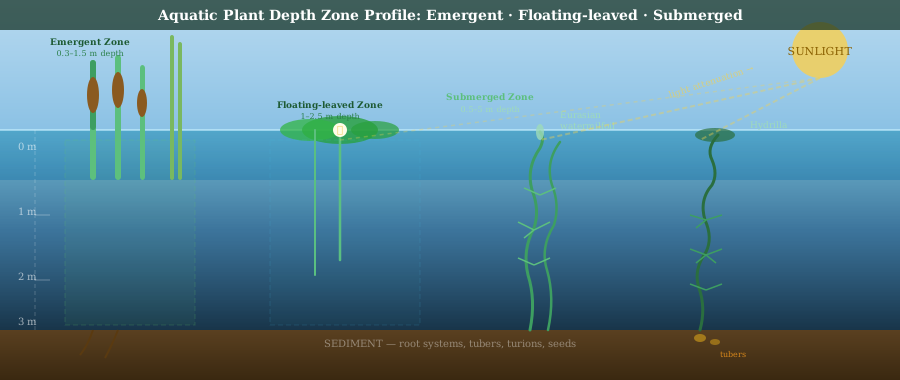
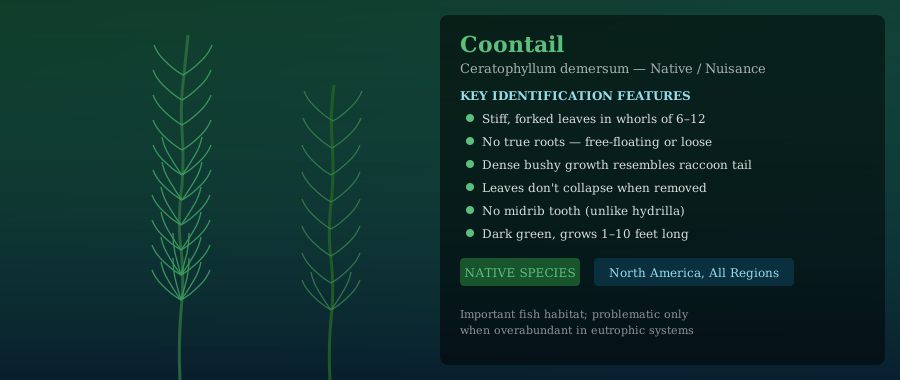
Coontail (Ceratophyllum demersum) is one of the most recognizable submerged aquatic plants once you know its defining feature: it has no true roots. It is the only common submerged aquatic plant in North America that is completely rootless. The plant floats freely in the water column or is loosely anchored by modified basal leaves that grip the sediment without forming true root tissue. When pulled from water, there are no fibrous roots, rhizomes, or white root tissue — just green stem.
The leaves are distinctive: stiff, forked (dichotomously branched) into Y-shaped segments, arranged in whorls of 6–12 around the stem. Each leaf fork has tiny tooth-like serrations that give the leaf a rough, rasping feel when pulled between the fingers. The overall stem-plus-whorled-forked-leaves appearance resembles a raccoon's tail — the source of the common name. Plants are dark green to bright green, becoming deep green in low light and bright green in high light. Leaf identification guide →
Biology
Coontail is a native North American plant that provides essential ecological services in freshwater systems. Its rootless habit means it derives all nutrients directly from the water column, making it particularly efficient at nutrient uptake in eutrophic conditions. It produces turions (dense, compact dormancy buds) in autumn that sink to the sediment and overwinter before germinating in spring. It does not produce seeds in the traditional sense but does produce small nuts in the axils of the forked leaves that can persist in the sediment.
In nutrient-rich conditions, coontail can form very dense, free-floating masses that fill the water column from sediment to surface. These masses can be extremely productive for invertebrate communities and serve as critical refuge and feeding habitat for juvenile fish, but dense coverage can also impede navigation and reduce dissolved oxygen at night. Dormancy and overwintering →
Ecological Value
Coontail is generally regarded as ecologically beneficial in most contexts. It provides some of the densest and most productive invertebrate habitat of any submerged plant — the forked leaves and rough surfaces harbor periphyton and macroinvertebrates at exceptional densities. Walleye, perch, bass, and panfish use coontail beds as feeding and spawning habitat. Waterfowl (particularly American coots and diving ducks) eat coontail material and nest in adjacent areas. The plant's native status and ecological benefits mean management should be approached conservatively.
Distribution
Coontail is found throughout North America from Florida to Canada, in lakes, ponds, rivers, ditches, and wetlands from sea level to moderate elevation. It is one of the most cosmopolitan submerged aquatic plants in the world, occurring on every continent except Antarctica. In the U.S., it is most abundant in nutrient-rich (eutrophic) inland lakes and ponds in the Midwest and Northeast. Midwest distribution →
Management (When Needed)
Because coontail is native and ecologically valuable, management should be conservative. Nutrient management is the primary approach for reducing excessive coontail density. Physical removal by raking or harvesting can provide localized, temporary access improvement. Chemical treatment is rarely warranted for native coontail alone; most aquatic herbicides effective against coontail are non-selective and will also kill native plants. Consult your state DNR before any chemical treatment targeting coontail. Control methods →
Frequently Asked Questions
Is coontail a good plant for my pond?
In moderate amounts, coontail is an excellent native plant for ponds and lakes — it oxygenates the water, provides fish habitat, supports invertebrate communities, and does not require rooting in sediment so it can colonize deeper areas. The concern arises when coontail reaches very high densities in eutrophic ponds where it can reduce dissolved oxygen at night and create navigation problems. If coontail density is manageable and not causing access problems, the ecological benefits typically outweigh the costs.
How do I tell coontail from other submerged plants in my pond?
The two most reliable diagnostic features: (1) Pull a plant from the water and look for roots — coontail has none; any other common submerged plant will have fibrous roots or rhizomes. (2) Feel the leaf by pulling a stem through your fingers — coontail's forked leaf teeth give a distinctive rasping, rough feel. These two features together are sufficient to confirm coontail in virtually all North American water bodies.
Native Plant Conservation Considerations
Because coontail is a native, ecologically valuable species, management decisions warrant particular care and a conservative approach. Before any treatment targeting coontail, lake managers and property owners should document coontail density and distribution with baseline surveys, identify any co-occurring invasive species that may be a higher management priority, consult with the state department of natural resources on permit requirements, and evaluate whether nutrient management can reduce coontail density to acceptable levels without direct plant treatment.
In many U.S. states, treatment of native aquatic plants including coontail requires additional documentation, justification, or permitting steps beyond those required for invasive species control. Misidentification of coontail as hydrilla — two species that can occupy similar habitats — is a documented real-world error that has led to unnecessary and ecologically harmful broad-spectrum herbicide applications. Any submerged plant suspected of being hydrilla should be confirmed by an aquatic botanist or sent to a university extension service for identification before treatment. Coontail identification by a qualified professional, when in doubt, is both legally prudent and ecologically responsible. Coontail vs. hydrilla comparison →
Full Species Profile: Visit the Coontail authority page →