Identification Features
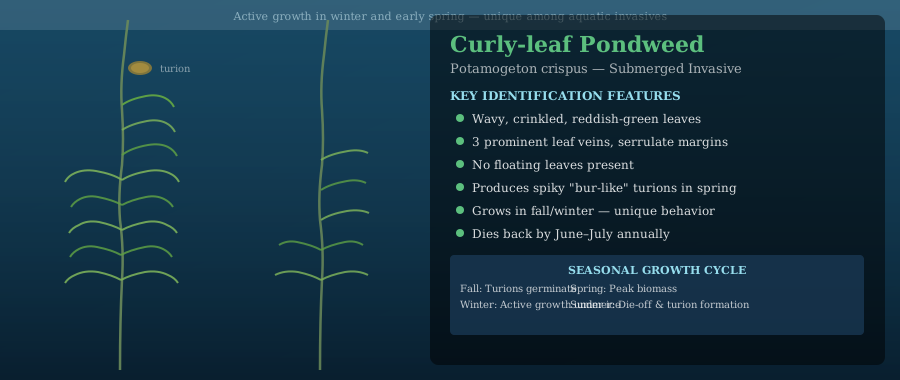
Curly-leaf pondweed (Potamogeton crispus) is immediately recognizable by its wavy, crinkled leaf margins — the most diagnostic visible feature. Leaves are ribbon-like, 4–9 cm long and 0.5–1 cm wide, reddish to olive-green, with three prominent parallel veins and distinctly wavy, ruffled margins that are also finely serrated. The wavy margin texture is visible to the naked eye and gives the plant its common name. Leaves are arranged alternately (one per node) along the stem. The plant feels stiff and somewhat rigid compared to most other submerged plants.
Curly-leaf pondweed's seasonal pattern is also diagnostic: it is the only common invasive submerged plant that grows most actively in fall and early spring, when water is cold, and goes dormant in summer heat. In summer, it may appear as scattered brown, dying stems or may be absent — replaced by the turions (small, compact, spiny-margined dormancy buds) it produces in spring before dying back. Seasonal identification guide →
Biology and Cool-Season Adaptation
Curly-leaf pondweed is native to Eurasia and was likely introduced to North America in the 1800s, possibly via ballast water or waterfowl transport. Its cool-season growth pattern is a significant competitive advantage: it begins growth in late September to November when water cools below 15°C — months before native submerged plants emerge in spring. By the time native plants begin growing in May, curly-leaf pondweed has already established a dense canopy that shades them out.
In May to June, it produces turions — small, 1–2 cm, hard, spiny-margined buds that detach from the plant, sink to the sediment, and remain dormant through summer. The parent plant dies back by June–July, leaving the water body apparently weed-free in summer — only to have the turion bank germinate en masse in autumn. This summer absence is frequently misinterpreted as "the problem is gone" — in fact the turion bank guarantees the following year's infestation. Turion biology →
Ecological Impacts
Curly-leaf pondweed's spring growth creates severe management challenges for lakes in the northern U.S. and Canada. Dense spring canopies impede spring boating and fishing recreation before native plants emerge. Massive spring die-offs in June–July release large quantities of nutrients that fuel cyanobacterial (blue-green algae) blooms in midsummer — one of the most well-documented curly-leaf pondweed impacts in Midwestern lakes. The nutrient release from dying pondweed biomass can be severe enough to cause hypoxic events and fish kills.
Distribution
Curly-leaf pondweed is the most widely distributed invasive submerged aquatic plant in the upper Midwest and Northeast. Established in most northern U.S. states and Canadian provinces with cold winters, including Minnesota, Wisconsin, Michigan, New York, Pennsylvania, and the Great Plains states. Most problematic in shallow, eutrophic lakes with sandy or mucky sediment. Midwest distribution →
Control
Optimal treatment window is late fall through early spring (October–April in the North), when curly-leaf pondweed is actively growing and native plants are dormant — this timing allows selective treatment. Endothall, fluridone (spring application), and diquat are the primary herbicides used for curly-leaf pondweed management. All treatment requires state permits. Control methods →
Frequently Asked Questions
Why does curly-leaf pondweed seem to disappear in summer then come back worse each year?
Curly-leaf pondweed dies back naturally each summer when water temperatures rise above 20°C. The plant is not gone — it has converted to turions (dormancy buds) that sink to the sediment and remain viable through summer. When water cools in fall, the turion bank germinates and the cycle restarts. Without management intervention, the turion bank grows larger each year as the plant produces new turions each spring, compounding the problem over time. Early-season (fall/early spring) management before turion formation is the most effective approach.
Can curly-leaf pondweed be confused with native pondweeds?
Yes. Several native pondweed species (Potamogeton spp.) occur in similar habitats. The diagnostic features of curly-leaf pondweed are the distinctly wavy/crinkled (not smooth or slightly undulate) margins, the reddish-olive color, and the 3 prominent parallel veins. Many native pondweeds have smoother margins, different vein counts, or different leaf shapes. If in doubt, contact your state cooperative extension service for identification assistance — native pondweeds should not be treated.
Long-term Turion Bank Depletion Strategies
Curly-leaf pondweed management is fundamentally a multi-year effort aimed at reducing the turion bank density in the sediment — not simply eliminating above-ground biomass in any single season. Research in Minnesota lakes demonstrated that consistent early-spring herbicide treatment for 3–5 consecutive years can achieve dramatic (70–90%) reductions in turion bank density, leading to substantially reduced plant growth in subsequent years even without treatment. Skipping a single treatment year allows full turion bank replenishment and can set back a program by several years.
The most effective management programs combine: (1) early spring herbicide application (before turion formation, typically March–April in Minnesota and Wisconsin), using endothall or fluridone at DNR-approved doses; (2) winter lake level drawdown where water control structures allow, which exposes and desiccates turions in the dried sediment zone; (3) annual monitoring of turion bank density through sediment core sampling as a progress indicator; and (4) boat inspection and decontamination programs to prevent reintroduction of turions from adjacent water bodies. State programs in Minnesota, Wisconsin, and Michigan have developed and published detailed management guidelines based on this integrated approach. Management planning hub →
Full Species Profile: Visit the Curly-leaf Pondweed authority page →