Defining Aquatic Weeds
The term "aquatic weed" does not describe a single species, genus, or plant family. It is a management designation — applied to any aquatic plant, native or introduced, that grows in sufficient density or occupies locations where it causes ecological, economic, or recreational harm. A species widely regarded as a weed in one context may be an ecologically valuable native plant in another. The distinction depends not on taxonomy but on context, density, and impact.
Aquatic weeds are analogous to terrestrial weeds in their fundamental ecology: they are opportunistic plants that thrive where competitive checks are weakened, nutrient levels are elevated, or disturbed conditions favor rapid colonizers. In many documented cases, the emergence of a "weed problem" is actually a symptom of underlying change — enriched nutrients from agricultural runoff, altered hydrology from development, or the absence of native vegetation from prior mismanagement or introduced disease.
This distinction matters enormously for management. Treating a symptom (the plants) without addressing the underlying cause (excess nutrients, disturbed habitat) typically produces at best temporary results and at worst unnecessary damage to native biodiversity. The most effective management programs integrate weed control with water quality improvement, shoreline restoration, and long-term monitoring.
Globally, approximately 40 aquatic plant species cause significant economic or ecological problems. In the United States, roughly 20 species account for the majority of management expenditure and ecological damage. Understanding these species — their biology, spread mechanisms, and habitat requirements — is the starting point for every management decision.
Native vs. Invasive Aquatic Plants
One of the most critical distinctions in aquatic weed management is between native nuisance species and invasive non-native species. These two categories share superficial similarities — both can form dense, problematic growth — but differ fundamentally in their ecological relationships, management options, and long-term implications.
Native Nuisance Species
Native aquatic plants evolved alongside local fish, wildlife, invertebrates, and other plants over thousands of years. They occupy ecological roles as food sources (seeds, stems, tubers), breeding and nursery habitat, oxygen producers, sediment stabilizers, and nutrient filters. Under natural conditions, they are kept in check by a complex web of grazers, competitors, pathogens, and environmental constraints.
Native species become "weeds" when these checks are disrupted — most commonly by nutrient enrichment (eutrophication). When phosphorus and nitrogen levels rise from agricultural runoff, lawn fertilizers, septic systems, or urban stormwater, native opportunists like duckweed, coontail, and cattails can bloom to nuisance densities. The problem, in these cases, is not the plant itself but the degraded water quality enabling its expansion.
Invasive Non-Native Species
Invasive aquatic plants are species introduced beyond their native range — often from other continents — that escape the natural predators, competitors, and pathogens that keep them in check at home. Without these controls, invasive species can spread far faster and more extensively than they ever would in their native habitats.
The three worst invasive submerged weeds in the United States — hydrilla, Eurasian watermilfoil, and curly-leaf pondweed — were all introduced through the aquarium trade, accidentally or deliberately. Water hyacinth was introduced as an ornamental at the 1884 World Cotton Exposition in New Orleans and has since become one of the world's most destructive aquatic invasive plants. Alligator weed arrived in ship ballast water and is now a federally listed noxious weed across the Gulf Coast states.
Key Principle: Not all aquatic plants are weeds, and not all weeds are equally harmful. Accurate species identification is the non-negotiable first step in any management program. Treating a beneficial native plant as a weed — or misidentifying one invasive species as another — can cause significant ecological damage and waste substantial resources. See the identification hub before making any management decisions.
The Three Categories of Aquatic Weeds
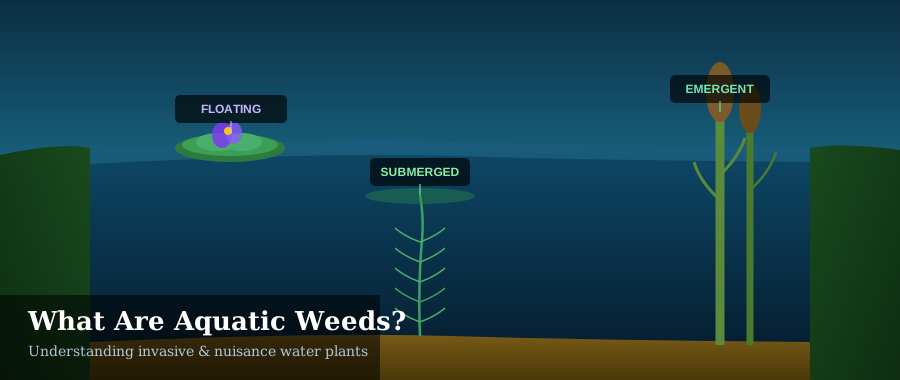
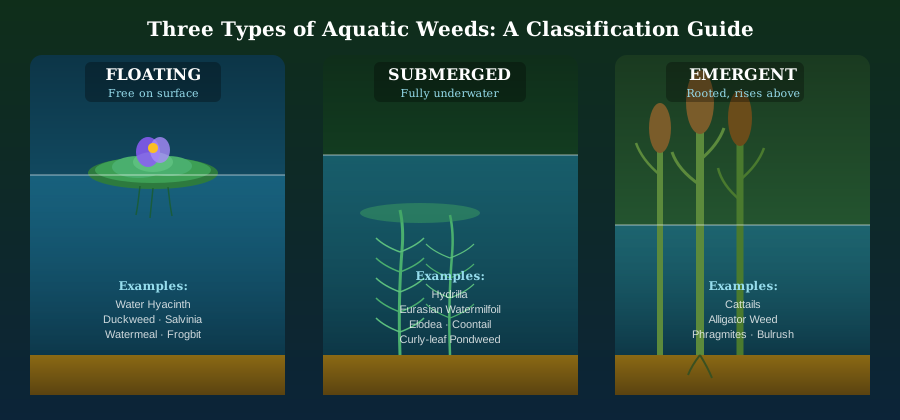
Aquatic weeds are classified by their position relative to the water surface — the most fundamental distinction for both identification and management planning. Each category has distinct biological adaptations, ecological impacts, and responses to different control methods.
Floating Aquatic Weeds
Floating weeds drift freely on the water surface, with roots hanging in the water column and leaves and stems above. They access atmospheric carbon dioxide and sunlight directly, enabling extraordinarily rapid growth. Water hyacinth can double its population in 12 days; the entire surface of a 5-acre pond can be covered in weeks. Floating mats shade out submerged vegetation, reduce dissolved oxygen through decomposition, and create stagnant zones that host mosquito larvae. Major species: water hyacinth, duckweed, watermeal, giant salvinia, frogbit, azolla. Explore floating aquatic weeds →
Submerged Aquatic Weeds
Submerged weeds grow entirely beneath the water surface, rooted in bottom sediments (or free-floating, in the case of coontail) with stems extending upward through the water column. They photosynthesize using dissolved carbon dioxide, which limits their growth compared to surface plants — but several invasive species have evolved to succeed in very low light, allowing them to outcompete native submerged plants even in turbid water. Dense underwater canopies entangle boat propellers, reduce water circulation, and shade out competing native vegetation. Major species: hydrilla, Eurasian watermilfoil, curly-leaf pondweed, coontail, elodea, chara. Explore submerged aquatic weeds →
Emergent Aquatic Weeds
Emergent weeds are rooted in submerged or saturated sediment but extend their stems, leaves, and flowers above the water surface. They colonize shoreline margins and shallow water zones, often forming impenetrable monocultures that prevent access to the water's edge, alter water flow, trap sediment, and eliminate habitat diversity. Some emergent species — particularly invasive Phragmites — can form stands of 30 feet or taller, dramatically altering the structure and function of wetland ecosystems. Major species: alligator weed, phragmites, cattails, bulrush, primrose willow. Explore emergent aquatic weeds →
What Drives Aquatic Weed Growth?
Most aquatic weed problems are not random events — they are predictable outcomes of specific environmental and human-caused conditions. Understanding the primary drivers is essential for developing management programs that address root causes, not just symptoms.
- Nutrient enrichment (eutrophication): Phosphorus and nitrogen are the primary nutrients limiting plant growth in most freshwater systems. When these nutrients are elevated by agricultural runoff, lawn fertilizers, urban stormwater, septic system effluent, or livestock waste, aquatic plant growth can increase dramatically. Eutrophication is the single most common driver of native nuisance plant blooms and contributes significantly to the success of invasive species. See: Nutrient Loading and Eutrophication →
- Human transport: The primary mechanism of invasive aquatic plant spread between water bodies is human activity. Boat hulls, trailers, propellers, bilge water, live wells, and fishing equipment can all carry viable plant fragments or seeds between water bodies. The aquarium and water garden trades have introduced dozens of invasive species into U.S. waterways. A single small fragment of hydrilla on a boat propeller can establish a new infestation. Prevention — the "Clean, Drain, Dry" protocol — is the most cost-effective management strategy available. Learn more about prevention →
- Absence of natural controls: Non-native species lack the herbivores, pathogens, and competitors that regulate their growth in their native range. Without these controls, population growth is limited only by physical resources — light, nutrients, space, and temperature. This "enemy release" is the primary explanation for the exceptional spread rates of invasive aquatic plants compared to their behavior in their native regions.
- Warm water temperatures: Most problematic aquatic plants — particularly the invasive floating species — grow fastest in warm water. Florida, with its year-round warm temperatures, has the most severe aquatic weed problems in the nation. Climate warming is gradually expanding the potential range of many warm-water invasive species northward.
- Disturbed or degraded water bodies: Water bodies that have lost native plant communities through prior disturbance, reduced water clarity, or altered hydrology are significantly more vulnerable to invasive species establishment. Restoration of native plant communities and water quality improvement can significantly reduce the likelihood of invasive colonization.
The Scale of the Problem in the United States
Aquatic weed management is a significant national resource issue. The economic costs are substantial: control programs, reduced property values, diminished fishing and tourism revenue, clogged irrigation infrastructure, and damaged water intake systems collectively cost the U.S. economy an estimated $100 million to $1 billion annually. These figures do not account for the non-market ecological costs — biodiversity loss, wildlife habitat degradation, and ecosystem function impairment — which are likely far larger.
Geographically, the problem is national. Hydrilla has been documented in more than 30 U.S. states. Eurasian watermilfoil is established in every contiguous state. Giant salvinia — a federally listed noxious weed — is spreading across the Gulf South. Invasive Phragmites has radically altered wetland ecosystems across the Northeast, Great Lakes region, and Mid-Atlantic states. No region of the United States is immune to aquatic weed challenges. Explore U.S. distribution data →
The ecological damage is equally significant. Dense aquatic weed infestations reduce dissolved oxygen levels, alter pH and temperature profiles, trap sediment, fuel algal blooms, eliminate native plant diversity, and degrade the structural complexity of aquatic habitats that fish, waterfowl, amphibians, turtles, and aquatic invertebrates depend on. Fish kills following summer die-offs of dense aquatic weed beds are documented regularly across infested states. Understand the ecological impacts →
How Are Aquatic Weeds Managed?
Effective aquatic weed management requires accurate species identification, a clear understanding of the water body's ecology and conditions, realistic management goals, and in most cases a combination of control approaches applied as part of a multi-year program. No single method produces lasting results for serious infestations. The four primary management approaches — mechanical control, chemical control, biological control, and integrated management — each have specific strengths and limitations depending on species, infestation size, and water body characteristics.
Before any management action is taken, state permit requirements must be verified. In most U.S. states, applying herbicides to water bodies, introducing biological control agents, or conducting major mechanical operations requires permits from the state department of natural resources or environmental protection agency. Explore all control methods → | Permits and regulatory considerations →
Frequently Asked Questions
What is the difference between an aquatic weed and a native aquatic plant?
The distinction is management-based, not taxonomic. Native aquatic plants are species that evolved in the local ecosystem and play important ecological roles — providing food, habitat, and oxygen for native wildlife. An aquatic plant becomes a "weed" only when it grows in densities or locations that cause economic, ecological, or recreational harm. A native species can be a weed if it blooms to nuisance density due to nutrient enrichment, and a non-native species may be harmless in small numbers. Accurate identification and ecological assessment are required before any management decision is made.
How do aquatic weeds get into water bodies?
The primary vector for invasive aquatic plant spread in the U.S. is human-assisted transport. Boat hulls, trailers, propellers, bilge water, live wells, and fishing gear can carry viable plant fragments, seeds, or turions between water bodies. The aquarium and water garden trades have introduced many species. Natural vectors include waterfowl (plant material attached to feathers and feet), water currents during flooding, and migrating fish. For native species, eutrophication from human-sourced nutrient inputs is the primary driver of nuisance blooms.
Are all aquatic weeds invasive?
No. Many problematic aquatic plants are native North American species that become weedy only under degraded water quality conditions. Duckweed, coontail, and cattails are examples of native plants that can form nuisance growths in nutrient-enriched water bodies. Invasive species — those introduced from outside North America — represent a distinct and often more serious subset, as they lack the natural predators and competitors that limit native species. Both categories require management, but the strategies and ecological considerations differ.
What is the most invasive aquatic weed in the United States?
Hydrilla (Hydrilla verticillata) is widely regarded as the most problematic invasive submerged aquatic plant in the U.S., established in 30+ states, growing up to 1 inch per day, and reproducing via multiple mechanisms. Water hyacinth is the most problematic floating species in warm-climate states. Invasive Phragmites (common reed) is the most damaging emergent species across the northeast and Great Lakes. The "worst" species depends on region and water body type.
Do aquatic weeds affect drinking water?
Yes, in several ways. Dense aquatic weed growth can clog water intake screens at treatment plants, requiring increased maintenance. Decomposing plant material introduces taste and odor compounds (including 2-methylisoborneol and geosmin) into source water that are difficult and expensive to remove. Algal blooms — which can be promoted by nutrient cycling from decomposing aquatic weeds — can produce cyanotoxins that pose health risks at high concentrations. Many municipalities with aquatic weed problems face elevated water treatment costs as a result.
What should I do if I find an unfamiliar aquatic plant?
First, use our identification guides to attempt identification based on growth habit, leaf shape, and other diagnostic features. Photograph the plant from multiple angles, including close-ups of leaves, stems, and any flowers or fruits. If you suspect an invasive species, contact your state department of natural resources or university cooperative extension service immediately — early detection is critical for preventing establishment. Do not move the plant to other water bodies. Do not attempt management until identification is confirmed and permit requirements are checked.
References and Further Reading
- Madsen, J.D. (1997). "Methods for Management of Nonindigenous Aquatic Plants." Assessment and Management of Plant Invasions. Springer, New York.
- Langeland, K.A., and K. Craddock Burks, eds. (1998). Identification and Biology of Non-Native Plants in Florida's Natural Areas. University of Florida IFAS Publication SP 257.
- USDA APHIS. (2023). Federal Noxious Weed List. Animal and Plant Health Inspection Service, U.S. Department of Agriculture.
- Pimentel, D., et al. (2005). "Update on the environmental and economic costs associated with alien-invasive species in the United States." Ecological Economics, 52(3), 273–288.
- Smith, C.S., and J.W. Barko. (1990). "Ecology of Eurasian watermilfoil." Journal of Aquatic Plant Management, 28, 55–64.
- Weldon, L.W., R.D. Blackburn, and D.S. Harrison. (1969). Common Aquatic Weeds. USDA Agriculture Handbook No. 352.