A Region Under Invasion Pressure
The northeastern United States — New England (Maine, New Hampshire, Vermont, Massachusetts, Connecticut, Rhode Island), New York, New Jersey, Pennsylvania, Maryland, Delaware — faces expanding aquatic weed problems driven by the region's high recreational boating activity (which spreads invasives between the many interconnected lakes), nutrient loading from developed watersheds, and the northward range expansion of species previously confined to warmer states.
Variable-Leaf Milfoil and Eurasian Milfoil
Eurasian watermilfoil is established across most northeastern states and continues to spread. Variable-leaf milfoil (Myriophyllum heterophyllum), a less-studied invasive milfoil native to the southeastern U.S. but invasive in the Northeast, is an emerging management concern in New England and New York. Variable-leaf milfoil is more difficult to manage with selective herbicides (triclopyr and fluroxypyr, which are effective against Eurasian milfoil with reduced effect on native milfoils, are less selective against variable-leaf milfoil) and its spread in the region warrants monitoring. Milfoil profiles →
Hydrilla's Northward Expansion
Hydrilla has been documented in Connecticut, New York, New Jersey, Delaware, and Pennsylvania, representing a significant northward expansion of this invasive species beyond its traditional southeastern range. The monoecious biotype of hydrilla, more cold-tolerant than the dioecious southeastern biotype, is the primary driver of northeastern establishment. Connecticut has documented infestations in multiple water bodies and maintains an active management program. New York's Hudson River has established hydrilla populations. This northeastern expansion of hydrilla is an active management concern — the region's many recreational lakes and active boating community represent a high re-infestation risk if established populations spread to new water bodies. Hydrilla profile →
Fanwort (Cabomba) in New England
Cabomba (fanwort, Cabomba caroliniana) is an invasive submerged plant that is particularly problematic in Massachusetts, Connecticut, and Maine, where it has spread rapidly through recreational boating vectors since its initial establishment. New Hampshire and Maine manage cabomba infestations in multiple lakes. Cabomba is listed as a prohibited plant in several northeastern states, reflecting the recognition of its invasiveness in the region. Cabomba profile →
Management Programs and State Resources
All six New England states and the mid-Atlantic states maintain state-level aquatic invasive species programs funded through combinations of state appropriations and federal assistance from sources including the Environmental Protection Agency 319 grants and U.S. Fish and Wildlife Service State Wildlife Grants. New Hampshire's LAKES Program and Vermont's Clean Water Initiative are nationally recognized models for lake monitoring and early detection programs, using trained volunteer citizen monitors to survey hundreds of water bodies annually for new aquatic invasive plant introductions. New York maintains one of the most comprehensive watercraft inspection programs in the nation at high-traffic boat launches across the Adirondacks and Finger Lakes regions.
The New England Invasive Plant Council coordinates regional information exchange across state programs and publishes best management practice guides tailored to northeastern conditions. The Northeast Aquatic Invasives Program (funded through Sea Grant) provides research and outreach support. Prevention best practices →
Emerging Threats in the Northeast
Beyond Eurasian watermilfoil and curly-leaf pondweed — the established problem species — the Northeast faces expansion pressure from hydrilla (monoecious biotype now established in Connecticut and spreading northward), Brazilian waterweed (Egeria densa, a common aquarium plant escaping into southern New England water bodies), and water chestnut (Trapa natans) in the Lake Champlain and Connecticut River watersheds. Volunteer monitoring programs are critical for early detection of these emerging introductions in the Northeast's extensive lake systems. Hydrilla distribution and management →
Frequently Asked Questions
What should lake property owners in New England do to prevent new weed introductions?
The most impactful action is strict Clean, Drain, Dry practice every time a boat and trailer moves between water bodies — remove all plant material from boat, trailer, prop, and live well; drain all water; dry for at least 5 days before launching in a new lake. In New England, where boaters often use many lakes in a single summer, this practice matters enormously. Also: learn to recognize the primary invasive species in your state; participate in early detection volunteer monitoring programs; and report any suspected new infestations to your state DNR immediately — early detection and rapid response are the only scenarios where eradication is realistic.
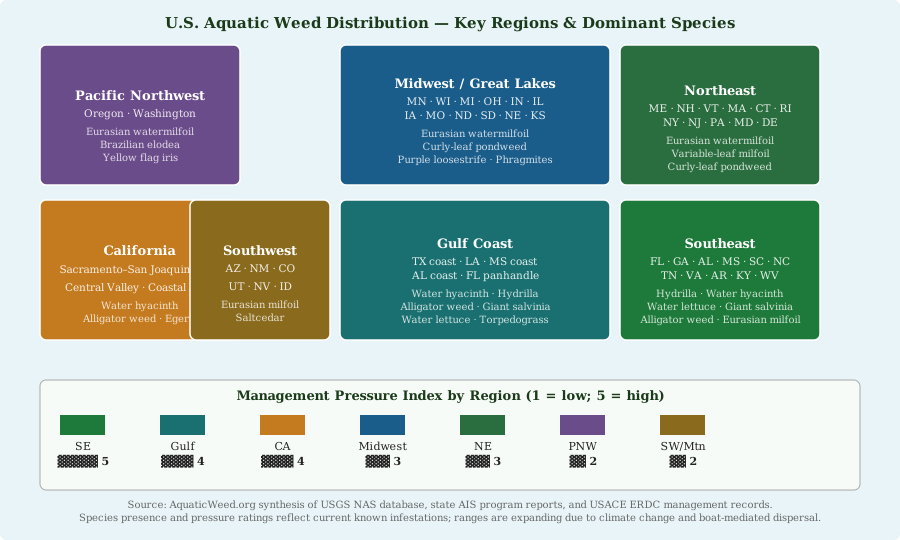
Climate Influence on Northeast Aquatic Weed Growth
The Northeast's cold continental climate fundamentally limits which aquatic weed species can establish and how severe their growth becomes. Water temperatures in Maine, Vermont, and New Hampshire lakes peak at 22–24°C in July–August — below the optimal growth range for tropical species like water hyacinth and hydrilla. These species are absent or rarely established in the region because even warm summer temperatures are insufficient for the aggressive summer growth that makes them management problems in the South.
The dominant invasive species — Eurasian watermilfoil and variable-leaf watermilfoil — thrive in the Northeast's climate precisely because they are adapted to cooler water temperatures. Eurasian watermilfoil resumes active growth in April–May when water temperatures reach 10–15°C, well before native aquatic plants emerge from dormancy, and continues growing productively in the 18–24°C summer temperatures that characterize northeastern lakes. Curly-leaf pondweed exploits the coolest end of the growing season, germinating in fall and reaching peak biomass in April–May before water temperatures exceed its optimal range.
Climate change is already detectable in the Northeast: growing season length has increased 1–2 weeks since the 1980s, lake ice-out dates are occurring 1–2 weeks earlier in northern New England, and summer peak water temperatures are rising. These changes are expanding the range of warm-season invasive species northward and increasing the intensity of milfoil growth in existing infestations. Hydrilla is now established in several Connecticut and Maryland water bodies, with range expansion risk increasing as climate warms.
Management Timing in the Northeast
| Species | Optimal Treatment Window | Notes |
|---|---|---|
| Eurasian watermilfoil | May–mid-June (pre-canopy) | Triclopyr most effective; treat before plants reach surface |
| Variable-leaf milfoil | May–July | Confirm species identity — different herbicide response than Eurasian |
| Curly-leaf pondweed | March–April (active growth) | Treat while still in pre-canopy growth; plants die back naturally by July |
| Phragmites | Late Aug–mid-September | Pre-senescence foliar treatment for maximum rhizome kill |
State-Level Variation in the Northeast
New Hampshire and Vermont operate strong lake association-based management programs through the NH LAKES and Vermont DCNR programs. Lake Winnipesaukee (NH) and Lake Champlain (VT/NY) are among the most intensively managed water bodies in the Northeast. Variable-leaf milfoil — distinct from Eurasian milfoil in genetics and management response — is a particular focus in Vermont.
Maine has the most restrictive approach to aquatic plant management in the Northeast: the Maine DEP emphasizes prevention and early detection, limiting chemical treatment to small, localized infestations and relying heavily on hand-harvesting and volunteer lake monitoring programs. Maine has successfully eradicated several early-detected invasive plant populations using this approach.
New York has hundreds of water bodies with invasive milfoil and is dealing with expanding water chestnut infestations in the Hudson River and Finger Lakes region. The NY DEC operates a cost-share program for lake management.
Maryland and New Jersey have both northern lake communities and coastal plain water bodies, with greater weed diversity including water hyacinth in some southern Maryland and New Jersey freshwater systems.