America's Aquatic Weed Hotspot
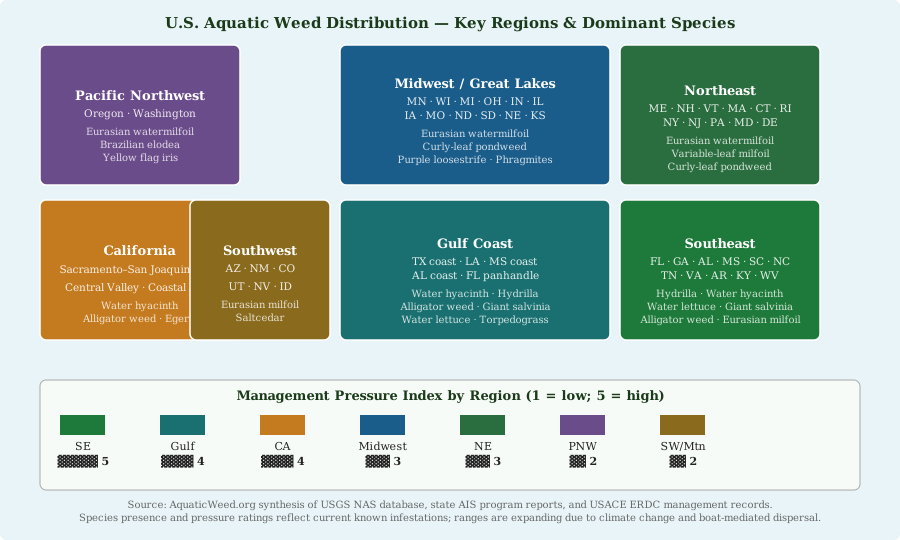
The southeastern United States — Florida, Georgia, Alabama, Mississippi, the Carolinas, Virginia, Tennessee, Arkansas, and surrounding states — is home to the most severe and diverse aquatic weed problems in the nation. The combination of warm climate (10–12 month growing season), abundant rainfall, extensive water bodies, high agricultural nutrient loading, and active tourism and horticulture industries creates near-optimal conditions for aquatic invasive plant establishment and spread.
Florida: Ground Zero
Florida is the epicenter of aquatic weed management in the United States. The Florida Aquatic Plant Management Program manages aquatic plants on approximately 2.8 million acres of public water bodies, spending $30–40 million annually. The primary targets: water hyacinth (Eichhornia crassipes) — present in virtually every nutrient-enriched water body statewide; hydrilla (Hydrilla verticillata) — present in over 600 water bodies and representing the state's most costly management challenge; water lettuce (Pistia stratiotes); and giant salvinia (Salvinia molesta) — particularly in the St. Johns River system and central Florida lakes.
Florida's water bodies range from spring-fed crystal-clear rivers (Silver Springs, Ichetucknee) to heavily eutrophic agricultural drainage canals and suburban retention ponds. The management challenges differ dramatically between these systems, requiring tailored approaches for each context.
Georgia, the Carolinas, and Virginia
The mid-Atlantic and upper South states face expanding hydrilla infestations, primarily from the dioecious biotype spreading northward from Florida. Lake Gaston (Virginia/North Carolina border), the Chowan River drainage, and multiple Piedmont reservoirs have documented infestations. Water hyacinth is present but less dominant than in Florida due to shorter frost-free seasons. Eurasian watermilfoil is significant in mountain and piedmont reservoirs. Eurasian milfoil profile →
Gulf States and Mississippi/Alabama
The Gulf Coast states (covered in detail in the Gulf Coast distribution page) have severe water hyacinth and alligator weed problems along coastal river systems and bayous. Mississippi and Alabama riverine systems are heavily impacted. The Black Warrior River system in Alabama and the Pearl River in Mississippi have documented water hyacinth infestations requiring active management.
Key Species by Sub-Region
| State Group | Primary Species | Management Programs |
|---|---|---|
| Florida | Hydrilla, water hyacinth, water lettuce, salvinia | FWC Aquatic Plant Management |
| GA, SC, NC | Hydrilla, Eurasian milfoil, water hyacinth | State DNR programs |
| VA, TN, AR | Hydrilla (expanding), Eurasian milfoil | State lake management programs |
Tennessee and Arkansas
Tennessee's extensive reservoir system — particularly TVA (Tennessee Valley Authority) reservoirs — faces ongoing challenges from Eurasian watermilfoil, hydrilla (both biotypes), and native nuisance species including coontail and pondweeds in highly productive reservoirs. The TVA manages aquatic vegetation across a reservoir system covering approximately 650,000 acres of water surface in seven states, making it one of the largest institutional aquatic weed management programs in the U.S. outside of Florida. Arkansas river and backwater systems have documented water hyacinth and alligator weed infestations in the Delta region.
Prevention Programs in the Southeast
The Southeast's high introduction risk — driven by warm climate enabling year-round survival of introduced species, a large recreational boating industry, and a tropical ornamental plant trade — has led several states to implement comprehensive prevention programs. Florida requires mandatory Clean Drain Dry messaging at public boat launches and funds a substantial aquatic invasive species education program. Louisiana and Texas have expanded watercraft inspection programs at major lakes with documented infestations. The 100th Meridian Initiative, coordinating prevention from the Pacific Coast to the Mississippi River, has Southeast state partners focused on preventing eastward expansion of western species and westward expansion of southeastern species. Prevention programs →
Frequently Asked Questions
Why is the Southeast so much worse for aquatic weeds than other regions?
Three primary factors make the Southeast the nation's aquatic weed epicenter: (1) Climate — 10–12 month growing seasons allow year-round plant growth and rapid biomass accumulation; most invasive aquatic plants are tropical or subtropical in origin and achieve maximum productivity in warm conditions. (2) Introduction history — Florida's extensive agriculture, aquaculture, water garden industry, and international trade created more introduction opportunities than any other state. (3) Hydrology — the interconnected river, lake, and canal systems of Florida and the Gulf Coast allow rapid natural spread of established invasives.
→ Hydrilla profile | Water hyacinth profile | Distribution hub
Climate Influence on Aquatic Weed Growth in the Southeast
The Southeast's climate is the primary driver of its aquatic weed severity. Average annual water temperatures in Florida range from 16°C in January to 32°C in August — nearly all species' optimal growth range for most of the year. The effective growing season for warm-season aquatic weeds in Florida is 10–12 months, compared with 4–5 months in the Upper Midwest. This extended growing season allows Florida water bodies to produce 2–4× the annual aquatic plant biomass of northern lakes with similar nutrient levels, and means that management programs must operate nearly year-round rather than during a defined summer season.
In northern parts of the Southeast — Tennessee, North Carolina, Virginia — water temperatures drop below optimal growing range in December–February, providing a 2–3 month reduced-growth period. In these transitional zones, spring treatment (March–May) can be timed to catch species like Eurasian watermilfoil in active early-season growth before surface canopy development. Moving south through Georgia and into Florida, the "spring treatment window" effectively extends year-round, with the optimal herbicide efficacy window shifting to February–April for hydrilla (before peak summer biomass) and to November–February for water hyacinth (when biomass is lower and plant stress is highest).
Climate projections indicate the Southeast will experience further warming water temperatures (+1.5–2.5°C by 2050), which will accelerate invasive plant growth rates, increase the number of annual generations for duckweed and water lettuce, and increase the reproductive output of hydrilla tubers and turions. Range expansion of tropical species currently limited to South Florida (water lettuce, giant salvinia) into Central and North Florida is projected.
Management Timing in the Southeast
| Species | Optimal Treatment Window | Method | Notes |
|---|---|---|---|
| Hydrilla | Feb–Apr (systemic); Jun–Aug (contact) | Fluridone, diquat, endothall | Year-round pressure; systemic in spring for best root kill |
| Water hyacinth | Nov–Mar (stress treatment) | 2,4-D, glyphosate, penoxsulam | Winter treatment when biomass is lower reduces treatment costs |
| Giant salvinia | Mar–Oct (growing season) | Diquat, glyphosate | Biocontrol (Cyrtobagous) for large infestations |
| Eurasian milfoil | Mar–May (early canopy) | Triclopyr, fluridone | Pre-surface canopy treatment most effective |
State-Level Variation in the Southeast
Florida operates the largest aquatic plant management program in the nation ($30–40M annually), managing water hyacinth, hydrilla, water lettuce, giant salvinia, and Eurasian milfoil across 2.8 million managed acres. The FDEP Aquatic Plant Management Program coordinates permits, treatment records, and program evaluation statewide.
Georgia faces rapidly expanding hydrilla infestations throughout the Piedmont and coastal plain, historically concentrated in navigation reservoirs on the Savannah and Altamaha river systems. Eurasian watermilfoil is the dominant management challenge in the Appalachian mountain lakes of north Georgia.
North and South Carolina have significant Eurasian watermilfoil problems in their mountain and Piedmont lakes, with hydrilla present in coastal plain river systems. The Carolinas also have significant Phragmites issues in coastal estuarine wetlands.
Tennessee and Alabama face TVA reservoir management challenges — the Tennessee Valley Authority manages hundreds of reservoir miles with mixed assemblages of hydrilla, Eurasian milfoil, and water primrose.
Key Species Pages for the Southeast
- Hydrilla management guide — the Southeast's primary invasive submerged weed
- Water hyacinth control — floating mat species requiring year-round management
- Giant salvinia — rapidly expanding in central and north Florida
- Eurasian watermilfoil — dominant in mountain and transitional zone lakes
- Developing a lake management plan for southeast water bodies
- Southeast permit requirements