Why Planning Matters: The Cost of Reactive Management
The most common mistake in aquatic weed management is reactive, ad hoc treatment — treating a visible weed problem when it becomes intolerable, without baseline data, clear goals, or a long-term program. Reactive management is consistently more expensive, less effective, and more ecologically disruptive than planned, proactive management. Without baseline data, you cannot measure improvement. Without clear goals, you cannot determine when a treatment program is working or needs adjustment. Without multi-year planning, you cannot deplete the propagule banks (tubers, turions, seeds) that regenerate populations after annual treatments.
A well-designed management plan costs more in planning time and upfront monitoring investment — but studies comparing planned vs. reactive management programs consistently show that planned programs achieve better ecological outcomes at lower long-term cost. This is because planned programs intervene earlier (when populations are smaller and more manageable), target resources effectively, and adapt based on monitoring data rather than guessing at what is working.
The Four Phases of Aquatic Weed Management Planning
Phase 1: Assessment and Inventory
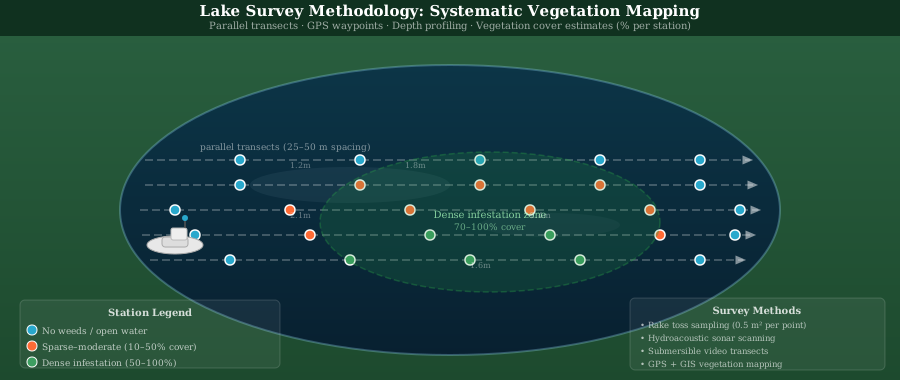
Before planning any management action, a complete baseline assessment is essential. This includes: accurate identification of all aquatic weed species present (professional identification assistance is strongly recommended — misidentification leads to ineffective treatment and potential ecological harm); quantitative assessment of infestation extent and density for each species, ideally using systematic survey transects or point-intercept sampling; documentation of water body characteristics (depth, area, existing native plant communities, water quality parameters, recreational use patterns); and identification of all management-relevant stakeholders (adjacent property owners, downstream water users, regulatory agencies). Monitoring and survey methods →
Phase 2: Goal Setting
Management goals must be specific, measurable, achievable, relevant, and time-bound (SMART). Vague goals like "reduce weeds" are not sufficient for a functional management program. Effective goals specify: which species (target vs. non-target); a measurable endpoint (reduce hydrilla coverage from 80% to below 20% of lake area); a realistic timeframe (3–5 years for established hydrilla with a large tuber bank); and the use of water body to be restored (swimming access, bass fishing, biodiversity). Setting management goals →
Phase 3: Treatment Program Design
With baseline data and clear goals, a multi-year treatment program can be designed that selects appropriate control methods, treatment timing, application rates, and monitoring checkpoints. Treatment selection must consider: species identity and biological characteristics (which methods are effective?); water body characteristics (size, depth, water uses, downstream users, permit requirements); budget and available resources; ecological constraints (non-target native plants, fish populations, water intake locations). Control methods hub →
Phase 4: Monitoring, Adaptive Management, and Documentation
A management plan is not static — it is a living document that is updated annually based on monitoring data. Post-treatment monitoring (conducted 4–8 weeks after treatment) confirms treatment efficacy and identifies any areas requiring follow-up. Annual surveys track progress toward management goals. When treatment efficacy is below target, the program is adjusted — dosage, timing, method selection, or combination of methods. All surveys, treatments, observations, and outcomes are documented as the basis for future planning and regulatory compliance. Mapping and documentation →
Regulatory and Permit Framework
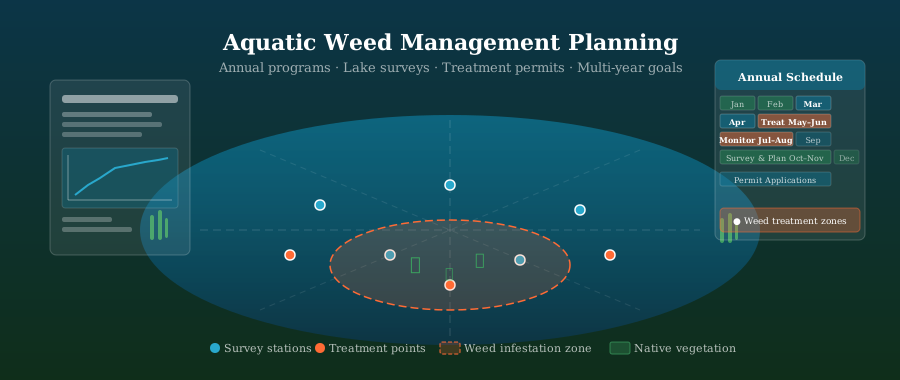
In virtually all U.S. states, aquatic plant management activities require permits. Mechanical operations, chemical treatments, and biological introductions all have permit requirements that vary by state and activity type. Permit applications require documentation of the species present, the water body type, the proposed treatment methods and timing, and (for chemical treatments) the specific products and rates to be used. Permit lead time is typically 4–12 weeks. Beginning the permit application process early — before the growing season — is essential for timely treatment during the optimal window. Permit requirements by state →
Management Planning by Water Body Type
- → Lake Management Plans
- → Pond Management Plans
- → Stormwater Basin Management
- → Monitoring and Survey Methods
- → Mapping and Documentation
- → Setting Management Goals
Multi-Year Program Design: Depleting the Propagule Bank
The most important — and most frequently misunderstood — aspect of aquatic weed management planning is the multi-year horizon required for lasting results. Invasive species with persistent sediment propagule banks (hydrilla tubers viable for 7+ years, milfoil fragments establishing year-round, curly-leaf pondweed turions persisting for 3–5 years) cannot be eliminated by a single season of even perfectly executed treatment. The propagule bank continues providing a regeneration source for years after parent plants are controlled. Effective program design explicitly plans for a 3–7 year depletion phase: each year's treatment reduces new propagule production while existing propagules germinate, are controlled, and their bank is gradually depleted. Programs designed for this reality achieve lasting suppression; programs that expect single-season results invariably return to baseline population levels within 2–3 years of treatment cessation. Propagule bank biology →
Permit Planning and Regulatory Timeline
Aquatic plant management in most jurisdictions requires advance permit applications — often 6–12 weeks before the planned treatment window. For complex or large-scale management programs in sensitive areas, pre-application coordination meetings with state regulatory staff can identify issues early and streamline the permit process substantially. The regulatory calendar should be built backwards from the target treatment window: if optimal treatment timing is early May, permit applications must typically be submitted in February–March. Waiting until the treatment window opens to begin permit applications means treating 6–8 weeks into a suboptimal growth stage or missing the season entirely. Permitting and regulatory guide →
Budget Planning for Multi-Year Programs
Realistic budget projections over the full management program horizon — not just year one — are essential for securing the sustained funding commitments that multi-year depletion programs require. Key budget components: baseline and annual monitoring surveys; permit fees; licensed applicator contracts; equipment costs (boats, aerators, boom containment for mechanical operations); contingency funds for re-treatment after weather disruption of scheduled treatments; and stakeholder communication costs. Lake association programs that present multi-year budget projections alongside projected ecological outcomes have significantly better stakeholder funding commitment rates than programs that present only year-one costs. Lake management plan guide →
Frequently Asked Questions
Do I need a professional to create an aquatic weed management plan?
For small private ponds with simple, low-density weed problems, a motivated property owner can develop a basic management plan using resources like this site and state cooperative extension publications. For larger lakes, complex infestations involving federally noxious weeds (hydrilla, water hyacinth, salvinia), or any situation involving chemical treatment, professional guidance is strongly recommended. Certified aquatic plant managers (through the Aquatic Plant Management Society) and state-licensed aquatic pesticide applicators have the training, tools, and permit relationships to develop and implement effective plans efficiently.
How long does an effective aquatic weed management program take?
The timeline depends on species and infestation history. For recently established infestations (1–2 years), significant improvement can be achieved in a single treatment year with multi-year monitoring follow-up. For established infestations with significant propagule banks (hydrilla tubers, milfoil fragments in multiple bays), expect 3–7 years for substantial improvement and ongoing management in perpetuity for connected water bodies vulnerable to re-infestation. There are no 'one and done' solutions for most significant aquatic weed infestations.
What is the biggest mistake lake managers make when planning aquatic weed control?
The most common and costly mistake is reactive, single-year treatment without a multi-year framework. Managers identify a weed problem, apply a single treatment to visible growth, and consider the problem addressed. This approach fails because: it does not account for the propagule bank (tubers, seeds, fragments) that drives the following year's population; it misses the critical early-season treatment timing that has the best cost-effectiveness; and it provides no data framework for measuring progress. A second common mistake is treating without an accurate species identification — applying a control method that works well for one species to a different species that responds poorly or not at all to that method.
How much does an aquatic weed management plan cost?
Costs vary enormously with water body size, species complexity, and management intensity. A basic professional management plan for a private pond (1–5 acres) may cost $500–$2,000 for a site assessment and written plan, with treatment costs separate. A comprehensive lake management plan for a 50–200 acre lake typically costs $3,000–$10,000 for professional planning services, plus significant additional costs for annual treatment programs. Lake associations can dramatically reduce per-acre costs by coordinating lake-wide programs: a coordinated program for a 200-acre lake is often 30–50% less expensive per acre than fragmented individual management by individual property owners.