Why Vague Goals Fail
The most common planning mistake in aquatic weed management is setting goals that are too vague to evaluate: "reduce weeds," "improve water quality," "restore native plants." These goals are directionally correct but functionally useless — they do not define success, they do not specify how progress will be measured, and they do not create accountability for the management program. Effective management goals are specific, measurable, achievable, relevant, and time-bound (SMART).
Goal Examples: From Vague to Effective
| Vague Goal | Effective SMART Goal |
|---|---|
| "Reduce hydrilla" | Reduce hydrilla frequency in point-intercept sampling from 72% to below 20% within 3 growing seasons |
| "Improve fishing" | Restore open-water zone in the north bay to at least 50% of surface area, sustaining dissolved oxygen above 5 mg/L through August, by end of year 2 |
| "Restore native plants" | Increase native plant species richness at survey transects from 4 to at least 12 species within 5 years |
Balancing Competing Goals
Management goals sometimes conflict. A property owner may want both maximum fish production (which requires some vegetation) and clear open water for swimming (which requires minimal vegetation). A lake association may have boaters who want all weeds removed and ecologists who want native plant communities preserved. These tensions are real and must be explicitly addressed in goal setting — not left to emerge as conflict during treatment planning.
Goal prioritization is most successful when based on shared data and evidence: showing property owners the fish production value of moderate native vegetation coverage, or the ecological cost of blanket herbicide treatment, shifts conversations from opinions to evidence. Where genuine conflicts remain after data-based discussion, professional facilitation may be helpful for multi-stakeholder lake planning processes.
Realistic Timelines by Species
Goal timelines should reflect the biological reality of the target species. A realistic timeline for achieving meaningful improvement in hydrilla coverage is 3–5 years. For curly-leaf pondweed, meaningful improvement may be achievable in 1–2 years. For Phragmites management in a large coastal wetland, 5–10 years of sustained effort is realistic. Setting unrealistically short timelines (expecting complete hydrilla eradication in one season) sets programs up for apparent failure and stakeholder frustration even when progress is actually being made. Why propagule banks require multi-year management →
Communicating Goals to Stakeholders
Management goals must be communicated clearly to all program stakeholders — property owners, lake association members, permitting agencies, and treatment contractors — before the program begins. Stakeholders who understand that a five-year program to reduce hydrilla coverage from 70% to under 15% is the realistic goal are prepared to evaluate annual progress appropriately, even in years when weather or permit delays limit treatment. Stakeholders who expect complete weed elimination in year one will be dissatisfied regardless of biological success.
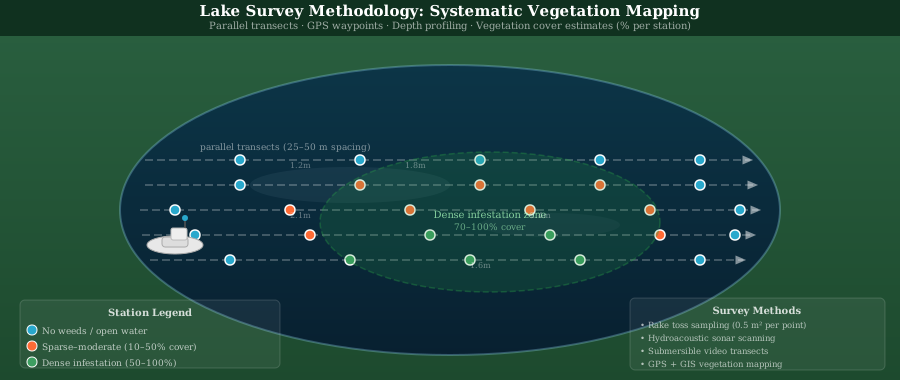
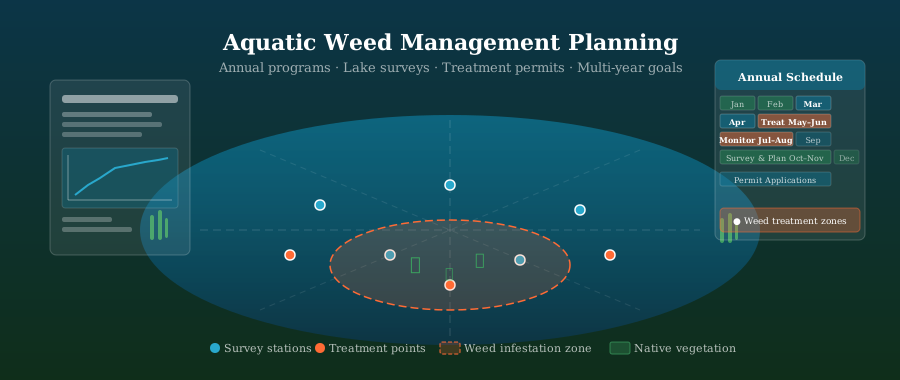
Visual tools — baseline infestation maps with annotated treatment zone boundaries, year-over-year coverage comparison charts, dissolved oxygen monitoring data presented alongside treatment history — communicate program progress more effectively than text reports alone. Many successful lake association programs hold annual stakeholder meetings to review monitoring data against goals and present the following year's treatment plan, maintaining engagement and accountability throughout multi-year programs. Monitoring and survey methods →
When Goals Need to Be Revised
Even well-designed management goals sometimes need adjustment as conditions change: discovery of a previously unidentified species requiring different management; an external re-introduction event that resets population levels; budget constraints that limit treatment intensity; or new science suggesting revised biological targets. Goal revision should be treated as normal adaptive management rather than program failure — documenting why goals changed and what the revised realistic timeline looks like maintains stakeholder confidence and regulatory clarity. Management planning hub →
Frequently Asked Questions
Should my goal be eradication or management?
For most established invasive aquatic plant infestations in large water bodies, eradication (complete elimination) is not a realistic goal — the propagule bank and re-infestation risk from connected water bodies make permanent eradication effectively impossible. Realistic goals are suppression (maintaining populations below levels that impair uses) and management (preventing expansion while native plants recover). Eradication is realistic only for very recently established, small, isolated infestations in water bodies with no ongoing external introduction pathway — and even then requires early detection, immediate aggressive response, and sustained monitoring.