How Aquatic Weeds Restructure Habitat
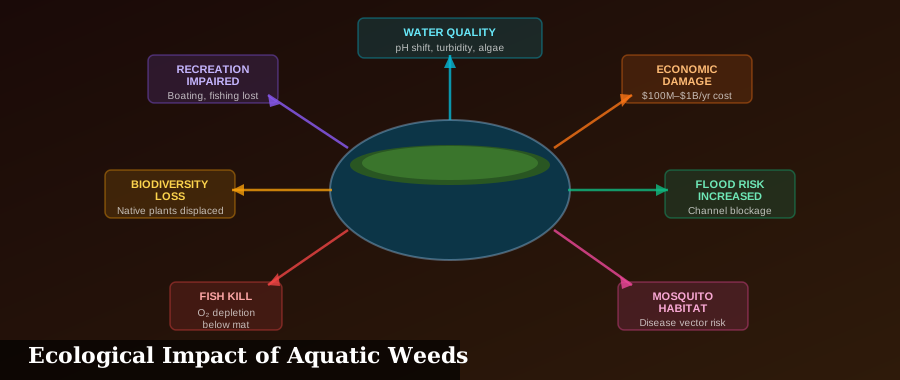
Invasive aquatic plants do not simply add biomass to a water body — they fundamentally restructure the physical and chemical habitat in ways that alter the entire food web. Some habitat changes selectively benefit opportunistic species adapted to dense vegetation, while eliminating the open-water and low-density vegetation structure that most native fish, waterfowl, and invertebrates require. Understanding these habitat effects is essential for connecting aquatic weed control to broader ecological restoration goals. Oxygen impacts on fish →
Fish Habitat and Fisheries Impacts
Dense aquatic weed infestations profoundly alter fish habitat quality, species composition, and fisheries productivity:
- Foraging habitat degradation: Predatory fish (largemouth bass, northern pike, walleye) are ambush predators that rely on moderate vegetation for cover, with adjacent open water for pursuing prey. Dense continuous weed beds at the scale of modern invasive infestations eliminate the prey-pursuit zones these predators depend on. As vegetation density increases beyond about 30–40% littoral coverage, catch rates and body condition of large predatory fish typically decline. The prey fish (bluegill, perch, shad) seeking refuge from predators in dense weed beds experience reduced predation pressure and often increase in abundance — but at smaller body sizes due to increased intraspecific competition. Milfoil fisheries impacts →
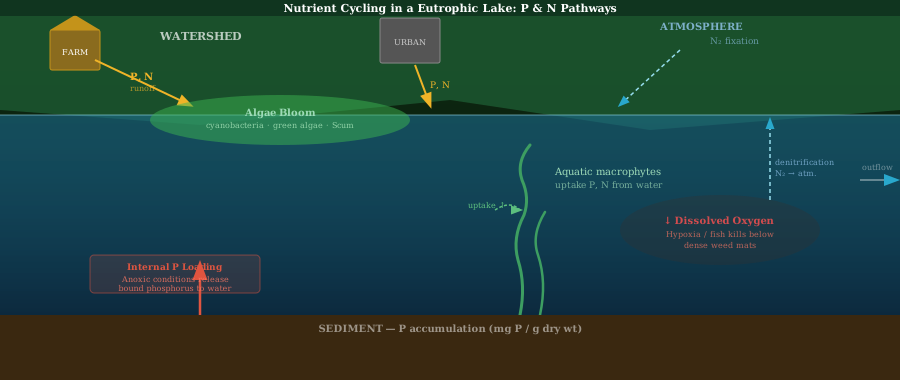
- Oxygen depletion-driven habitat compression: In lakes with dense weed beds, the nighttime oxygen sag compresses habitable oxygen space into progressively smaller zones — typically the upper water column during nighttime hypoxia events. Fish congregate in these oxygen refugia, creating conditions of extreme crowding, elevated feeding competition, and physiological stress. Repeated exposure to hypoxic conditions impairs immune function and reproductive performance even in fish that survive individual events. Oxygen depletion guide →
- Recruitment impacts: Nest-building fish (largemouth bass, bluegill, sunfish) use the hard substrate at the base of weed beds for spawning beds. Heavy sedimentation and anoxic conditions at the sediment surface in weed-impacted areas can make otherwise suitable spawning sites unusable. Successful spawning requires dissolved oxygen levels above 5–6 mg/L for egg development — levels that may not be maintained in heavily weeded areas during the spring spawning period.
- Thermal regime changes: Dense floating mats shade the water surface, reducing solar warming of the water column beneath the mat. This can lower summer water temperatures in shaded areas by 2–5°C — reducing growth rates and metabolic activity for warm-water species. In eutrophic lakes where summer temperatures are already suboptimal for salmonids, mat shading may exacerbate thermal habitat compression.
Waterfowl Habitat Impacts
Waterfowl and wading birds have complex, species-specific relationships with aquatic vegetation that are disrupted by invasive weed dominance:
- Diving ducks: Lesser scaup, canvasbacks, and ring-necked ducks are specialist consumers of specific native submerged plants (wild celery, native milfoil, pondweed tubers) and invertebrates associated with native vegetation. Dense monocultures of Eurasian milfoil, hydrilla, or water hyacinth can replace the palatable native species these birds require, reducing carrying capacity for diving ducks on important migration staging areas. Hydrilla and waterfowl →
- Dabbling ducks and geese: Many dabbling ducks (mallards, teal) actually benefit from dense emergent and floating vegetation that provides nesting cover and food. Some dabbling duck species will consume hydrilla and Eurasian milfoil, providing limited natural suppression. However, large floating mats that cover entire wetland basins eliminate the open-water feeding areas dabbling ducks require alongside cover vegetation, ultimately reducing habitat suitability.
- Wading birds: Great blue herons, great egrets, and other wading birds forage primarily in open shallow water with sparse to moderate vegetation. Dense continuous weed mats covering shallow areas eliminate this foraging habitat. Wading bird abundance is consistently lower in heavily infested wetlands than in those with moderate or sparse vegetation.
- Nesting habitat: Dense emergent weed beds (cattails, Phragmites) can provide excellent nesting habitat for some colonial waterbirds (red-winged blackbirds, herons in large stands) but these same dense monocultures exclude the open-water and low-stem-density conditions required by nesting dabbling ducks, shorebirds, and many marsh birds.
Macroinvertebrate Community Impacts
Aquatic macroinvertebrates — insects, crustaceans, mollusks, worms — are the primary pathway by which energy from aquatic plant production flows to fish and birds. Their community composition is highly sensitive to aquatic plant community changes:
- Native submersed plant beds support high-diversity, high-abundance invertebrate communities on their complex stem and leaf surfaces. In studies comparing native plant beds to invasive milfoil beds, invertebrate diversity is typically 30–50% lower in milfoil beds at equivalent densities.
- Dense Eurasian milfoil supports a simplified invertebrate community dominated by midges (Chironomidae) and a few pollution-tolerant taxa, while eliminating sensitive mayflies, stoneflies, and other EPT (Ephemeroptera, Plecoptera, Trichoptera) indicator taxa.
- Floating mat species (water hyacinth, giant salvinia) convert the open-water invertebrate community to one dominated by anoxia-tolerant taxa (chironomids, tubificid worms) due to the oxygen depletion under the mat. This community is far less nutritionally valuable to fish and birds than the invertebrate community of healthy open water.
Amphibian and Reptile Impacts
Frogs, salamanders, turtles, and aquatic snakes are integral members of healthy aquatic ecosystems and are negatively affected by invasive aquatic plant dominance:
- Egg masses of amphibians require dissolved oxygen above 5 mg/L for development. The oxygen depletion associated with dense weed beds during the spring breeding season frequently falls below this threshold, reducing egg and larval survival rates.
- Dense Phragmites and cattail monocultures, while providing some structural habitat, eliminate the shallow open-water mud margins and sedge-grass mosaics that many frog and salamander species use for feeding and breeding.
- Snapping turtles and northern water snakes, which forage by ambushing prey in submerged vegetation, can persist in weeded environments; basking species requiring open-water access are more negatively affected by large floating mat coverage.
Frequently Asked Questions
Can some fish species benefit from aquatic weeds?
Yes — in moderation, aquatic vegetation of any type provides structural habitat that benefits fish. Juvenile fish of all species use vegetation as refuge from predators. Bass and pike use moderate vegetation as ambush cover. Very dense invasive infestations, however, exceed the threshold at which vegetation benefits fish and begin to degrade habitat — typically when dense continuous coverage reaches 40–60% of the littoral zone. The management goal in most sport fish lakes is not the elimination of all vegetation but the reduction of invasive species to levels where native plant communities can co-exist and habitat structure diversity is restored.
Will controlling aquatic weeds improve fishing?
Typically yes, when infestations are above the threshold that degrades fish habitat. Multiple studies have documented improvements in predator fish body condition, catch rates, and size structure following successful aquatic weed management programs that reduced dense continuous weed coverage to moderate levels. The relationship is most clear for largemouth bass in lakes where Eurasian milfoil or hydrilla coverage had exceeded 50–70% of the littoral zone before management. In lightly infested lakes where weed coverage is modest, vegetation management may not produce measurable fisheries benefits.
References
- Engel, S. (1995). Eurasian watermilfoil as a fishery management problem. Fisheries, 20(6), 20–27.
- Posey, M.H. (1988). Community changes associated with the spread of an introduced seagrass, Zostera japonica. Ecology, 69(4), 974–983.
- Thorp, J.H., and Covich, A.P. (eds.) (2010). Ecology and Classification of North American Freshwater Invertebrates, 3rd ed. Academic Press.
- Gettys, L.A., et al. (2014). Biology and Control of Aquatic Plants: A Best Management Practices Handbook, 3rd ed. Aquatic Ecosystem Restoration Foundation.